


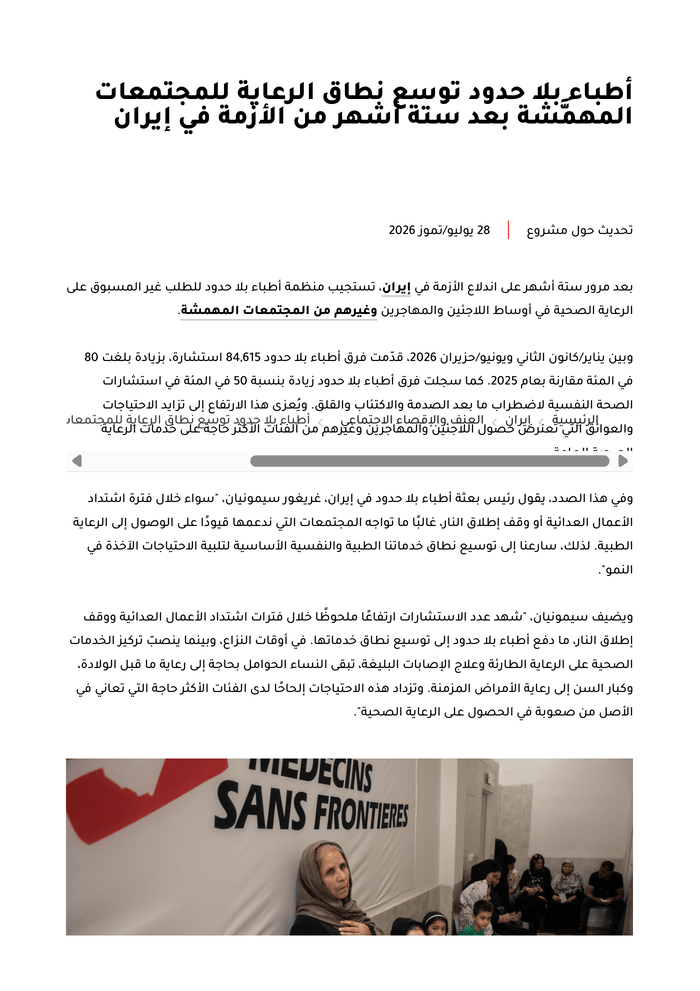
Country: Iran (Islamic Republic of) Source: Médecins Sans Frontières Please refer to the attached file. Five months into the crisis in Iran, Médecins Sans Frontières (MSF) is responding to unprecedented demand for healthcare among refugees, migrants, and other marginalised communities. Between January and June 2026, MSF teams provided 84, 615 consultations, which represents an 80 per cent increase compared to the full year of 2025. MSF teams also recorded a 50 per cent increase in mental health consultations for post-traumatic stress disorder (PTSD), depression, and anxiety. The increase is driven by growing needs and barriers to public healthcare for refugees, migrants, and other vulnerable people. “During periods of intensified hostilities and ceasefire, the communities we support often face limited access to medical care, ” says Grigor Simonyan, MSF head of mission in Iran. “We have urgently scaled up core medical and mental health services to meet needs that continue to grow. ” “Consultations spiked during both intensified hostilities and ceasefire periods, prompting MSF to scale up services, ” says Simonyan. “While healthcare services focus on emergency and trauma care in conflict, mothers still need to have antenatal care and older people still need non-communicable disease care. Especially those who are more vulnerable, with already limited access to healthcare. ” Adapting services during escalation The health system in Iran has faced further strain from repeated escalations of violence since the start of the year. This has disrupted the continuity of basic healthcare services, particularly for communities that already had limited access. MSF is running four projects in Iran, in Tehran, Mashhad, and Kerman. In South Tehran, we provide basic healthcare through both fixed and mobile clinics. Services include medical consultations, mental health counselling and psychiatric care, sexual and reproductive health, and hepatitis C diagnosis and treatment. In Mashhad, near the border with Afghanistan, MSF continues to support refugees and marginalised communities through a fixed clinic, mobile clinics, and outreach in government-mandated drug rehabilitation centres. Teams provide medical and psychological consultations, follow-up for non-communicable diseases, referrals, community health promotion, and hepatitis C services for high-risk groups, including people who inject drugs. Recently, we extended services to a centre that provides medical and mental health consultations, and referral services for the most vulnerable people. In Kerman in the southeast, we have started operating a new healthcare clinic focusing on improving access to healthcare for refugees and migrants. The MSF clinic offers a package of care including general medical consultations, sexual and reproductive health, mental health and referrals to hospitals in the area. As health needs intensify and become more pressing, we are ready to expand our activities further. Grigor Simonyan, MSF head of mission in Iran More access, better preparedness needed In February, MSF signed an Emergency Preparedness and Response Memorandum of Understanding with the Iranian authorities, to support emergency response efforts if needed. In response to growing needs, MSF launched a second project in southwest Tehran at the end of April. The project focuses on basic healthcare for the general community. While emergency and trauma care were being managed by the Ministry of Health and the Iranian Red Crescent, basic and community health services required more attention. As part of our emergency response, we also donated non-food item kits and medical supplies to the Iranian Red Crescent, including outpatient department kits, paediatric kits, burn kits, emergency room kits, and surgical kits. The team is currently finalising assessments for a potential fifth project in Minab, Hormozgan province, focused on basic healthcare and mental health. We are also discussing further response options in Tehran with the relevant authorities. MSF remains committed to adapting and scaling up our response to meet evolving medical needs, in close coordination with the authorities. “As health needs intensify and become more pressing, we are ready to expand our activities further to ensure vulnerable people can access free and independent care”, says Simonyan.



GrowthPakistan brings you the latest news to keep an eye on Pakistan’s startup ecosystem. Business keeps you growing when you stay aware of your competitors' moves. GrowthPakistan offers Business, Tech, Global Tech, Global, Auto, and Startup News straight from industries all around the globe. This platform will help you identify upcoming opportunities not only in Pakistan but worldwide.
Email : growthpakistan@gmail.com
Whatsapp : +92320-9497079
© growthpakistan