


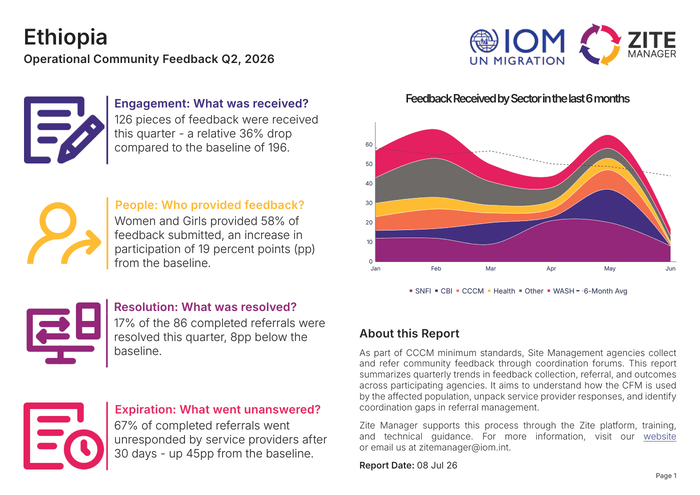
Country: Ethiopia Source: International Organization for Migration Please refer to the attached file. During the reporting period, IOM’s Shelter Land and Site Coordination (SLSC) program provided assistance to 83, 798 individuals across 13 IDP sites and three perimeters in Shire, Endabaguna, Contested Area 2 with support from GERF, ECHO and EHF. The Area based approach program enabled inclusive operational coordination at the three perimeters facilitating service mapping and referrals, strengthening site governance structures, Shelter repairs, maintenance, site improvements, NFI assistance and supporting community participation and engagement including Community Complaint and Feedback Mechanisms (CFM), and community consultations. Engagement: What Feedback was Received? This quarter, 126 feedback entries were received, representing a 36% decrease from the baseline. Almost all feedback (98%) consisted of requests for assistance, services, or repairs, while the remaining 2% were general enquiries about assistance. Although Shelter & NFI received the highest volume of feedback overall, this was largely driven by requests from Shire Perimeter. Other perimeters showed different trends. Endabaguna Perimeter accounted for the largest share of referrals related to CBI, while requests within Mai Tserbri Perimeter were primarily related to WASH and CCCM. People: Who Provided Feedback? Most feedback this quarter was received through the Information Desk (63%), followed by Mobile Outreach (23%) and Group Meetings/Activities (7%). Almost all feedback (91%) came from IDPs, with the remaining 9% from host community members. Host community feedback primarily related to requests for cash-based support and new shelter construction. Among IDPs, the most common requests concerned shelter repairs, cash-based support, and shelter materials or kits. Resolution: What Referrals were Resolved? Of the 86 completed referrals, 17% were successfully resolved by service providers, representing an 8pp decrease from the baseline. Resolution rates declined across most sectors, particularly CBI, SNFI, CCCM, and Health, while WASH recorded a notable improvement. A further 15% of completed referrals were marked as unresolved, down 37pp from the baseline. Shire Perimeter recorded the highest unresolved referral rate (20%). The most common reasons for unresolved referrals were “No Agency or Service”, meaning no agency is providing the support requested. Referral expirations increased substantially, with 67% of referrals expiring— 45pps above the baseline—highlighting an area for improvement. Endabaguna Perimeter recorded the highest expiration rate, accounting for over one-quarter (26%) of all expired referrals.



GrowthPakistan brings you the latest news to keep an eye on Pakistan’s startup ecosystem. Business keeps you growing when you stay aware of your competitors' moves. GrowthPakistan offers Business, Tech, Global Tech, Global, Auto, and Startup News straight from industries all around the globe. This platform will help you identify upcoming opportunities not only in Pakistan but worldwide.
Email : growthpakistan@gmail.com
Whatsapp : +92320-9497079
© growthpakistan