

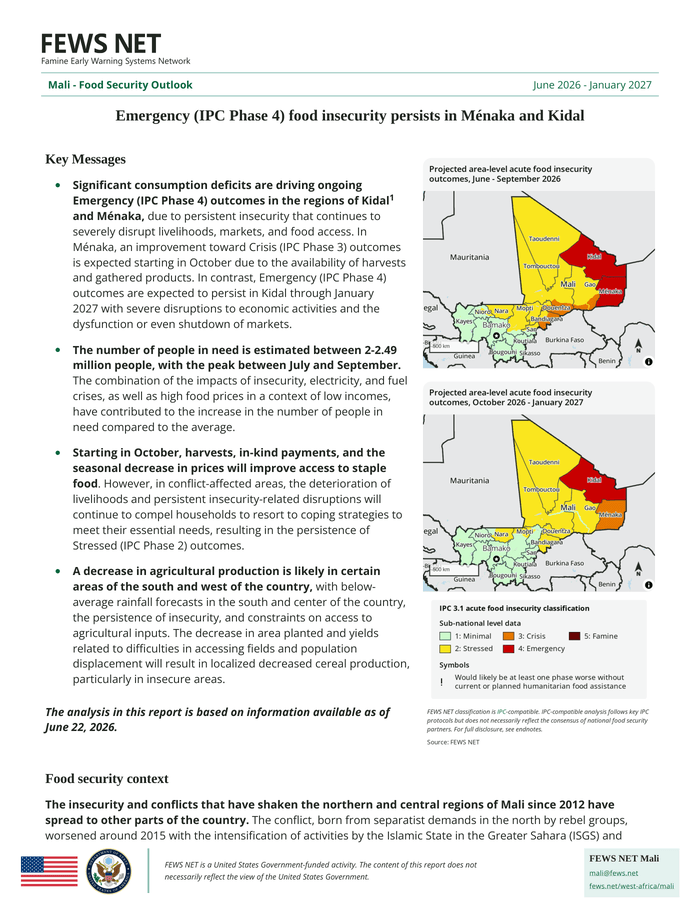
Country: Mali Source: Famine Early Warning System Network Please refer to the attached file. Key Messages Significant consumption deficits are driving ongoing Emergency (IPC Phase 4) outcomes in the regions of Kidal1 and Ménaka, due to persistent insecurity that continues to severely disrupt livelihoods, markets, and food access. In Ménaka, an improvement toward Crisis (IPC Phase 3) outcomes is expected starting in October due to the availability of harvests and gathered products. In contrast, Emergency (IPC Phase 4) outcomes are expected to persist in Kidal through January 2027withsevere disruptions to economic activities and the dysfunction or even shutdown of markets. The number of people in need is estimated between 2-2. 49 million people, with the peak between July and September. The combination of the impacts of insecurity, electricity, and fuel crises, as well as high food prices in a context of low incomes, have contributed to the increase in the number of people in need compared to the average. Starting in October, harvests, in-kind payments, and the seasonal decrease in prices will improve access to staple food. However, in conflict-affected areas, the deterioration of livelihoods and persistent insecurity-related disruptions will continue to compel households to resort to coping strategies to meet their essential needs, resulting in the persistence of Stressed (IPC Phase 2) outcomes. A decrease in agricultural production is likely in certain areas of the south and west of the country, with below-average rainfall forecasts in the south and center of the country, the persistence of insecurity, and constraints on access to agricultural inputs. The decrease in area planted and yields related to difficulties in accessing fields and population displacement will result in localized decreased cereal production, particularly in insecure areas.
Mali: Food Security Outlook Update – Emergency (IPC Phase 4) food insecurity persists in Ménaka and Kidal, June 2026 – January 2027

RELATED ARTICLES


