


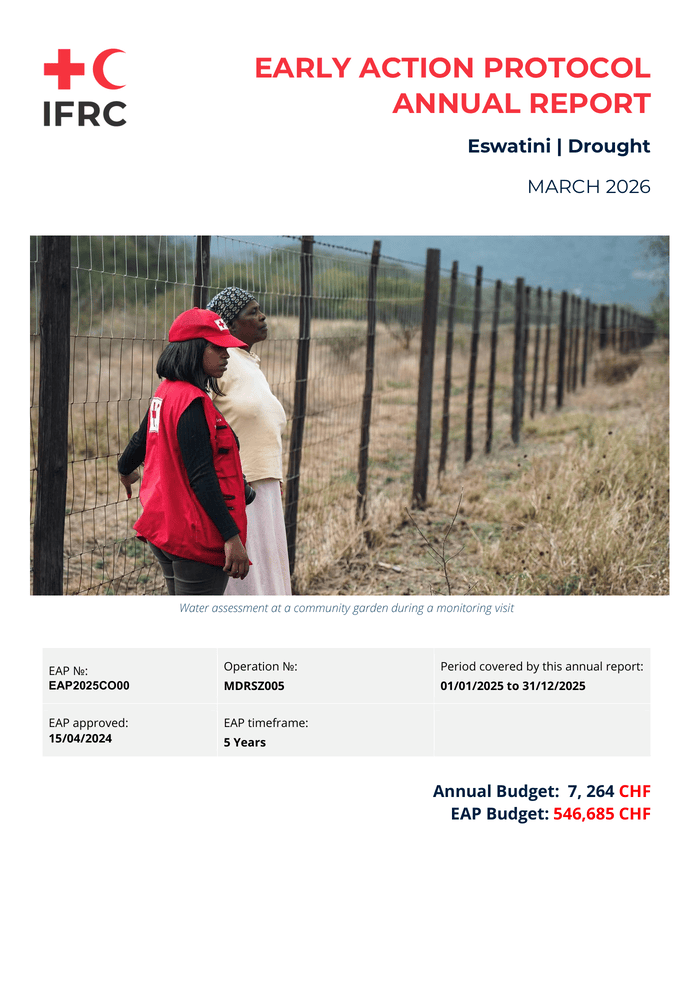
Country: Eswatini Source: International Federation of Red Cross and Red Crescent Societies Please refer to the attached file. SUMMARY OF THE EARLY ACTION PROTOCOL The IFRC Disaster Response Emergency Fund (DREF) has allocated CHF 546, 685 for the implementation of anticipatory actions aimed at reducing and mitigating the impact of drought in Eswatini. This Early Action Protocol includes an allocation to pre-position stock and carry out annual readiness activities to enable the implementation of early actions when the trigger is reached. The early actions to be undertaken have been pre-agreed with the National Society and are outlined in the Early Action Protocol summary. Eswatini Drought Early Action Protocol. Eswatini Drought Early Action Protocol Overview This report provides a summary of achievements, lessons learnt, challenges and future outlook of the annual readiness and prepositioning activities planned in the agreed reporting period and plan. In 2025, the BERCS EAP for drought entered its second-year reporting period (January–December 2025). The implementation of Drought EAP activities for Year 1 (March 2024–December 2024) was postponed to 2025. All readiness and pre-positioning activities were delayed but were completed only in 2025. ACHIEVEMENTS The Eswatini EAP aims to reduce human loss and suffering, protect livelihoods, and improve food security in anticipation of a forecasted drought hazard. The prioritized risks and impacts to be addressed by early actions include drought-induced crop failure, declining yields and deteriorating pasture, livestock deaths due to hunger and thirst, water shortages for both human and livestock consumption, loss of income and livelihoods, and compromised dietary intake or hunger. Early actions under the respective Areas of Focus (AOF) include providing multi-purpose cash for food security; conditional and restricted cash for garden fencing materials, vegetable seeds or seedlings, animal care kits; procuring water tanks and transporting and delivering treated water to at-risk communities; and procuring, transporting, and delivering hay bales. The intended number of households to be reached varied across interventions food-for-cash, backyard gardening, farm inputs and agro-seeds, and hay bales for livestock. The total number of households targeted is 5, 400 as of year 2 initiavtives, 9 300 community members were reached.



GrowthPakistan brings you the latest news to keep an eye on Pakistan’s startup ecosystem. Business keeps you growing when you stay aware of your competitors' moves. GrowthPakistan offers Business, Tech, Global Tech, Global, Auto, and Startup News straight from industries all around the globe. This platform will help you identify upcoming opportunities not only in Pakistan but worldwide.
Email : growthpakistan@gmail.com
Whatsapp : +92320-9497079
© growthpakistan