


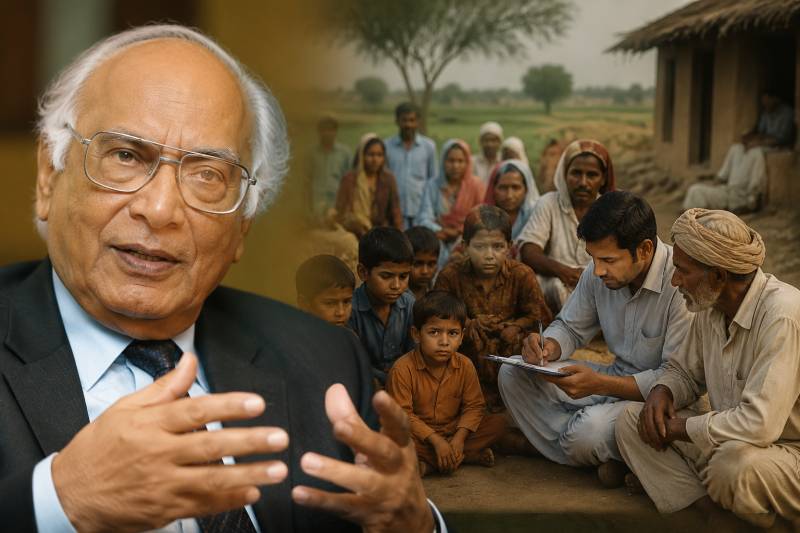
The 28th death anniversary of Dr. Mahbub ul Haq on July 16 is a fitting occasion to revisit his enduring vision of human-centred development for Pakistan’s progress. Certainly, Mahbub ul Haq was a great Pakistani social scientist whose intellectual work had global implications. He was a leading public policy expert. In line with the Kantian categorical imperative, Mahbub ul Haq earnestly declares that whenever you make public policy in economics, politics, culture, and education, always put people first. This people-first approach was the first milestone in human development. Does Pakistan embrace a People-First approach when devising public policies? No. That is why the level of human development in Pakistan is, unfortunately, very low. There is, however, a dire need to promote Mahbub ul Haq’s legacy of human development for building a better Pakistan. Mahbub ul Haq (1934-1998) had an excellent academic record at the University of the Punjab (Pakistan), Cambridge University (UK), and Yale and Harvard Universities (USA). At Cambridge, Manmohan Singh, Amartya Sen, and Mahbub ul Haq were classmates from South Asia; all were eminent figures in their intellectual and practical endeavours. Manmohan Singh became the Prime Minister of India. Amartya Sen won the Nobel Prize in economics. In his memoir, Home in the World (2021), Sen describes how they first met by chance on the road to their economics lecture at Cambridge and that their friendship lasted until Mahbub ul Haq’s demise. Mahbub ul Haq held significant positions, served at the World Bank and the United Nations Development Program (UNDP). In Pakistan, he held ministerial positions in Finance, Planning and Development. Human development’ means enlarging people’s choices. Whereas, poverty of education restricts people’s intellectual choices. In his classic work, Reflections on Human Development (1995), Mahbub ul Haq states, ‘We are at an exciting juncture in our human journey. People now stand at the center of development. .. we can sing of the dawning of a new human age, guided by a new vision of human progress. At least, such a human vision should be our guiding star – and our sincere endeavor. For human destiny is a choice, not a chance’. In the new age, human progress depends upon better choices. His two great achievements include the Human Development Reports (HDR) and the Human Development Index (HDI) at the United Nations. Sen correctly remarks, “We have to remember that Mahbub wanted to change the world, not merely to measure it”. The UNDP has continued Mahbub ul Haq’s enduring legacy by publishing the HDRs and creating the annual HDI. Human Development Is the Best Contraception Being a visionary development economist, Mahbub ul Haq may be called the Adam Smith of Pakistan. When Mahbub ul Haq was the Minister of Planning and Development, Sen visited him in Pakistan. Sen remembers, ‘The sun set on a magically bewitching Karachi, Mahbub’s voice rose, mixing analysis with deeply rebellious passion. He knew how to confront Pakistan’s old problems but was sceptical of finding any immediate possibility of progress. ’ He was sceptical due to the narrow-minded politics and feudal structure in Pakistan. By any definition, Mahbub ul Haq is a cosmopolitan thinker. This is his cosmopolitanism, which defends the equality of human beings as a guiding principle and rejects any discrimination against people on the basis of sect, class, status, gender, or religion. Mahbub ul Haq redefined ‘development’ and ‘poverty’. Poverty and development are contrary. He defines ‘development’ in terms of human capital rather than Gross National Product (GNP). The economy of human lives, in terms of human capabilities, has more value than a nation’s economy. He states that human development tends to enrich people’s lives, enabling them to enjoy long, healthy, and creative lives. So, ‘human development’ means enlarging people’s choices. Poverty is the main cause restricting people’s choices in numerous ways. Economic poverty limits people’s buying choices. Poverty of education restricts people’s intellectual choices. Poverty, in the sense of the denial of freedom, restricts people’s political choices. So, poverty limits people’s choices. Human development, according to Mahbub ul Haq, cannot be achieved without financial security, quality education, adequate nourishment, health care, a crime-free society, entertainment, political and cultural freedoms, and a sense of participation in community activities. These conditions comprise a comprehensive framework necessary to create an enabling environment for the real growth of human potential. Significantly, education, health, justice, peace, democratic politics, and art and culture are vital for human development. Sadly, the enabling environment is compromised; therefore, a sufficient level of human development could not be achieved in Pakistan. From Conflict To Confidence: Pakistan’s Rise Since Marka-E-Haq Pakistan lacks policymaking in education, economics and politics. Due to the lack of policymakers, there seems to be regression rather than progress. For instance, consider the case of education. Education is the first step toward improving human development in the country. Our educationists could not devise educational policies that could foster freedom to flourish. Universities in Pakistan have failed to produce quality research for a number of reasons, one of which is a lack of funds. Almost all public universities in Pakistan are currently facing a severe financial crisis. Financial poverty limits universities’ research choices, thereby restricting the human capital. The number of universities is increasing, sometimes for political reasons, but no attention is being paid to improving existing ones by providing adequate budgets for their proper functioning. Many politicians want to establish universities in their respective political precincts, mostly not to provide education to the people, but to secure vote banks. The primary purpose of educational policy should be to develop students’ human capabilities, such as creativity, analytical and critical rationality, so that they can meet emerging challenges. In addition, the educational policy should promote research ethics in universities to foster a culture of genuine research for the creation of new knowledge. The enduring legacy of Mahbub ul Haq’s human development approach is the only path toward progress. Quality education, financial security, better nutrition, health care, a just society, entertainment, political and cultural freedoms, and participation in community activities are essential for expanding people’s choices to live their lives as they want. People first, not anything else, was Mahbub ul Haq’s main thrust. That is why he was critical of the arms race in the subcontinent and the world. Thus, the intellectual legacy of Mahbub ul Haq is a key to advancing Pakistan’s human development by fulfilling the necessary conditions. CSSPR Marks One-Year Anniversary Of Marka-E-Haq Through High-Level Strategic Webinar



GrowthPakistan brings you the latest news to keep an eye on Pakistan’s startup ecosystem. Business keeps you growing when you stay aware of your competitors' moves. GrowthPakistan offers Business, Tech, Global Tech, Global, Auto, and Startup News straight from industries all around the globe. This platform will help you identify upcoming opportunities not only in Pakistan but worldwide.
Email : growthpakistan@gmail.com
Whatsapp : +92320-9497079
© growthpakistan