

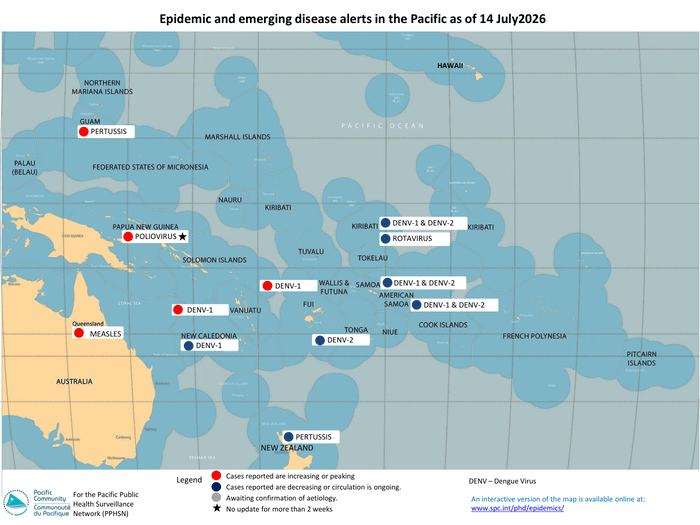
Countries: World, Australia, Cambodia, New Caledonia (France), New Zealand, United States of America, Vanuatu Source: Pacific Community Please refer to the attached Map. Highlights/updates since the last map was sent on PacNet on 07 July 2026: Dengue • New Caledonia: As of 05 July 2026, a cumulative total of 2, 181 dengue cases have been reported in New Caledonia since 1st January 2026, with 1, 982 confirmed autochthonous cases. After peaking in week 17, the epidemic is now in a declining phase, consistent with the onset of the cool season, which is usually associated with a slowdown or interruption of transmission. Serotype 1 (DENV-1) remains the only serotype circulating. The median age of cases is 29 years, and the male-to-female sex ratio is 0. 9, with the highest incidence rates observed among 10–14-year-olds (338 cases) and 15–19-year-olds, mainly in school settings. A total of 78 patients have been hospitalised, including one in the last 15 days (mean age 46 years), and three deaths have been recorded: one in a person who was co-infected with leptospirosis and dengue, and two in persons with comorbidities. The territory-wide incidence rate stands at 804 cases per 100, 000 inhabitants. A total of 32% of declared cases reside in Grand Nouméa communes where the World Mosquito Program is deployed and where Wolbachia is present in approximately 80% of mosquitoes; weekly incidence in this area has remained below 40 cases per 100, 000 inhabitants, compared with a peak of around 200 per 100, 000 outside Grand Nouméa at the end of April. The public is advised to seek prompt medical care in case of fever, headache, or muscle and joint pain, and to avoid aspirin and ibuprofen in case of suspected dengue. The blue alert for dengue remains in effect. – Source: ALERTE DASS – Épidémie de dengue (05 July 2026) and La dengue | Direction des Affaires Sanitaires et Sociales de Nouvelle-Calédonie accessed on 14 July 2026. • Vanuatu: As of EpiWeek 27, the dengue outbreak on South-West Efate Island, Shefa Province, continues, with a cumulative total of 38 laboratory-confirmed cases, including nine new cases in EpiWeek 27. Weekly counts remaining above the alert threshold of four cases per week. Two additional hospitalisations were reported in EpiWeek 27, bringing the cumulative total of hospitalisations to six (15. 8%); one case remains admitted to hospital, while all other hospitalised cases have recovered and been discharged. No dengue-related deaths have been recorded to date. Cases are concentrated in the Pango Area Council (34%), followed by Eratap (21%), with additional cases reported from Erakor, Eton, Port Vila and Mele Area Councils, suggesting a widening geographic distribution of the outbreak. Males accounts for 55% of cases, and the majority (64%) were reported among individuals aged under 26 years. Five samples referred for confirmatory testing and serotyping were all confirmed as dengue virus serotype 1. Response activities continue in the affected communities, including case investigation, vector control and source reduction. The red alert for dengue (DENV-1) remains in effect. – Source: Dengue Outbreak on South-West Efate Island, Shefa Province, Vanuatu – Situation Report #7, Vanuatu National Surveillance Unit shared on PacNet on 10 July 2026. Pertussis/Whooping cough • New Zealand: Pertussis activity in New Zealand continues as part of the ongoing national epidemic declared in November 2024. In the surveillance week ending 03 July 2026, 42 cases were notified, a decrease compared with 55 cases in the previous week (ending 26 June 2026), bringing the cumulative total for 2026 to 1, 013 cases as of 03 July 2026. Data are provisional and subject to retrospective revision. The blue alert for pertussis remains in effect. – Source: Pertussis dashboard, PHF Science accessed on 14 July 2026. • Vanuatu: As of EpiWeek 28, no new pertussis cases have been reported in Vanuatu since EpiWeek 23. The most recent clinically diagnosed case was reported in EpiWeek 23, while the last laboratory-confirmed case was reported in EpiWeek 14. The cumulative total remains unchanged at 833 cases, comprising 789 clinically diagnosed and 44 laboratory-confirmed cases, with 75 hospitalisations and seven pertussis-associated deaths (six in Tanna and one in Shefa). Cases remained concentrated in Efate (≈55%) and Tanna (≈37%). The highest proportion of cases occurred among children aged 1–9 years, with a substantial proportion also among infants aged under 1 year. Among cases with known vaccination status, 48% were unvaccinated, 36% had received one dose, 6% two doses and 10% three doses of a pertussis-containing vaccine. Weekly case counts have remained below the outbreak threshold since EpiWeek 15, and 42 days (six weeks) have now elapsed since the last clinically diagnosed case, corresponding to the completion of two incubation periods without evidence of ongoing transmission. The epidemiological criteria for declaring the outbreak over have therefore been met and the Vanuatu Ministry of Health has officially declared the pertussis outbreak over. The blue alert for pertussis in Vanuatu has been removed from the map. Routine surveillance and prompt investigation of suspect cases will continue in order to ensure early detection of any future transmission. – Source: Vanuatu Pertussis Outbreak Situation Report 23, Vanuatu National Surveillance Unit shared with the PPHSN Coordinating Body Focal Point on 14 July 2026. Other Information: Avian influenza • Cambodia: On 09 July 2026, the Ministry of Health of Cambodia confirmed a human case of highly pathogenic avian influenza A(H5N1) in a nine-month-old girl from Prek Ta Kong Village, Meanchey District, Phnom Penh. The case was confirmed by the National Institute of Public Health and the Institut Pasteur du Cambodge and is the fifth human H5N1 case reported in Cambodia in 2026. The child is in isolation and receiving intensive medical care. National and sub-national rapid response teams, working with provincial departments of agriculture and local authorities, are investigating the source of infection in both animals and humans and are tracing contacts. The source of infection remains under investigation, and no specific animal exposure has been confirmed to date. Since the re-emergence of human A(H5N1) infections in Cambodia in February 2023, the country has reported 6 cases (4 deaths) in 2023, 10 cases (2 deaths) in 2024 and 18 cases (9 deaths) in 2025. – Sources: Press release, Ministry of Health, Kingdom of Cambodia (11 July 2026) and Fifth human case of HPAI (H5N1) reported in a nine-month-old in Phnom Penh, Cambodia – BEACON accessed on 14 July 2026. Ciguatera • Vanuatu: As of EpiWeek 27, ciguatera fish poisoning (CFP) activity in Vanuatu has remained below the alert threshold since EpiWeek 24, with two new cases reported from Efate in EpiWeek 27, bringing the cumulative total to 214 cases since the start of the year, with no deaths and no current hospitalisations (five cases hospitalised and discharged to date). Males accounted for 60% of cases, and individuals aged 15–34 years remained the most affected group (51%), followed by adults aged 35 years and over (34%). Cases have been reported across ten islands, with Efate accounting for the largest proportion (46%). Most cases were linked to the consumption of unspecified “other” fish species (103 cases) and reef fish (96 cases). Overall, ciguatera activity continues to show a declining trend. Health authorities continue to monitor the situation closely, to investigate newly reported cases in order to identify high-risk fish species and fishing areas, and to reinforce public health messaging promoting safe fish consumption practices and early care-seeking. – Source: Vanuatu Ciguatera Fish Poisoning Outbreak Situation Report #11, Vanuatu National Surveillance Unit shared on PacNet on 10 July 2026. Dengue • Hawai’i: As of 10 July 2026, the Hawaiʻi Department of Health (DOH) reported a new travel-related dengue case in an Oʻahu resident who was exposed to the virus while travelling in a region where dengue is common. This brings the total number of dengue cases reported in the state to six for 2026. Given the specifics of the case, the expected risk of onward transmission is considered low. Dengue is not endemic in Hawaiʻi, and cases remain limited to travellers. – Source: DOH reports travel-related dengue virus case in Oʻahu resident, Hawaiʻi Department of Health (10 July 2026) accessed on 14 July 2026. • New Zealand: In New Zealand, during EpiWeek 27 (04–10 July 2026), one probable dengue case was reported. The case had travelled to Samoa during the incubation period. Given the known serological cross-reactivity between dengue and other flaviviruses, some cases reported as dengue may ultimately be attributed to other flaviviruses, and the data may change as cases are further investigated. – Source: NZ Arbovirus Notifications by Country (EpiWeek 27: 04/07/2026–10/07/2026) shared with the PPHSN Coordinating Body Focal Point on 13 July 2026. Highly Pathogenic Avian Influenza in wild birds • Australia: On 10 July 2026, Australian authorities confirmed the first detection of H5 avian influenza in a native, non-migratory bird in Australia, a greater crested tern ( Thalasseus bergii ) found in Robe, South Australia, approximately 340 km south-east of Adelaide. Testing identified the virus as the globally circulating H5N1 clade 2. 3. 4. 4b. All previous Australian detections had occurred in migratory seabirds arriving from the subantarctic region, the first of which was confirmed on 14 June 2026 in a brown skua ( Stercorarius antarcticus ) at Esperance, on the southern coast of Western Australia. As of 10 July 2026, a total of 12 H5 detections have been confirmed across Australia, including additional cases in South Australia and Western Australia, with a further suspected case in Western Australia under laboratory investigation. No mass mortality events in local wildlife, no detections in poultry or other agricultural settings, and no human infections have been reported to date. The Australian Centre for Disease Control has reassessed the risk to human health in Australia and considers it to remain low. The South Australian Government is leading the on-the-ground response, with enhanced surveillance activated around Robe, and the Australian Chief Veterinary Officer and federal experts are actively monitoring the situation. The detection of H5N1 in a resident seabird species, which had no prior exposure and therefore no population-level immunity, marks a new phase of the incursion in Australia and raises the risk of establishment in resident wildlife. This event highlights the ongoing risk of H5N1 introduction to the Pacific via migratory birds and underscores the need for continued vigilance and enhanced surveillance in the region. – Sources: H5 bird flu detected in non-migratory seabird, Australian Centre for Disease Control (10 July 2026) and First detection of avian influenza H5 in native resident seabirds marks new phase of incursion risk in South Australia and Western Australia – BEACON accessed on 14 July 2026.
World: Epidemic and emerging disease alerts in the Pacific as of 14 July 2026

RELATED ARTICLES


