

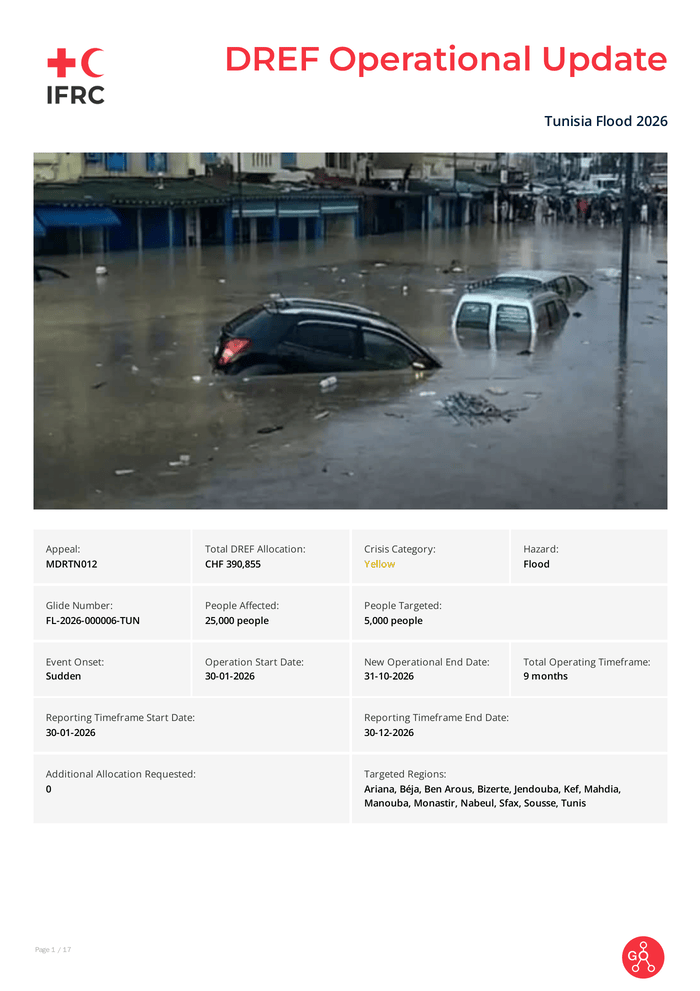
Country: Tunisia Source: International Federation of Red Cross and Red Crescent Societies Please refer to the attached file. Description of the Event 19-01-2026 What happened, where and when? In January 2026, Tunisia experienced exceptionally heavy and sustained rainfall that triggered widespread flooding, flash floods, and river overflows across large parts of the country. According to meteorological authorities, rainfall levels reached records not seen since the 1950s. Particularly intense precipitation on 19 and 20 January rapidly overwhelmed drainage systems and saturated soils, resulting in extensive damage to housing, critical infrastructure, and public services. The floods caused five confirmed fatalities, while several individuals were reported missing during the emergency phase. Flood risks were further aggravated by increased flows in rivers originating from Algeria following the cyclone’s movement across the border, contributing to the scale and duration of the flooding. The event affected 15 governorates across eastern and northern Tunisia, including Tunis, Ariana, Manouba, Ben Arous, Bizerte, Nabeul, Sousse, Monastir, Mahdia, Sfax, Béja, Jendouba, and Kef. Impacts were reported in urban, peri-urban, rural, coastal, and mountainous areas. Low-lying neighbourhoods, flood-prone settlements, and communities with inadequate drainage infrastructure were particularly affected. Flooded roads and inundated residential areas disrupted access to essential services, markets, and livelihoods, while some remote communities became temporarily isolated. An estimated 25, 000 people were affected nationwide, including households cut off by floodwaters. Continued rainfall on 20 and 21 January compounded the effects of already saturated ground conditions and increased the extent of flooding in several areas. By the end of January 2026, although water levels had gradually receded in most locations, significant humanitarian needs remained due to damage to homes, infrastructure, livelihoods, and basic services. The scale of the impacts required continued response efforts and recovery support from national authorities and humanitarian partners.
Tunisia: Flood 2026 – DREF Operational Update (MDRTN012)

RELATED ARTICLES


