


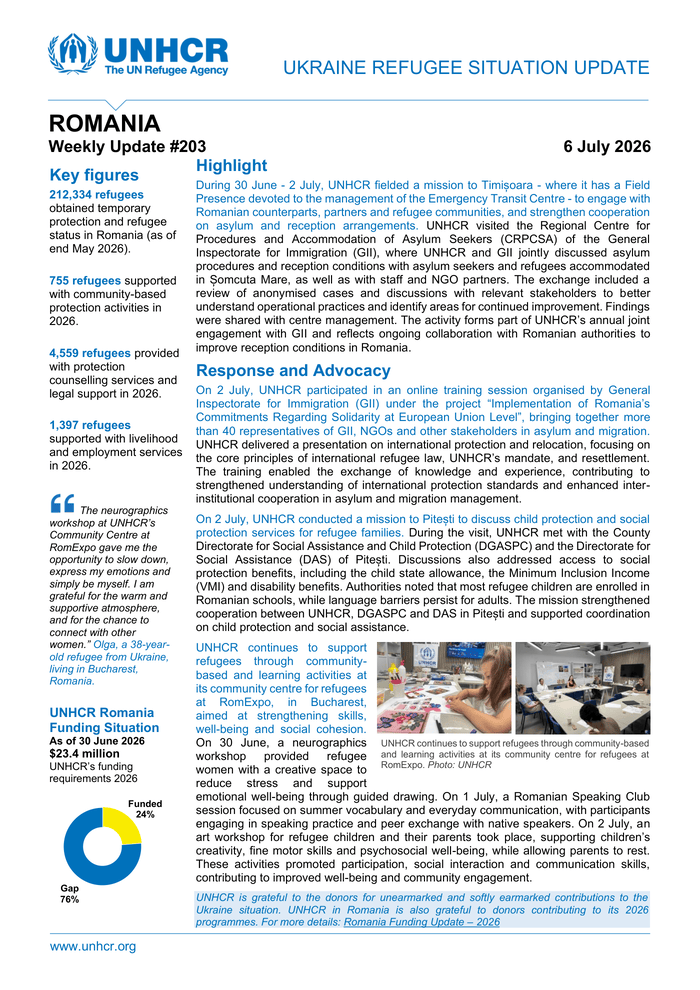
Countries: Romania, Ukraine Source: UN High Commissioner for Refugees Please refer to the attached file. Highlight During 30 June – 2 July, UNHCR fielded a mission to Timișoara – where it has a Field Presence devoted to the management of the Emergency Transit Centre – to engage with Romanian counterparts, partners and refugee communities, and strengthen cooperation on asylum and reception arrangements. UNHCR visited the Regional Centre for Procedures and Accommodation of Asylum Seekers (CRPCSA) of the General Inspectorate for Immigration (GII), where UNHCR and GII jointly discussed asylum procedures and reception conditions with asylum seekers and refugees accommodated in Șomcuta Mare, as well as with staff and NGO partners. The exchange included a review of anonymised cases and discussions with relevant stakeholders to better understand operational practices and identify areas for continued improvement. Findings were shared with centre management. The activity forms part of UNHCR’s annual joint engagement with GII and reflects ongoing collaboration with Romanian authorities to improve reception conditions in Romania. Response and Advocacy On 2 July, UNHCR participated in an online training session organised by General Inspectorate for Immigration (GII) under the project “Implementation of Romania’s Commitments Regarding Solidarity at European Union Level”, bringing together more than 40 representatives of GII, NGOs and other stakeholders in asylum and migration. UNHCR delivered a presentation on international protection and relocation, focusing on the core principles of international refugee law, UNHCR’s mandate, and resettlement. The training enabled the exchange of knowledge and experience, contributing to strengthened understanding of international protection standards and enhanced interinstitutional cooperation in asylum and migration management. On 2 July, UNHCR conducted a mission to Pitești to discuss child protection and social protection services for refugee families. During the visit, UNHCR met with the County Directorate for Social Assistance and Child Protection (DGASPC) and the Directorate for Social Assistance (DAS) of Pitești. Discussions also addressed access to social protection benefits, including the child state allowance, the Minimum Inclusion Income (VMI) and disability benefits. Authorities noted that most refugee children are enrolled in Romanian schools, while language barriers persist for adults. The mission strengthened cooperation between UNHCR, DGASPC and DAS in Pitești and supported coordination on child protection and social assistance. UNHCR continues to support refugees through communitybased and learning activities at its community centre for refugees at RomExpo, in Bucharest, aimed at strengthening skills, well-being and social cohesion. On 30 June, a neurographics workshop provided refugee women with a creative space to reduce stress and support emotional well-being through guided drawing. On 1 July, a Romanian Speaking Club session focused on summer vocabulary and everyday communication, with participants engaging in speaking practice and peer exchange with native speakers. On 2 July, an art workshop for refugee children and their parents took place, supporting children’s creativity, fine motor skills and psychosocial well-being, while allowing parents to rest. These activities promoted participation, social interaction and communication skills, contributing to improved well-being and community engagement.



GrowthPakistan brings you the latest news to keep an eye on Pakistan’s startup ecosystem. Business keeps you growing when you stay aware of your competitors' moves. GrowthPakistan offers Business, Tech, Global Tech, Global, Auto, and Startup News straight from industries all around the globe. This platform will help you identify upcoming opportunities not only in Pakistan but worldwide.
Email : growthpakistan@gmail.com
Whatsapp : +92320-9497079
© growthpakistan