


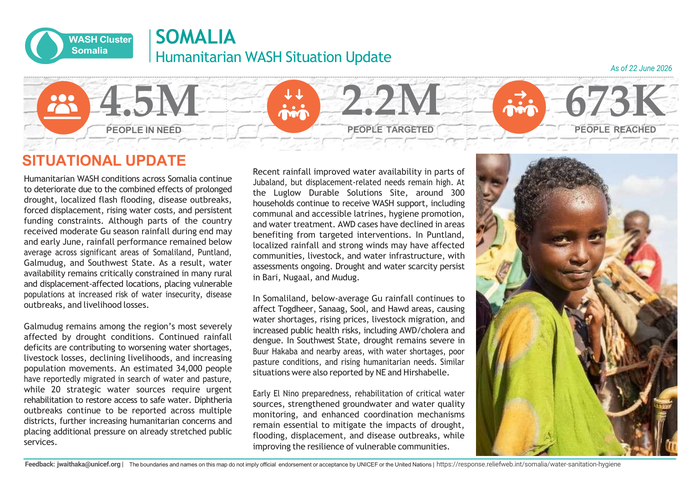
Country: Somalia Sources: UN Children’s Fund, WASH Cluster Please refer to the attached file. SITUATIONAL UPDATE Humanitarian WASH conditions across Somalia continue to deteriorate due to the combined effects of prolonged drought, localized flash flooding, disease outbreaks, forced displacement, rising water costs, and persistent funding constraints. Although parts of the country received moderate Gu season rainfall during end may and early June, rainfall performance remained below average across significant areas of Somaliland, Puntland, Galmudug, and Southwest State. As a result, water availability remains critically constrained in many rural and displacement-affected locations, placing vulnerable populations at increased risk of water insecurity, disease outbreaks, and livelihood losses. Galmudug remains among the region’s most severely affected by drought conditions. Continued rainfall deficits are contributing to worsening water shortages, livestock losses, declining livelihoods, and increasing population movements. An estimated 34, 000 people have reportedly migrated in search of water and pasture, while 20 strategic water sources require urgent rehabilitation to restore access to safe water. Diphtheria outbreaks continue to be reported across multiple districts, further increasing humanitarian concerns and placing additional pressure on already stretched public services. Recent rainfall improved water availability in parts of Jubaland, but displacement-related needs remain high. At the Luglow Durable Solutions Site, around 300 households continue to receive WASH support, including communal and accessible latrines, hygiene promotion, and water treatment. AWD cases have declined in areas benefiting from targeted interventions. In Puntland, localized rainfall and strong winds may have affected communities, livestock, and water infrastructure, with assessments ongoing. Drought and water scarcity persist in Bari, Nugaal, and Mudug. In Somaliland, below-average Gu rainfall continues to affect Togdheer, Sanaag, Sool, and Hawd areas, causing water shortages, rising prices, livestock migration, and increased public health risks, including AWD/cholera and dengue. In Southwest State, drought remains severe in Buur Hakaba and nearby areas, with water shortages, poor pasture conditions, and rising humanitarian needs. Similar situations were also reported by NE and Hirshabelle. Early El Nino preparedness, rehabilitation of critical water sources, strengthened groundwater and water quality monitoring, and enhanced coordination mechanisms remain essential to mitigate the impacts of drought, flooding, displacement, and disease outbreaks, while improving the resilience of vulnerable communities.



GrowthPakistan brings you the latest news to keep an eye on Pakistan’s startup ecosystem. Business keeps you growing when you stay aware of your competitors' moves. GrowthPakistan offers Business, Tech, Global Tech, Global, Auto, and Startup News straight from industries all around the globe. This platform will help you identify upcoming opportunities not only in Pakistan but worldwide.
Email : growthpakistan@gmail.com
Whatsapp : +92320-9497079
© growthpakistan