

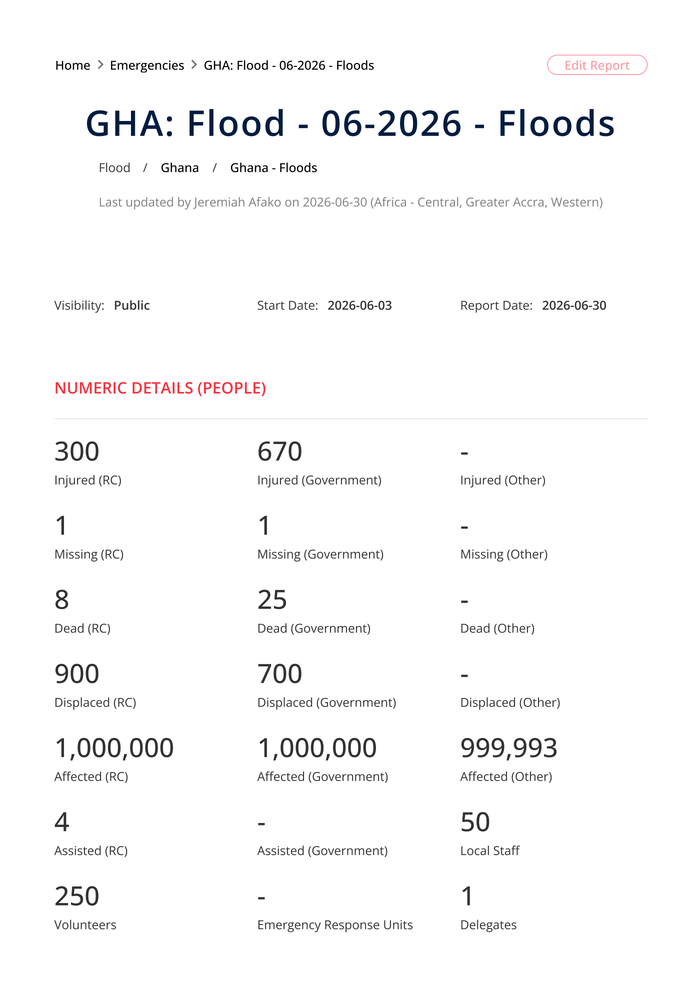
Country: Ghana Source: International Federation of Red Cross and Red Crescent Societies Please refer to the attached file. Description A catastrophic climate emergency struck Ghana’s southern coastline on Monday, June 29, 2026, when torrential rains triggered devastating floods across the Greater Accra, Central, and Western regions. The relentless downpour, which began late the previous evening, completely paralyzed the Monday morning economic rush hour and submerged vast swathes of residential and commercial property. The disaster claimed at least 12 lives in the Greater Accra and prompted immediate emergency interventions as rising waters trapped hundreds of citizens in their homes and vehicles. In the Greater Accra Region, the capital city became the epicentre of the crisis, experiencing some of the highest rainfall volumes recorded in recent years (140 millimeters of rainfall). Key economic hubs and transit choke points, including the Kwame Nkrumah Circle, Kaneshie Market, Alajo, Shiashie, Madina, Abokobi, Kasoa, Weija and Adabraka, were completely inundated, forcing the National Disaster Management Organisation (NADMO), the Ghana Red Cross, National Fire Service and the military to deploy rescue boats to evacuate over 400 stranded residents. Compounding the chaos, a massive fire erupted at a rubber factory in Accra, stretching emergency responders to their limits as they battled flames amidst deep floodwaters. Further west along the coastal corridor, the Central Region suffered severe structural damage as raging stormwaters tore through low-lying communities. Key arterial roads connecting coastal towns were washed away or left impassable, heavily disrupting transit along the critical N1 highway corridor. The region also accounted for several of the confirmed fatalities, with local emergency services responding to multiple incidents of drowning and structural collapses caused by the intense pressure of the water. Simultaneously, the Western Region faced widespread logistical disruption as heavy, localized rain cells saturated urban and industrial zones. Secondary drainage networks failed entirely, sending torrents of water through local businesses and stalling activity around major regional shipping and trade networks. The combined impact across these three regions highlighted the vulnerability of the country’s southern economic belt to sudden, extreme weather anomalies.
Ghana: GHA: Flood – 06-2026 – Floods (2026-06-30)

RELATED ARTICLES


