

Country: Viet Nam Source: International Federation of Red Cross and Red Crescent Societies Please refer to the attached file. Description of the Event Date of event 23-11-2025 What happened, where and when? Since August 2025, Viet Nam has been impacted by successive typhoons, including Wipha, Kajiki, Bualoi, and Matmo, causing significant damage across several northern and north-central provinces. From late October through November 2025, continuous heavy monsoon rains, tropical depressions, and prolonged low-pressure systems triggered widespread flooding and landslides across Central and South-Central Viet Nam. The most severe impacts have been recorded in Quång Tri, Da Nang, Hue, Quang Ngai, Dak Lak, Khanh Hoa, Lam Dong, and Gia Lai, where intense rainfall caused riverine flooding, flash floods, and slope failures. From 16 November until 25 November, prolonged heavy rainfall combined with rapidly rising river levels has caused widespread flooding across the central and Central Highlands provinces. The situation was driven by a strong cold surge interacting with the intertropical convergence zone, affecting multiple provinces, with Gia Lai, Khanh Hoa and Dak Lak being the most severely impacted. On 21 November 2025, the Dak Lak Provincial People’s Committee declared a state of emergency in 40 communes and wards, On 23 November, the Central Committee of the Viet Nam Fatherland Front launched an appeal for support from individuals, private sector, and international organizations to assist affected communities in the Central region and Central Highlands. According to the Viet Nam Disaster and Dyke Management Authority (VNDMA) report on 27 November, severe flooding across several central and highland provinces has resulted in significant human and economic losses. With Dak Lak and Khanh Hoa recording the highest fatalities, housing damage remains extensive, including impacts on education services, health services, agriculture, and transportation infrastructure. Provincial authorities continue to consolidate damage assessments, restore essential services, clear debris, and accelerate early recovery activities in affected communities. In addition, relevant Viet Nam government authorities have forecasted another tropical storm expected to hit the same areas around 1 or 2 December, which may further exacerbate an already severe situation in the affected provinces. Moreover, since August 2025, Viet Nam has been affected by consecutive typhoons that caused widespread damage, prompting the Viet Nam Red Cross Society (VNRC) to launch a DREF operation (MDRVN025) to support ten provinces: Bac Ninh, Cao Bang, Dien Bien, Ha Tinh, Lao Cai, Nghe An, Quang Tri, Thai Nguyen, Thanh Hoa and Tuyen Quang. With the current situation of recurrent and unpredictable flooding across the country, VNRC’s domestic resources are now overstretched. To address the emerging needs in newly affected areas, VNRC requested an additional DREF allocation (MDRVN026) to support Dak Lak, Gia Lai, Khanh Hoa and Lam Dong provinces. These provinces are not covered under the existing DREF operation, ensuring there is no overlap in target areas. While significant progress has been achieved, including the completion of large-scale housing repairs and restoration of basic services in many affected areas, communities continue to face recovery challenges, particularly related to livelihoods, damaged local infrastructure, and increased vulnerability to climate-related hazards. Agricultural households in the Central Highlands, especially coffee-producing communities, remain impacted by production losses and disrupted income sources following the floods and landslides experienced during late 2025. By early 2026, from the government report the flood-affected provinces of Đắk Lắk, Gia Lai, Khánh Hòa and Lâm Đồng have largely transitioned from emergency response to recovery and reconstruction phases. Government-led recovery efforts focused on housing repair and reconstruction, rehabilitation of damaged transport infrastructure, restoration of agricultural production, and livelihood recovery support for affected households.
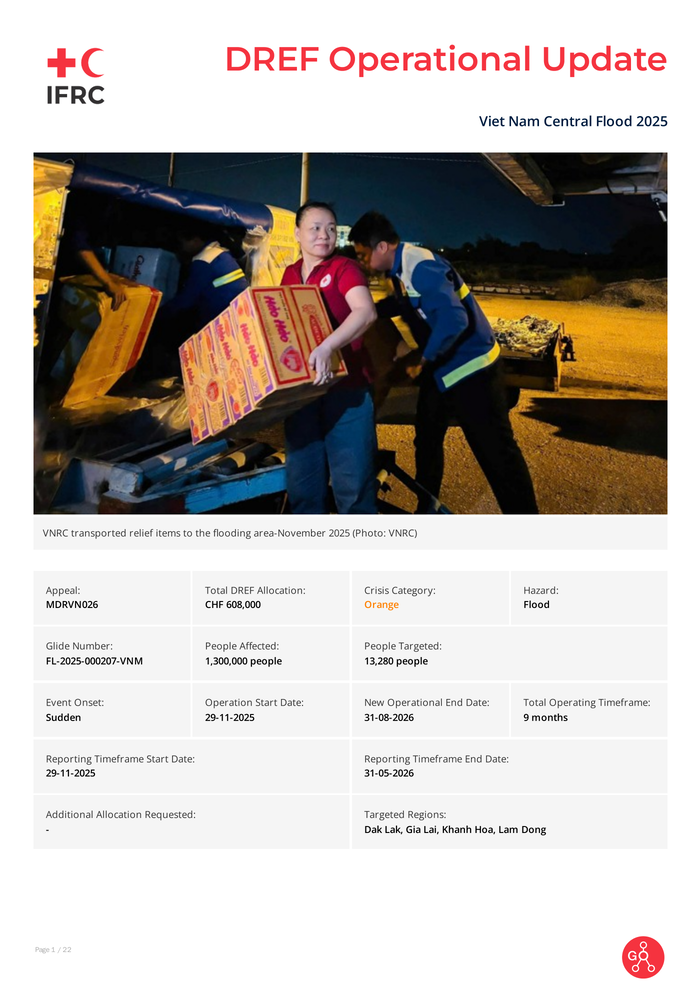
Viet Nam Central Flood 2025 – DREF Operational Update (MDRVN026)

RELATED ARTICLES


