

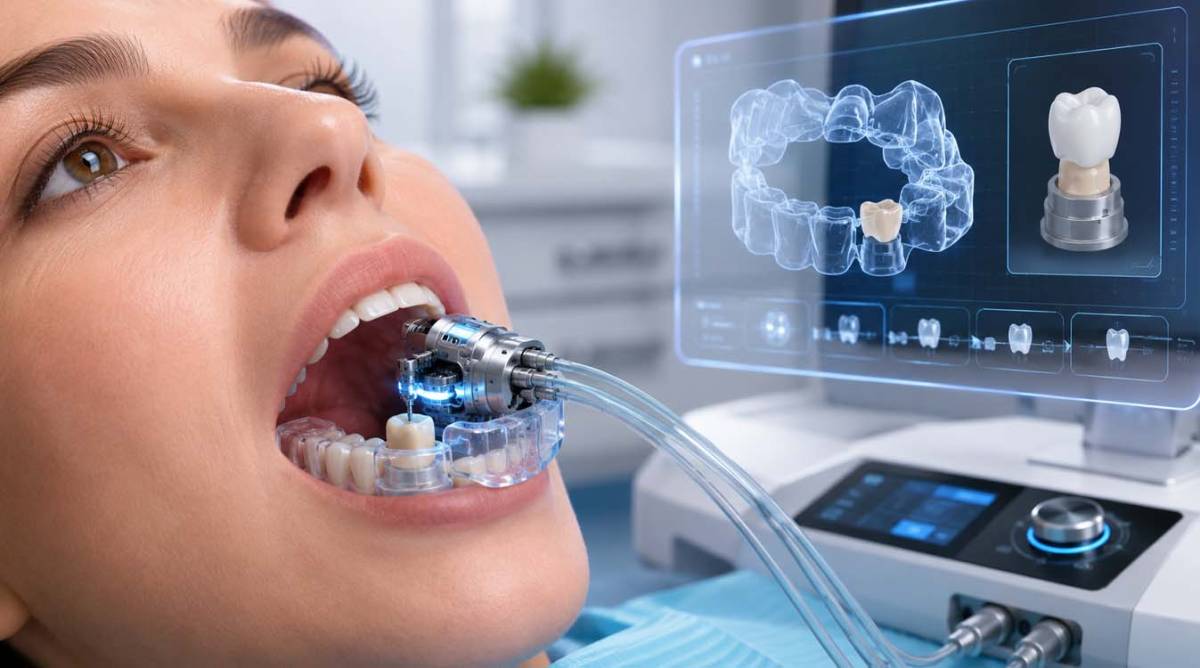
A tiny intraoral robot developed by researchers at the University of Basel could transform the future of restorative dentistry by enabling dentists to complete crown preparations in a single appointment, potentially eliminating the need for patients to return for additional visits. The miniature device, created by researchers in the Department of Biomedical Engineering at the University of Basel, is roughly the size of a cork and is designed to fit comfortably inside a patient’s mouth. Unlike conventional dental handpieces, the robot’s controls remain outside the mouth and are connected to the device through flexible cables. Researchers say the innovation could significantly streamline digital crown workflows by carrying out highly precise tooth preparation based on a pre-planned digital treatment strategy. Under the proposed workflow, a patient first undergoes a diagnostic scan of the tooth. Dentists can then digitally plan exactly how much tooth material needs to be removed before immediately ordering the final crown restoration. Because the robot performs the preparation according to the digital plan, developers believe the process could eliminate the need for a second appointment that is often required in traditional crown procedures. The digital scan also generates a custom-fitted dental splint that serves as the robot’s support system during treatment. The miniature robot attaches directly to the splint, allowing it to move synchronously with the patient. This design helps maintain positioning accuracy even if the patient moves their head during the procedure. The robot prepares the tooth in two stages. It first uses a wider drill to remove tooth material from the upper surface and reduce the tooth structure. It then switches to a finer drill to precisely shape the sides of the tooth and complete the crown preparation. To evaluate the technology, researchers tested the system on tooth models made of synthetic resin and on ceramic materials with hardness comparable to natural tooth enamel. The experiments demonstrated a positional error margin of less than 0. 2 millimetres, a level of precision that researchers expect to improve further after the integration of advanced positional sensors. The force generated during drilling was also assessed and found to be less than five newtons, roughly equivalent to the weight of a 500-millilitre bottle of water. Researchers are continuing to evaluate the robot’s noise levels and other performance characteristics to determine its suitability for use in routine dental practice. According to Yukiko Tomooka, first author of the study, the addition of sensors could further enhance the system’s reliability and operational continuity. “Even after a power outage, the miniature intraoral robot would know where it is and where it needs to continue based on the sensor data,” Tomooka said. Although dental robotics remains largely experimental in clinical dentistry in many countries, robot-assisted technologies are gradually gaining momentum worldwide. Robotic implant placement systems are already being used in several regions, and researchers believe miniature robotic systems may represent the next major step in digital and minimally invasive dentistry. Experts say that if future testing confirms its safety, precision and clinical effectiveness, the intraoral robot could eventually reshape restorative dentistry by reducing treatment times, improving workflow efficiency and offering patients the convenience of receiving crown preparations and restorations in a single visit. Stay informed, stay alert! pk/29-Jun-2026/tiny-intraoral-robot-could-make-single-visit-dental-crowns-possible” target=”_blank” rel=”nofollow noopener noreferrer”>Read full story on Dental News
Tiny intraoral robot could make single-visit dental crowns a reality, researchers say

RELATED ARTICLES


