

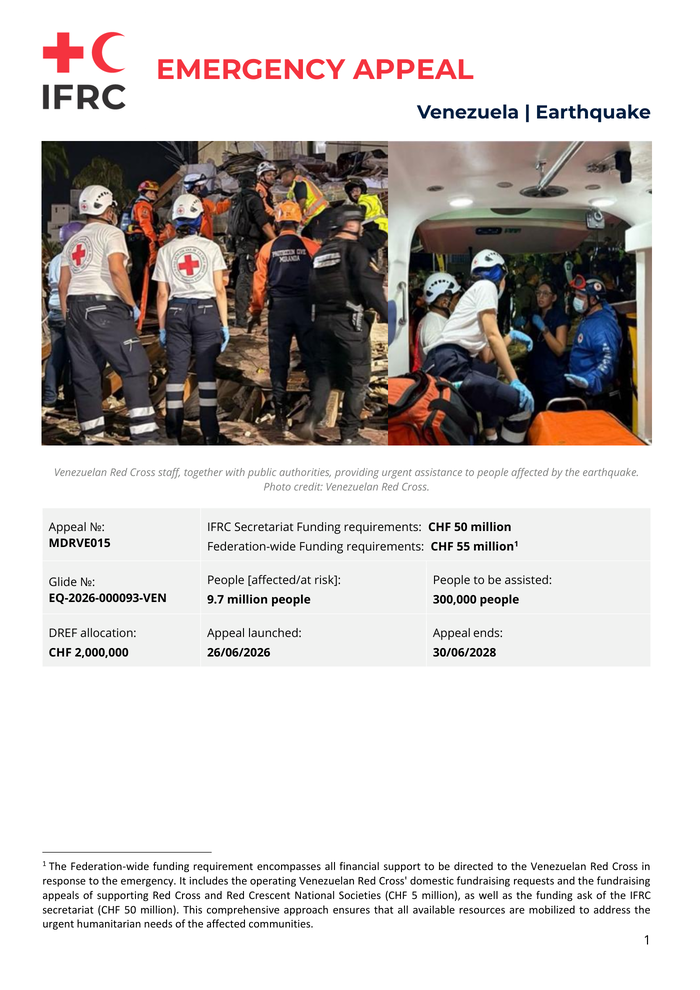
Country: Venezuela (Bolivarian Republic of) Source: International Federation of Red Cross and Red Crescent Societies Please refer to the attached file. SITUATION OVERVIEW On 24 June 2026, two major earthquakes struck north-central Venezuela in rapid succession, with preliminary magnitudes of 7. 2 and 7. 5. The epicentres were located near Morón and Yumare, in Carabobo and Yaracuy states, west of Caracas. The earthquakes were felt across much of the country, including Greater Caracas, La Guaira, Aragua, Carabobo, Miranda, Falcon, and neighbouring states, and were also felt in parts of Colombia, the Caribbean, and Brazil – reaching as far as Martinique and the Brazilian Amazon, more than 1, 700 km from the epicentre. The Government of Venezuela has declared a State of Emergency. According to the most recent report available at the time of this document’s release, an estimated 9, 730, 000 people have been affected, including approximately 530, 000 exposed to severe to extreme earthquake intensity. These figures are based on GDACS modelled projections and should be understood as indicative estimates rather than confirmed counts. Additionally, at least 188 deaths and approximately 1, 520 injuries have been reported, along with damage to critical infrastructure, including the collapse of over 204 buildings, severe structural damage to a further 217 buildings, and partial damage to approximately 300 others. In addition, the Venezuelan Red Cross has received 1, 133 Restoring Family Links (RFL) requests, mainly from La Guaira. These figures remain preliminary and are expected to change as search and rescue operations continue, particularly in La Guaira and Greater Caracas. According to the USGS statistical model, there is a one-in-two chance that the number of casualties (deaths and injuries) will fall between 1, 000 and 10, 000, and a three-in-ten chance that it will exceed 10, 000. The coastal city of La Guaira has emerged as the most affected area and has been described by authorities as a Zona de Desastre (Disaster Zone). Severe damage has also been reported in Greater Caracas, including collapsed buildings and ongoing search and rescue operations in areas such as Los Palos Grandes and Chacao. Preliminary national figures indicate that 117 buildings have completely collapsed, 119 have sustained severe structural damage, and a further 149 have sustained partial damage. The predominant building types in the affected areas are unreinforced masonry and adobe structures, while over half of Caracas’ population lives in informal hillside settlements exposed to earthquake-induced landslides. As aftershocks continue, with at least 20 recorded since the initial earthquake, a significant portion of the urban population remains unable to return to visibly damaged buildings because of the risk of further collapse. Essential services, including electricity, water, gas, telecommunications, and transport, have been disrupted in several areas. Metro and rail services were suspended as a precaution, while classes and non-essential activities have been suspended pending safety inspections. Furthermore, Simón Bolívar International Airport in Maiquetía, La Guaira, has sustained significant damage. The health system is now under extreme strain. Public healthcare facilities – relied upon by over 90 per cent of the population – are facing a surge in trauma cases alongside pre-existing shortages of staff, medical supplies, and functional operating theatres. According to the President of Venezuela’s National Assembly, eight hospitals have been damaged, some of which have been evacuated, with patients transferred to other facilities. The hospital at the Venezuelan Red Cross headquarters was forced to close on the first night after reaching maximum capacity. Meanwhile, some patients in the hardest-hit area, La Guaira, are being transferred to Caracas to receive adequate care due to the overload of the local health system. The Venezuelan Red Cross has received a request from the Ministry of Health to deploy a basic field hospital to La Guaira to treat injured people and help relieve pressure on existing facilities. Preliminary USGS economic loss modelling indicates a 30 per cent probability that losses will exceed USD 100 billion, potentially reaching up to 20 per cent of Venezuela’s current GDP. Market and economic disruptions are occurring against a backdrop of macroeconomic fragility with inflation exceeding 270 per cent and fiscal and currency constraints limiting Venezuela’s capacity to finance recovery efforts. Communications disruptions have separated families, prompting Red Cross Societies in Ecuador, Colombia, Mexico, Costa Rica, Honduras, and Argentina to activate RFL services for the Venezuelan diaspora. The headquarters of the Venezuelan Red Cross has sustained critical infrastructure damage. Despite this, the National Society remains operational and has activated search and rescue groups, first aid, Restoring Family Links, emergency health support, field assessments, and the dissemination of earthquake safety messages.
Venezuela | Earthquake: Emergency Appeal (MDRVE015)

RELATED ARTICLES


