

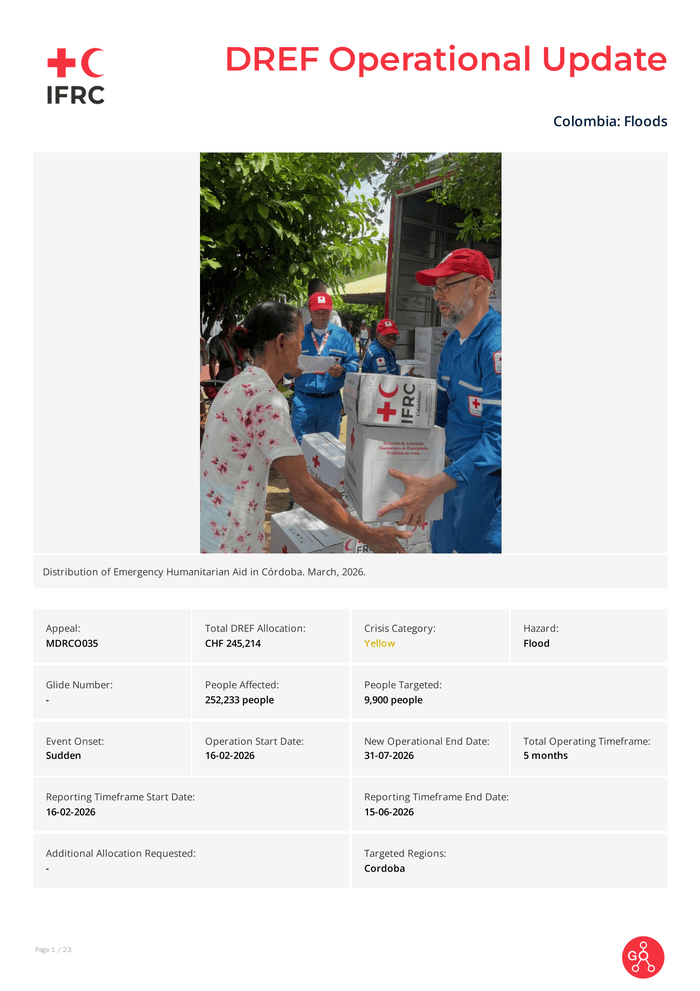
Country: Colombia Source: International Federation of Red Cross and Red Crescent Societies Please refer to the attached file. Description of the Event Date of event 11-02-2026 What happened, where and when? Between February 1 and 6, 2026, the Colombian Caribbean region was affected by an atypical hydrometeorological event associated with the anomalous latitudinal displacement of a cold front, which brought intense and prolonged rainfall despite the fact that the country is in its first season of less rainfall for the Caribbean and Andean regions. This cold front caused a significant increase in precipitation in the Caribbean, Andean, Pacific, Orinoquía, and Amazon regions, causing flooding, flash floods, river overflows, and alterations in the normal runoff dynamics in multiple watersheds. The magnitude was such that, as of April 30, the National Unit for Disaster Risk Management (UNGRD) had recorded 520 emergency events associated with the rains in 280 municipalities across the country, with the departments of Córdoba and Antioquia being the most affected territories, with widespread flooding that has impacted homes, infrastructure, roads, and the livelihoods of rural and urban communities. The Government of the Department of Córdoba declared a state of public calamity due to heavy rains, through Decree No. 0039 of February 2, 2026, due to the impact on at least 18 municipalities, including: San Carlos, Montelibano, Puerto Escondido, Los Cordobas, Monteria, San Jose de Uré, La Apartada, Valencia, Puerto Libertador, Canalete, San Antero, San Pelayo, Momil, Cereté, San Bernardo del Viento, Lorica, Tierra Alta, and Ciénga de Oro. In addition, the Government of Antioquia department, through Decree 11 of February 2, 2026, declared a state of public calamity due to the serious damage caused in the Urabá region of Antioquia by heavy rains and flooding, mainly affecting the municipalities of Necoclí, Arboletes, San Pedro de Urabá, San Juan de Urabá, and Carepa. Therefore, the National Government declared a State of Economic, Social, and Ecological Emergency in the departments of Córdoba, Antioquia, La Guajira, Sucre, Bolívar, Cesar, Magdalena, and Chocó on February 11, through Decree No. 0150, which takes precedence over the Disaster Declarations issued by the National Government in this type of extraordinary situation. The Decree states that the situation exceeded the ordinary response capacity of several territorial entities, which led to the adoption of special measures at the national level, recognizing that: • The event has a multisectoral and multidepartmental impact. • It requires coordination between the national and territorial levels. • It involves the mobilization of extraordinary technical, administrative, and financial resources. In addition, the livestock sector, represented by the Colombian Federation of Livestock Farmers (FEDEGÁN), reported that the atypical floods have caused a serious production and humanitarian emergency in rural areas, particularly in the department of Córdoba and northern Urabá, where thousands of farms are under water and hundreds of thousands of animals (cattle and buffalo) are at risk due to excessive rainfall and flooding.
Colombia: Floods – DREF Operational Update #2 (MDRCO032)

RELATED ARTICLES


