


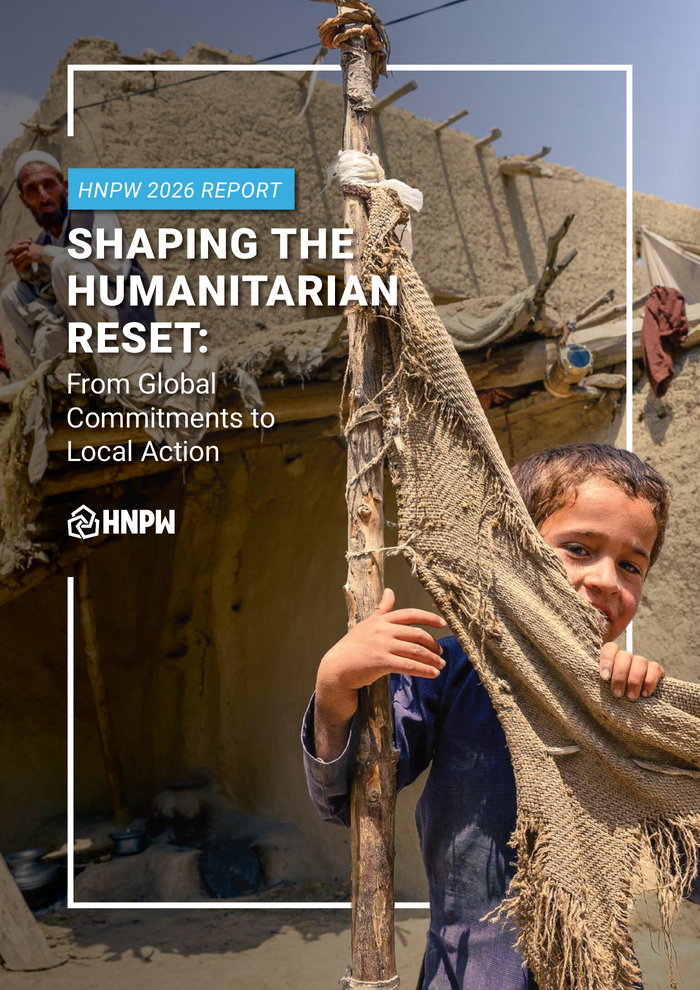
Country: World Source: UN Office for the Coordination of Humanitarian Affairs Please refer to the attached file. Executive Summary The 12th iteration of the Humanitarian Networks and Partnerships Weeks (HNPW), co-hosted by OCHA and Switzerland, returned in 2026 with a renewed, shorter format and a strengthened strategic focus, with this year’s chosen theme centred on shaping the humanitarian reset and moving from global commitments to local action. The newly introduced Community Day on Wednesday, 11 March 2026 served as the anchor of the event, bringing together networks and partnerships to deepen collective reflection initiated at last year’s HNPW on how the humanitarian system must evolve amid shifting geopolitics and declining global funding, and to identify practical steps to drive the reset forward. Marking one year since the launch of the humanitarian reset, OCHA convened a briefing on the humanitarian reset prior to HNPW to update networks and partners on progress against commitments. During the Community Day, Under-Secretary-General for Humanitarian Affairs and Emergency Relief Coordinator, Tom Fletcher led a keynote dialogue with humanitarian leaders from Yemen, the Democratic Republic of the Congo, Afghanistan, and South Sudan. The discussion offered an honest assessment of achievements to date, the barriers that hinder progress and the commitments needed to accelerate change. Participants acknowledged early improvements, such as increased allocations of country-based pooled funding to local and national NGOs, stronger representation in country teams and examples of co-leadership of clusters. However, they stressed that key parts of the system are still falling short in delivering on the humanitarian reset’s localization commitments. They called for genuine power sharing and more substantial local representation in global and regional-level decision-making bodies. Community Day sessions, focused on Transition of Power, Resilience and Sustainability, Streamlined Coordination and Efficiency and Innovative Financing, reaffirmed several core commitments essential to advancing the humanitarian reset and shifting from global commitments to local action. These included: re-directing resources and authority to national responders without unnecessary intermediaries, investing in long-term system strengthening of local institutions rather than short-term parallel mechanisms; improving operational agility by streamlining coordination and reducing bureaucratic barriers as well as diversifying funding flows. Together, these discussions underscored a shared determination to ensure the humanitarian reset delivers tangible improvements for people living through crisis. There was a clear call for humanitarian actors to maintain momentum and concrete action over the coming year to translate commitments into measurable impact on the ground.



GrowthPakistan brings you the latest news to keep an eye on Pakistan’s startup ecosystem. Business keeps you growing when you stay aware of your competitors' moves. GrowthPakistan offers Business, Tech, Global Tech, Global, Auto, and Startup News straight from industries all around the globe. This platform will help you identify upcoming opportunities not only in Pakistan but worldwide.
Email : growthpakistan@gmail.com
Whatsapp : +92320-9497079
© growthpakistan