

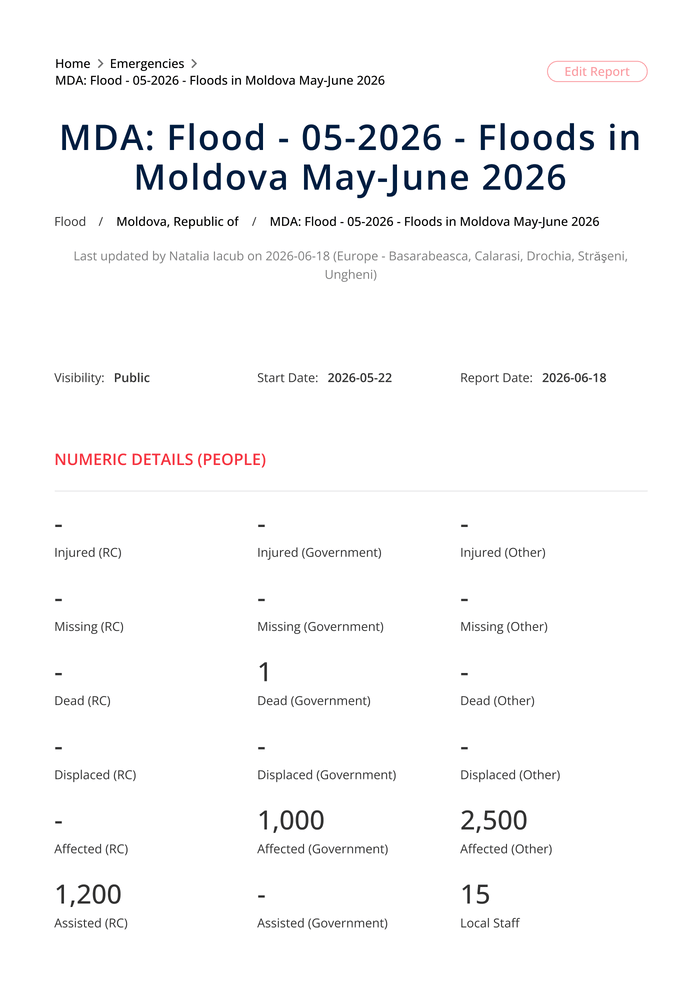
Country: Moldova Source: International Federation of Red Cross and Red Crescent Societies Please refer to the attached file. Description The hydrometeorological crisis that affected the Republic of Moldova from late May through mid-June 2026 caused widespread flooding and infrastructure damage across multiple regions, directly affecting an estimated 800–1, 000 people. According to information from the General Inspectorate for Emergency Situations (IGSU), the National Crisis Management Center (CNMC), and local authorities, the severe weather impacted communities in 15 districts and municipalities. The first wave of torrential rainfall began in late May, affecting 25 localities, primarily in central Moldova. Călărași District was among the hardest hit and recorded the only confirmed fatality of the disaster, when a 48-year-old resident of Dereneu drowned near his home. In Hîrjăuca, extreme water pressure caused the rupture of a protection dam, resulting in sudden downstream flooding. Significant damage to homes, roads, and agricultural land was also reported in Mărtinești (Strășeni District) and Pașcani (Criuleni District). Emergency services responded by reinforcing embankments and constructing protective infrastructure, including a 3-meter-high earthen dike in Strășeni, helping safeguard approximately 400 households at risk. Nationally, the floods affected 25 localities, inundated or damaged 69 households, flooded around 400 hectares of agricultural land, and damaged approximately 55 km of roads. On 26 May 2026, the leadership of the Red Cross Society of Moldova (MRCS), together with representatives of regional branches, conducted a field mission to Călărași District to assess the humanitarian situation. The delegation visited Dereneu, Bularda, and Mândra, meeting with local authorities, affected families, social workers, and emergency responders. In Bularda, the MRCS team supported personnel engaged in reinforcing flood protection structures and later provided food supplies to emergency teams working on-site. By 27–28 May, emergency measures such as dike reinforcement, controlled drainage, and water pumping had reduced the immediate threat, although authorities continued assessing damage and planning recovery measures. A second and more intense wave of storms struck during 6–7 June 2026, prompting emergency interventions across 10 districts. In Gangura (Ialoveni District), around 100 households were flooded, while firefighters pumped more than 900 cubic metres of water from affected areas. Additional flooding affected Puhoi, Țipala, and Cărbuna, while in Gribova (Drochia District) runoff inundated 20 households and damaged two bridges. Emergency pumping operations were also carried out in Strășeni Municipality, Vărzărești (Nisporeni District), Soroca, Căușeni, Anenii Noi, Cimișlia, Bălți, Chișinău, and Durlești. The severe weather persisted through 11–12 June, triggering renewed Orange Code alerts and dozens of additional emergency interventions. Particularly severe conditions were reported in Pepeni (Sîngerei District), where local authorities described the flooding as the worst in four decades. In Telenești District, emergency teams completed 25 interventions in a single day, pumping water from flooded basements, courtyards, and commercial buildings. Similar operations were conducted in Edineț, Ocnița, and Dondușeni. Overall, the crisis resulted in significant infrastructure damage, including the rupture of one protection dam, damage to two bridges, temporary disruption of railway traffic, flooded transport routes, and extensive impacts on agricultural land and local infrastructure. As of 7 June 2026, the Red Cross Society of Moldova had provided humanitarian assistance to 176 families affected by the floods across the districts of Călărași, Strășeni, Ungheni, Basarabeasca, and Drochia. The largest intervention took place in Călărași District, where 160 families from Bularda, Dereneu, Hîrjăuca, Mândra, and Bravicea received 1, 220 essential relief items, including hygiene kits, bed linen sets, blankets, water filters, water filter cartridges, pillows, and other household essentials. In Greblești, Strășeni District, 11 families received more than 120 relief items, including blankets, duvets, pillows, bed linen, water filters, kitchenware, and hygiene products. In Cornova, Ungheni District, 5 families received 65 essential household items, including hygiene kits, bedding, water filters, and kitchen utensils such as pots and frying pans. Additional humanitarian distributions included 330 relief items in Basarabeasca District, consisting of hygiene kits, bed linen sets, blankets, cooking pots, and water filters, as well as 96 relief items in Drochia District, where beneficiaries received assistance across eight categories, including bedding, hygiene supplies, water filters, pillows, and bed covers. Alongside relief distributions, the Red Cross Society of Moldova supported emergency operations by supplying food to first responders working on flood mitigation activities in Bularda. The organization continues to monitor the situation in affected communities and conduct needs assessments. Subject to available resources, the humanitarian response will be further expanded through the provision of essential household goods, hygiene and cleaning kits, psychosocial support, and targeted assistance for the most vulnerable households.
MDA: Flood – 05-2026 – Floods in Moldova May-June 2026 (2026-06-18)

RELATED ARTICLES


