

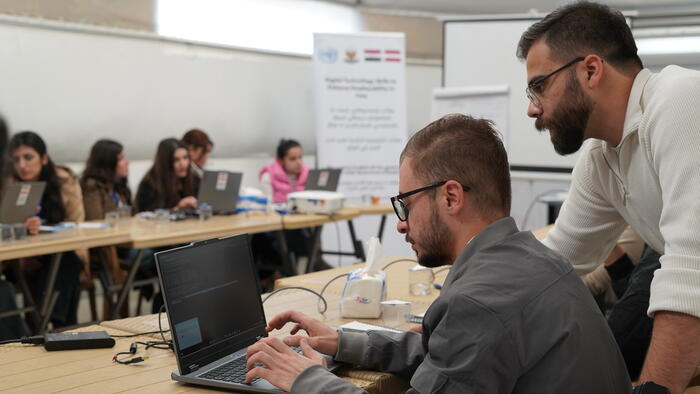
Country: Iraq Source: UNIDO Iraq, Duhok Governorate, the United Nations Industrial Development Organization (UNIDO), with funding from the Austrian Government, delivered a thirteen-day intensive training in Sharya Township, Duhok Governorate, in the Kurdistan Region of Iraq, under the initiative “Digital Technology Skills to Enhance Employability in Iraq. ” The program brought together 25 young women and men from Internally Displaced Persons (IDPs) and host communities for comprehensive instruction in Computer Networking, Cybersecurity, and the Entrepreneurship Development Program (EDP). Sixteen of the participants were IDPs, primarily Yezidis from Sinjar, and nine were from the host community. Fifteen were male and ten were female, reflecting UNIDO’s commitment to inclusive access to technical education. Many participants continue to face economic hardship and limited employment opportunities despite completing higher education. Maryam Khudhur Khudida, a 28-year-old participant originally from Sinjar and now living in Sharya, described the economic challenges facing many displaced families. “There are no jobs available. Any jobs that are available are very low paying, so it is difficult to live on my father’s monthly social security, ” she explained. Although she recently completed a university degree in physics and worked while studying, the income was too limited to meaningfully support her household. For Maryam, the training represented renewed opportunity and direction. Reflecting on the experience, she stated, “We received the key from the training, but it is up to us which doors we choose to open in the future, ” expressing strong confidence in applying the lessons learned to secure better employment. The Cybersecurity and Networking component was delivered by Saman Auyb, who works across media agencies, telecommunications, and production companies. He emphasized that the program’s impact extended beyond theoretical instruction. “The most important improvement was not only in technical knowledge, but in technical behavior, ” he noted. “Participants became more capable of handling basic setup, troubleshooting, and common system issues with structure rather than guesswork. ” While acknowledging that a short training cannot produce specialists, he added that it created “readiness, discipline, and a strong foundation for entry level IT roles and continued growth. ” Khdir Murad Alyas, a 25-year-old participant from Sinjar but living in Sharya who helps support his five-member family financially, explained that although he had studied computer technology engineering at university, “the cybersecurity training from UNIDO was very helpful and greatly increased my knowledge. ” He emphasized that the skills are not only valuable professionally but also essential for everyday life, allowing him to secure networks, protect data, and keep himself and his family safe online. He also expressed interest in applying the entrepreneurship lessons to eventually open his own technology related business. Similarly, Shakir Bashar Hussein, a 23-year-old computer engineering graduate from Sinjar also living in Sharya, described how the training strengthened his technical confidence. While he previously had basic knowledge of networking and cybersecurity, he explained that the course taught him new practical tools to secure devices and systems. He highlighted the importance of learning not to connect randomly to unsecured wireless networks and to use protective software and secure practices such as Virtual Private Networks (VPNs) to safeguard privacy. Shakir added that “As a web developer for the past three years, I believe the cybersecurity tools I gained from this training will help me build more secure websites and grow professionally. In the future, I hope to work with government institutions and eventually establish my own business. ” For participants without a strong technical background, the impact was equally significant. Wasila Ismail Hussein, a 25-year-old female originally from Sinjar who now lives in Sharya and helps support her eleven-member household, shared that technology was not her primary field. “I did not have previous background or knowledge about cybersecurity, but this training helped me to learn how to protect myself online, ” she explained. She added that she has already begun sharing this knowledge with others in her community so they can also protect themselves in an increasingly digital environment. According to Saman, one of the strongest outcomes was a shift in mindset among participants. “Many participants shifted from a classroom mindset focused on finding the correct answer to a technical mindset focused on understanding the problem, isolating the cause, testing a step, and learning from the result, ” he observed. This structured and process-based approach strengthened their confidence, problem solving skills, and ability to work through uncertainty, all of which are essential for long term growth in the technology sector. Complementing the technical instruction, the Entrepreneurship Development Program (EDP) was delivered by Ammar Ahmed Jasim, who currently serves as Director of the Small and Medium Enterprises Department at the Ministry of Industry and Minerals. He explained that the entrepreneurship sessions were designed to help trainees translate technical knowledge into realistic income generating activities. “The sessions on business idea selection, feasibility studies, and business plan development were the most impactful, ” he noted, as they enabled participants to evaluate business ideas based on market need, cost, and feasibility within the camp and surrounding communities. A central objective of the program was helping youth clearly define and package their services. As Ammar explained, “We helped them link their technical skills to tangible outputs, such as basic website design, network repair services, digital tutoring, or simple digital products, rather than leaving their skills undefined. ” By learning simplified feasibility analysis, pricing strategies, and cost estimation methods, participants reduced the psychological barriers to starting a business. He emphasized that trainees gained “a practical framework to transform their technical expertise into marketable and feasible business offerings. ” Participants described how the entrepreneurship component expanded their professional vision. Khdir expressed interest in launching his own technology business in the future, combining cybersecurity knowledge with entrepreneurial planning. Shakir noted that understanding market gaps in areas such as Sinjar could create opportunities for projects that are currently unavailable there. Maryam shared her aspiration to become a teacher and prepare the next generation to understand and navigate the digital world effectively, demonstrating the multiplier effect of the training. Ammar observed clear improvements in participants’ confidence and decision making after completing the Entrepreneurship Development Program. He noted that they demonstrated increased self-confidence, enhanced problem solving abilities, and a clearer vision of short- and medium-term goals. He emphasized that in displacement affected settings, “the most viable pathways must consider spatial limitations, low capital availability, and the needs of the local market, ” highlighting low-cost technical services, small scale digital work, and cooperative models as realistic and sustainable entry points. Although several participants mentioned that they wished the training had been longer due to the volume of knowledge delivered, they consistently described the experience as motivating and transformative. They left with enhanced technical awareness, stronger entrepreneurial thinking, and clearer professional direction. The Austrian Government funded initiative “Digital Technology Skills to Enhance Employability in Iraq” represents a strategic investment in youth potential and inclusive economic development. By integrating cybersecurity, networking, and entrepreneurship into a single program, UNIDO ensures that skills acquisition is directly connected to economic opportunity and long-term resilience. In recognition of excellence and dedication, the top performing trainees will receive laptops from UNIDO to support continued learning, career development, or business start-up efforts. Through initiatives such as this, UNIDO continues to strengthen pathways toward sustainable livelihoods in Iraq, ensuring that young women and men, regardless of displacement status, have equitable access to the knowledge, confidence, and direction needed to build resilient futures in an increasingly digital economy.
Iraq: UNIDO: Strengthening Employability Through Cybersecurity, Networking, and Entrepreneurship Training

RELATED ARTICLES


