


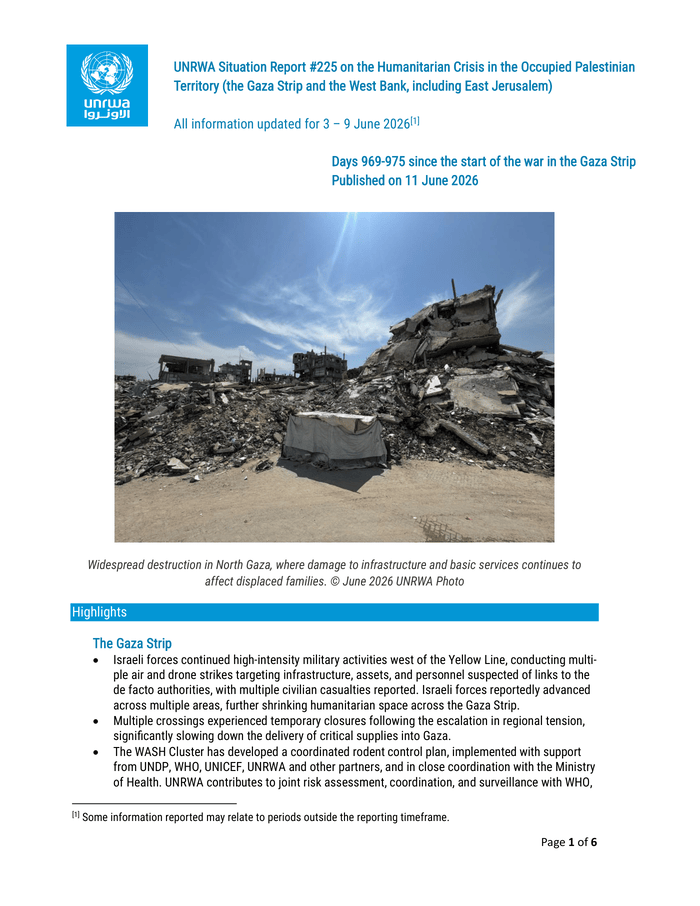
Country: occupied Palestinian territory Source: UN Relief and Works Agency for Palestine Refugees in the Near East Please refer to the attached files. Highlights The Gaza Strip Israeli forces continued high-intensity military activities west of the Yellow Line, conducting multiple air and drone strikes targeting infrastructure, assets, and personnel suspected of links to the de facto authorities, with multiple civilian casualties reported. Israeli forces reportedly advanced across multiple areas, further shrinking humanitarian space across the Gaza Strip. Multiple crossings experienced temporary closures following the escalation in regional tension, significantly slowing down the delivery of critical supplies into Gaza. The WASH Cluster has developed a coordinated rodent control plan, implemented with support from UNDP, WHO, UNICEF, UNRWA and other partners, and in close coordination with the Ministry of Health. UNRWA contributes to joint risk assessment, coordination, and surveillance with WHO, UNDP and the Ministry of Health, and implements targeted pest control in high-risk displacement sites and installations, large-scale waste removal, hygiene promotion and community outreach near its displacement sites. Severe shortages of engine oil, tyres, and spare parts are placing life-saving humanitarian operations at risk across the Gaza Strip. Health services are particularly affected, as most facilities rely on generators that face frequent breakdowns. At the same time, water production, pumping and distribution systems — alongside wastewater and solid waste management — are at imminent risk of failure, as they depend almost entirely on ageing generators that are operating beyond design limits. Approximately 25 per cent of UNRWA vehicles — including water tankers and waste collection trucks — and 25 per cent of UNRWA generators are already out of service. Without urgent resupply, disruptions to healthcare, safe water access, and waste collection are expected to rapidly escalate public health risks and operational constraints.



GrowthPakistan brings you the latest news to keep an eye on Pakistan’s startup ecosystem. Business keeps you growing when you stay aware of your competitors' moves. GrowthPakistan offers Business, Tech, Global Tech, Global, Auto, and Startup News straight from industries all around the globe. This platform will help you identify upcoming opportunities not only in Pakistan but worldwide.
Email : growthpakistan@gmail.com
Whatsapp : +92320-9497079
© growthpakistan