


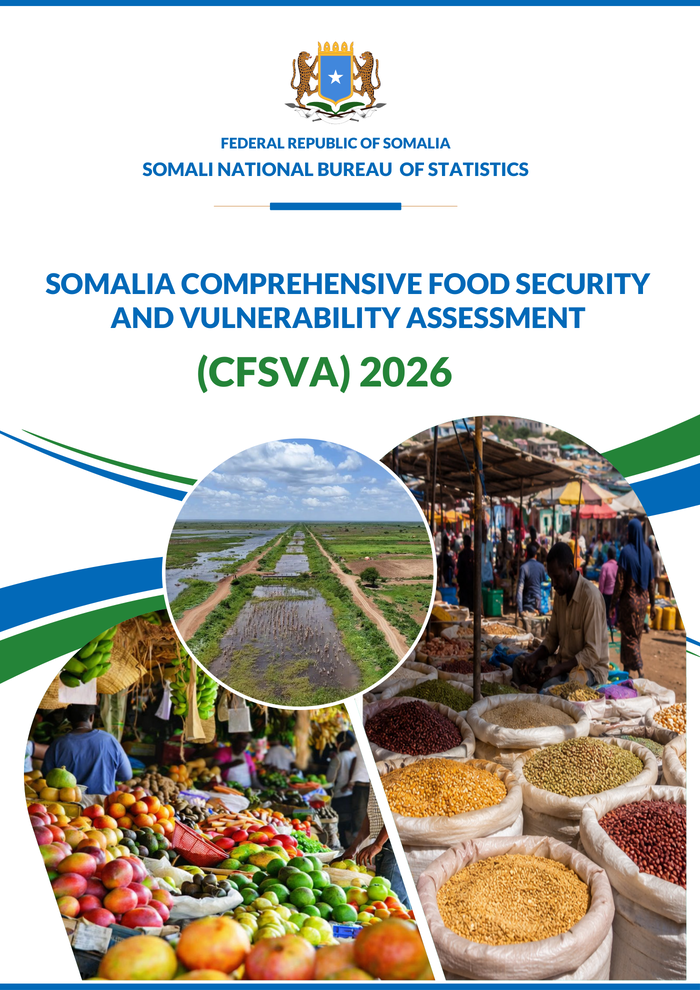
Country: Somalia Source: Government of Somalia Please refer to the attached file. Executive Summary The Somalia Comprehensive Food Security and Vulnerability Analysis (CFSVA) 2026 provides a representative evidence base for 17 out of 18 pre-war administrative regions of Somalia (excluding Middle Juba region), covering urban, rural, and IDP populations. The assessment was jointly implemented by the Somalia National Bureau of Statistics (SNBS), the World Food Programme (WFP), and the Food and Agriculture Organisation (FAO) through the FAO Food Security and Nutrition Analysis Unit (FSNAU). Fieldwork was conducted between February and May 2025. The survey covered 8, 816 households across 34 districts in 17Somalia’s 18 pre-war administrative regions; Middle Juba was not covered due to access and security constraints, generating representative estimates at the regional and national levels for urban, rural, and internally displaced populations. The Middle Juba region was not covered due to access and operational constraints. Furthermore, the nomadic population were not included in the survey due to their mobile nature and the logistical challenges. The CFSVA was designed to go beyond measuring current food consumption. It analyses Somalia’s food security status, identifies the structural issues and driving forces behind vulnerability, and provides evidence for development pathways that address root causes. In doing so, it supports national efforts to advance food security, strengthen resilience, and contribute to the ambition of achieving zero hunger. It also establishes an important benchmark for future food security monitoring, national policy formulation, humanitarian and development programming, as well as monitoring progress on the Somalia National Transformation Plan (NTP). The findings show that food insecurity in Somalia is driven by a combination of structural poverty, displacement, recurrent climatic and economic shocks, weak purchasing power, market dependence, limited savings, debt, and unequal access to basic services. While national food consumption indicators suggest that most households are still maintaining acceptable food consumption, many are doing so under fragile conditions. This means that food security cannot be assessed through food consumption alone. A broader picture, combining the Consolidated Approach for Reporting Indicators of Food Security (CARI), the Essential Needs Approach (ENA), Economic Capacity to Meet Essential Needs (ECMEN), coping strategies, and access to basic services, shows that many households remain highly vulnerable to deterioration. At the time of the assessment, 29 per cent of households in the surveyed 17 regions population were classified as food insecure under the CARI framework, including 25 per cent moderately food insecure and 4 per cent severely food insecure. A further 40 per cent were marginally food secure, meaning a large share could deteriorate if exposed to additional shocks. IDP households face the most severe burden, with only 9 per cent classified as food secure and 53 per cent classified as food insecure. Rural households also face elevated food insecurity, while urban households show comparatively better outcomes. These differences confirm that displacement, rural deprivation, and limited-service access remain central drivers of vulnerability. The Essential Needs Approach (ENA) deepens this picture by showing that vulnerability extends beyond food security outcomes alone. in the surveyed 17 regions population, 36 per cent of households are classified as highly or extremely vulnerable in their ability to meet essential needs, including 8 per cent classified as extremely vulnerable. This burden is most acute among IDP households, where 61 per cent fall into the highly or extremely vulnerable categories, compared with 45 per cent of rural households and 24 per cent of urban households. This is important because some households may not appear severely food-insecure based on food consumption indicators but still face serious constraints in other dimensions of basic needs. ENA, therefore, complements CARI by identifying households whose vulnerability may be less visible through food consumption alone but whose overall living conditions and ability to withstand shocks remain severely constrained. Market dependence is a defining feature of food access in Somalia. Market purchases account for 68 per cent of food acquisition, leaving households highly exposed to price increases, income losses, and market disruptions. Food expenditure is also heavily concentrated on cereals, which account for 34. 4 per cent of food spending, while expenditure on more nutritious foods remains limited. Many households may therefore maintain calorie intake but still struggle to afford a diverse and nutritious diet. Financial resilience is weak, with only 10 per cent of households reporting cash savings and more than half carrying debt.



GrowthPakistan brings you the latest news to keep an eye on Pakistan’s startup ecosystem. Business keeps you growing when you stay aware of your competitors' moves. GrowthPakistan offers Business, Tech, Global Tech, Global, Auto, and Startup News straight from industries all around the globe. This platform will help you identify upcoming opportunities not only in Pakistan but worldwide.
Email : growthpakistan@gmail.com
Whatsapp : +92320-9497079
© growthpakistan