

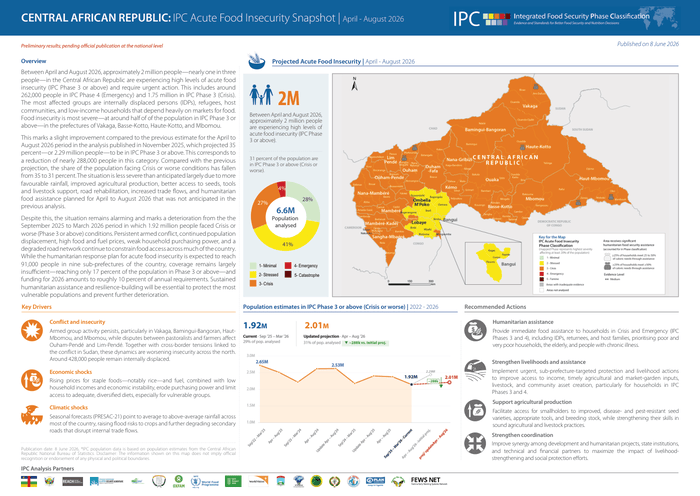
Country: Central African Republic Source: Integrated Food Security Phase Classification Please refer to the attached Infographic. Overview Between April and August 2026, approximately 2 million people—nearly one in three people—in the Central African Republic are experiencing high levels of acute food insecurity (IPC Phase 3 or above) and require urgent action. This includes around 262, 000 people in IPC Phase 4 (Emergency) and 1. 75 million in IPC Phase 3 (Crisis). The most affected groups are internally displaced persons (IDPs), refugees, host communities, and low-income households that depend heavily on markets for food. Food insecurity is most severe—at around half of of the population in IPC Phase 3 or above—in the prefectures of Vakaga, Basse-Kotto, Haute-Kotto, and Mbomou. This marks a slight improvement compared to the previous estimate for the April to August 2026 period in the analysis published in November 2025, which projected 35 percent—or 2. 29 million people—to be in IPC Phase 3 or above. This corresponds to a reduction of nearly 288, 000 people in this category. Compared with the previous projection, the share of the population facing Crisis or worse conditions has fallen from 35 to 31 percent. The situation is less severe than anticipated largely due to more favourable rainfall, improved agricultural production, better access to seeds, tools and livestock support, road rehabilitation, increased trade flows, and humanitarian food assistance planned for April to August 2026 that was not anticipated in the previous analysis. Despite this, the situation remains alarming and marks a deterioration from the the September 2025 to March 2026 period in which 1. 92 million people faced Crisis or worse (Phase 3 or above) conditions. Persistent armed conflict, continued population displacement, high food and fuel prices, weak household purchasing power, and a degraded road network continue to constrain food access across much of the country. While the humanitarian response plan for acute food insecurity is expected to reach 91, 000 people in nine sub-prefectures of the country, coverage remains largely insufficient—reaching only 17 percent of the population in Phase 3 or above—and funding for 2026 amounts to roughly 10 percent of annual requirements. Sustained humanitarian assistance and resilience-building will be essenti
Central African Republic: IPC Acute Food Insecurity Snapshot | April – August 2026

RELATED ARTICLES


