


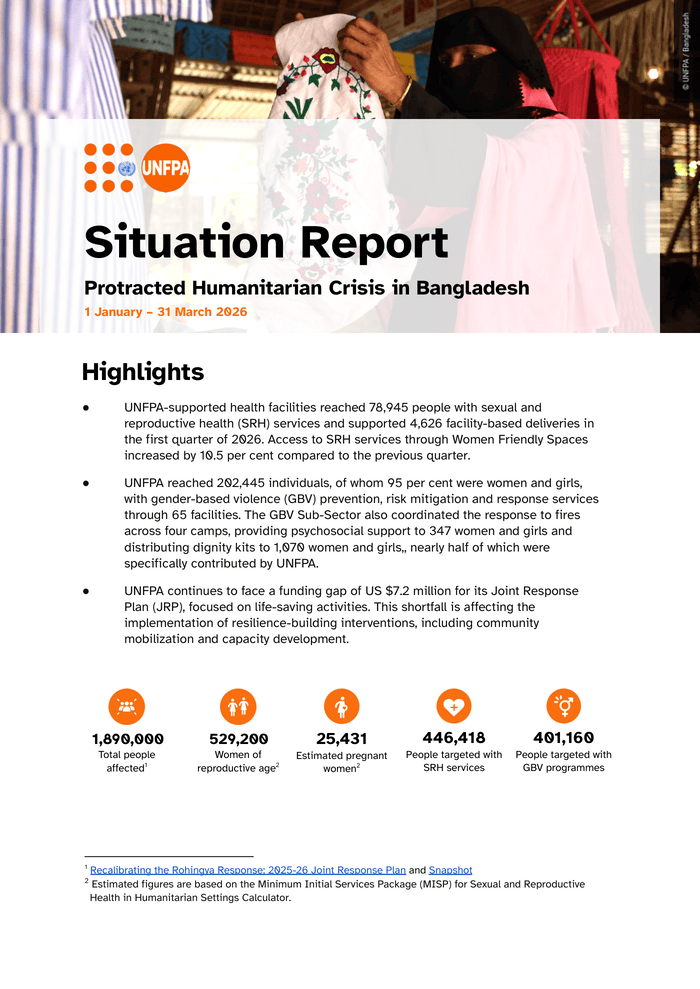
Countries: Bangladesh, Myanmar Source: United Nations Population Fund Please refer to the attached file. As of 31 March 2026, Bangladesh hosted nearly 1. 19 million registered Rohingya refugees, with women and girls comprising 51 per cent of the population. While maternal mortality declined by 20 per cent in 2025, preventable maternal deaths persist, and services face mounting strain due to declining funding and growing needs. Tensions have risen regarding long-term food security and the impact of a new food ration policy, with ongoing concerns about potential supply chain disruptions for essential goods and the upcoming monsoons, which may further exacerbate challenges for households. In response, UNFPA-supported facilities provided sexual and reproductive health (SRH) services to 78, 945 individuals and assisted with 4, 626 facility-based deliveries during the first quarter of 2026. Furthermore, UNFPA reached 202, 445 individuals with gender-based violence (GBV) prevention and response services through 65 facilities. The GBV Sub-Sector, led by UNFPA, also coordinated the response to fires across four camps, providing psychosocial support to 347 women and girls and distributing dignity kits to 1, 070 women and girls, nearly half of which were specifically contributed by UNFPA. UNFPA is appealing for US $20. 5 million to provide life-saving SRH and GBV services to Rohingya refugees and host communities. The $7. 2 million funding gap is affecting the implementation of resilience-building interventions, including community mobilization, community-based services, and capacity development.



GrowthPakistan brings you the latest news to keep an eye on Pakistan’s startup ecosystem. Business keeps you growing when you stay aware of your competitors' moves. GrowthPakistan offers Business, Tech, Global Tech, Global, Auto, and Startup News straight from industries all around the globe. This platform will help you identify upcoming opportunities not only in Pakistan but worldwide.
Email : growthpakistan@gmail.com
Whatsapp : +92320-9497079
© growthpakistan