


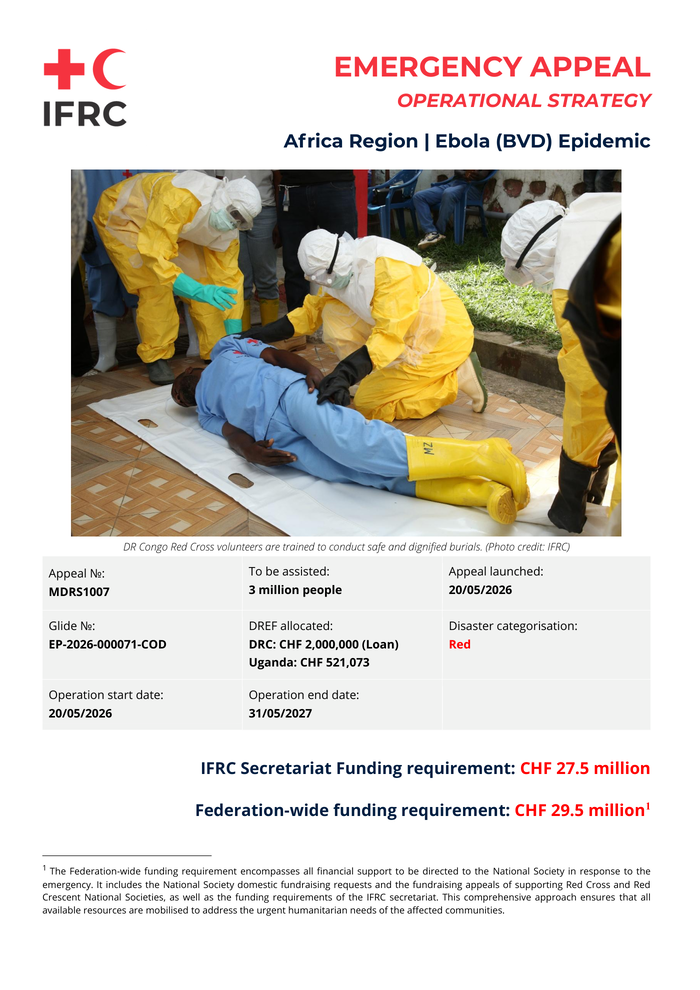
Countries: Democratic Republic of the Congo, Uganda Source: International Federation of Red Cross and Red Crescent Societies Please refer to the attached file. DESCRIPTION OF THE EVENT On 24 April 2026, a suspected viral haemorrhagic fever case was reported in eastern Democratic Republic of Congo (DRC). On 15 May, the Institut National de Recherche Biomédicale (INRB) in Kinshasa confirmed an outbreak of Bundibugyo Virus Disease (BVD), a strain of Ebola, in Ituri Province, DRC. The outbreak is reported to have originated in the Mongbwalu, Bunia, and Rwampara health zones of Ituri province. Uganda subsequently reported two imported cases in Kampala, highlighting the elevated risk of cross-border transmission and regional spread. On 15 May, Uganda’s Ministry of Health declared a BVD outbreak after confirming a case in a 59-year-old Congolese man treated in Kampala. On 17 May, the World Health Organisation (WHO) declared the outbreak a Public Health Emergency of International Concern (PHEIC), due to the risk of further spread within the region. 2 On 18 May, the Africa Centres for Disease Control (CDC) declared the outbreak a Public Health Emergency of Continental Security (PHECS). As of 2 June, the DRC had reported 116 suspected cases, 367 confirmed cases, and 72 confirmed deaths across 25 health zones in Ituri, North Kivu, and South Kivu provinces. In Uganda, 15 confirmed cases had been reported in Kampala and Wakiso, including one confirmed death. High population mobility is a major driver of cross-border BVD transmission. The DRC and Uganda are connected through established transport corridors, extensive trade networks, particularly those linked to mining activities in Ituri, and numerous informal border crossings. These linkages, reinforced by routine economic activity and access to services, increase the risk of transmission and underscore the need for strengthened surveillance, enhanced community engagement, and a coordinated cross-border response. At the same time, existing gaps in the DRC’s health system, combined in some areas with limited awareness of preventive measures and low levels of trust in health providers and epidemic responders, have contributed to the continued spread of the virus. Unlike previous outbreaks caused by Zaire ebolavirus, Bundibugyo virus currently has no licensed vaccine or specific targeted treatment. As a result, community-based interventions, early detection, supportive care and isolation, contact tracing, safe and dignified burials, and other public health and social measures are more critical than ever. Internationally, governments and health agencies have introduced precautionary measures to limit further spread. These include enhanced screening of travellers from affected countries, public health advisories, and the preparation of health systems to detect and manage potential imported cases. Concurrently, the WHO and partner organisations are scaling up response efforts in support of Ministries of Health in the affected areas. On 19 May 2026, the WHO Director-General convened the first meeting of the International Health Regulations (IHR) Emergency Committee, which issued temporary recommendations to States Parties on 22 May 2026. These recommendations underscore the importance of coordinated outbreak control, enhanced cross-border collaboration, and sustained surveillance and preparedness to prevent further regional spread and ensure an effective public health response.



GrowthPakistan brings you the latest news to keep an eye on Pakistan’s startup ecosystem. Business keeps you growing when you stay aware of your competitors' moves. GrowthPakistan offers Business, Tech, Global Tech, Global, Auto, and Startup News straight from industries all around the globe. This platform will help you identify upcoming opportunities not only in Pakistan but worldwide.
Email : growthpakistan@gmail.com
Whatsapp : +92320-9497079
© growthpakistan