

Country: Saint Vincent and the Grenadines Sources: International Federation of Red Cross and Red Crescent Societies, Saint Vincent and the Grenadines Red Cross Society Please refer to the attached file. Description St. Vincent and the Grenadines has been severely impacted by the effects of climate change (National Adaptation Plan, 2019). Global climate change projections shown temperatures are expected to either continue at or near record levels in the next 5 years causing an increase in climates risks and impacts (World Meteorological Organization, 2025). According to those projections, we can expect a drier and hotter Saint Vincent and the Grenadines with less natural coastal defence structures (mangroves, coral reefs, sand dunes) to buffer more intense and more frequent storm systems. The SVG Meteorological Office has reported in the National Rainfall Outlook for March to May, 2026 that drought conditions are forecast for SVG in the months ahead (March 2026). This information correlates with releases from the Central Water and Sewage Authority in January 2026 which stated that rainfall during the 2025 wet season ending in December was 687. 1 mm, down from 1552. 0 mm in 2024 which meant that water rationing nationally would be implemented sooner than expected and last for extended periods. This is significant since this period allows for the capturing of water in preparation for the dry season from January to June of the following year. As it stands, the Grenadines which possess no rivers are the most severely affected given the absence of any rivers and the traditional reliance on rainwater harvesting during the wet season for water during the remainder of the year. Geography presents a constraint in access to goods and services in the Grenadines. A lack of price regulation nationally translates into increase cost of goods on the Grenadine islands which puts additional strain on the already economically vulnerable. After hurricane Beryl in 2024, where 90% of the housing infrastructure was destroyed, the number of persons in this category has increased. In 2026, the Prime Minister, Dr. Godwin Friday stated that some homes are yet to be rebuilt alongside the business infrastructure necessary for the restoration of livelihoods. Roofs are needed on houses to harvest rainwater into tanks/barrels which were also largely destroyed during hurricane Beryl. This situation remains at the forefront of the minds of residents with unofficial sources reporting an increase in negative coping mechanisms such as an increase in alcohol consumption and smoking. The elderly, school aged children, single and pregnant mothers are the most vulnerable especially with two months remaining in the dry season. These groups make up roughly 33% of the population of the Grenadines. Request For Assistance Government Requests International Assistance: No NS Requests International Assistance; No Information Bulletin Published No Actions taken by National Society General Water & Sanitation Summary The SVG Red Cross has provided volunteers to assist with one water distribution on Bequia. The situation on the ground is being monitored by community Red Cross groups and CDRTs. Actions taken by others Water Mission in partnership with CWSA, an NGO, has started some water distributions on Bequia and Union Island. Those persons who are able to, have been buying water. Persons have been trying to access receptacles for storing water including black tanks and barrels.
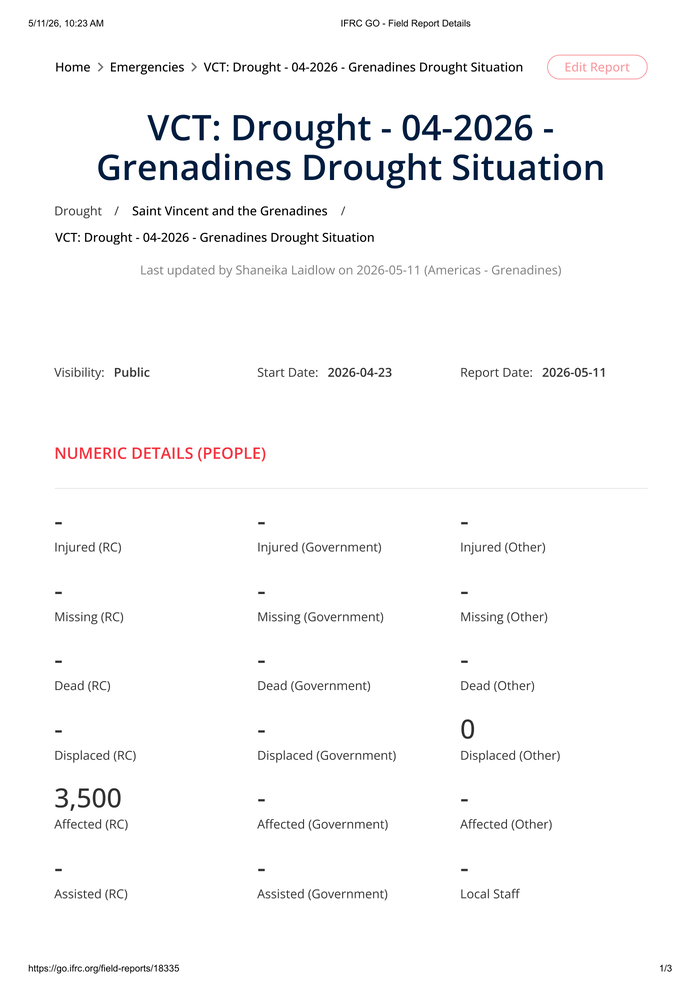
St. Vincent & Grenadines: VCT: Drought – 04-2026 – Grenadines Drought Situation (2026-05-11)

RELATED ARTICLES


