

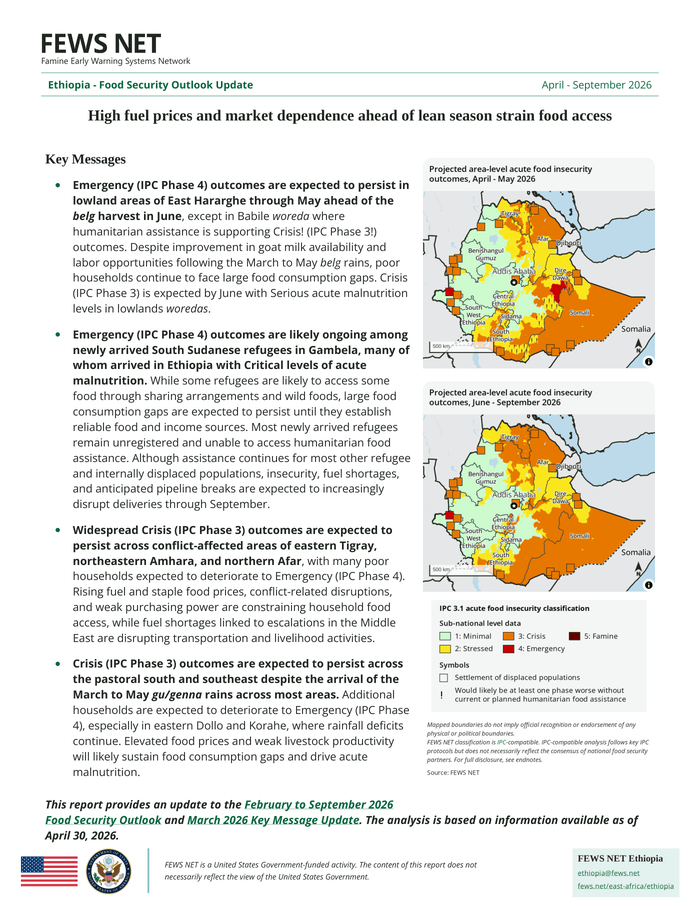
Country: Ethiopia Source: Famine Early Warning System Network Please refer to the attached file. Key Messages Emergency (IPC Phase 4) outcomes are expected to persist in lowland areas of East Hararghe through May ahead of the belg harvest in June, except in Babile woreda where humanitarian assistance is supporting Crisis! (IPC Phase 3!) outcomes. Despite improvement in goat milk availability and labor opportunities following the March to May belg rains, poor households continue to face large food consumption gaps. Crisis (IPC Phase 3) is expected by June with Serious acute malnutrition levels in lowlands woredas. Emergency (IPC Phase 4) outcomes are likely ongoing among newly arrived South Sudanese refugees in Gambela, many of whom arrived in Ethiopia with Critical levels of acute malnutrition. While some refugees are likely to access some food through sharing arrangements and wild foods, large food consumption gaps are expected to persist until they establish reliable food and income sources. Most newly arrived refugees remain unregistered and unable to access humanitarian food assistance. Although assistance continues for most other refugee and internally displaced populations, insecurity, fuel shortages, and anticipated pipeline breaks are expected to increasingly disrupt deliveries through September. Widespread Crisis (IPC Phase 3) outcomes are expected to persist across conflict-affected areas of eastern Tigray, northeastern Amhara, and northern Afar, with many poor households expected to deteriorate to Emergency (IPC Phase 4). Rising fuel and staple food prices, conflict-related disruptions, and weak purchasing power are constraining household food access, while fuel shortages linked to escalations in the Middle East are disrupting transportation and livelihood activities. Crisis (IPC Phase 3) outcomes are expected to persist across the pastoral south and southeast despite the arrival of the March to May gu/genna rains across most areas. Additional households are expected to deteriorate to Emergency (IPC Phase 4), especially in eastern Dollo and Korahe, where rainfall deficits continue. Elevated food prices and weak livestock productivity will likely sustain food consumption gaps and drive acute malnutrition.
Ethiopia Food Security Outlook Update: High fuel prices and market dependence ahead of lean season strain food access, April – September 2026

RELATED ARTICLES


