


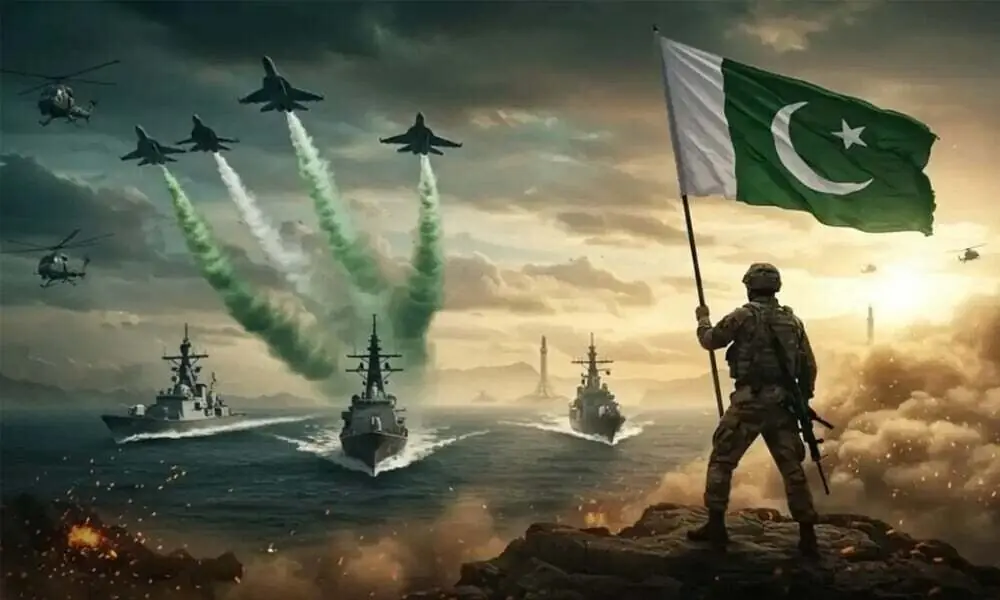
EDITORIAL: A year on from the brief but fraught armed conflict between India and Pakistan, analysts are now issuing worrying warnings that another confrontation is becoming more likely and could also prove far more perilous, with escalation risks extending into the nuclear domain. That is a prospect that should be unthinkable in any rational order, yet is becoming harder to dismiss in a geopolitical environment increasingly untethered from international law. Last year’s crisis, triggered by India’s reckless cross-border action under the pretext of avenging the Pahalgam incident ended in a sharp reversal for New Delhi, most visibly in the downing of multiple Indian fighter jets by the Pakistan Air Force, underscoring its operational brilliance and the air forces’ top command’s agility in calibrating a swift and multi domain, truly effective response. But the Modi government still appears inclined to test the limits again, driven both by a desire to avenge that humiliation and mounting domestic pressures, particularly on the economic front, that make external confrontation a tempting diversion. Moreover, a recent Washington Post editorial points towards a dangerous lesson that India may have drawn from last year: that a limited conventional war can be fought without crossing the nuclear threshold. In the fog of war, however, escalation pathways are neither linear nor controllable, and miscalculation can swiftly push events towards the unthinkable. The risks were already evident during Operation Sindoor when India struck the vicinity of the Nur Khan Airbase, dangerously close to the National Command Authority’s headquarters. That move is the point that prompted intervention by the Trump Administration to contain a conflict that was rapidly approaching the brink. In any future crisis, however, India may prove less receptive to international pressure, given the opprobrium the Modi regime faced from the opposition as a result of President Trump’s repeated assertions of having played a central role in halting the conflict. As one analysis in Foreign Affairs notes, both countries are now treating the last exchange as a blueprint, identifying gaps to close and advantages to exploit should hostilities recur. For Pakistan, this demands readiness across all domains: military, diplomatic, economic, and strategic. The challenge is exacerbated by India suspending the Indus Waters Treaty, alongside manipulating river flows into Pakistan. Having already termed the treaty’s suspension an act of war, Islamabad must factor escalating water tensions into its broader preparedness calculus. It bears noting that regimes practicing exclusionary politics built on hatred towards communities and countries often struggle to demonstrate competence in the more demanding domains of governance as their political energy is consumed by division rather than delivery. In the BJP’s case, its anti-Muslim and anti-Pakistan rhetoric has fostered a climate in which a generation has been conditioned into viewing Pakistan through a lens of hostility and dehumanisation. That narrative has boxed the Indian leadership into a corner where it cannot even begin to consider the most rational option i. e. , de-escalation and dialogue, as that risk political suicide after a decade entrenching a hard-line anti-Pakistan narrative. Combined with the aftershocks of last year’s humiliation and growing agitation over Pakistan’s pre-eminent diplomatic positioning on the global stage, the space for restraint in India may have narrowed further, heightening the risk that its rulers’ domestic compulsions and divisive politics could push it towards another confrontation with Pakistan. There are two basic truths that regional actors continue to overlook to their disadvantage. First, geography is immutable, which means neighbours cannot be wished away. And second, conflict between nuclear-armed nations cannot be a viable option, given the unthinkable consequences any escalation could unleash. Dialogue, therefore, must remain the only responsible constant. But given India’s current posture, Pakistan must remain prepared across all fronts, whether on the battlefield, over water resources, or in the diplomatic arena. Copyright Business Recorder, 2026



GrowthPakistan brings you the latest news to keep an eye on Pakistan’s startup ecosystem. Business keeps you growing when you stay aware of your competitors' moves. GrowthPakistan offers Business, Tech, Global Tech, Global, Auto, and Startup News straight from industries all around the globe. This platform will help you identify upcoming opportunities not only in Pakistan but worldwide.
Email : growthpakistan@gmail.com
Whatsapp : +92320-9497079
© growthpakistan