

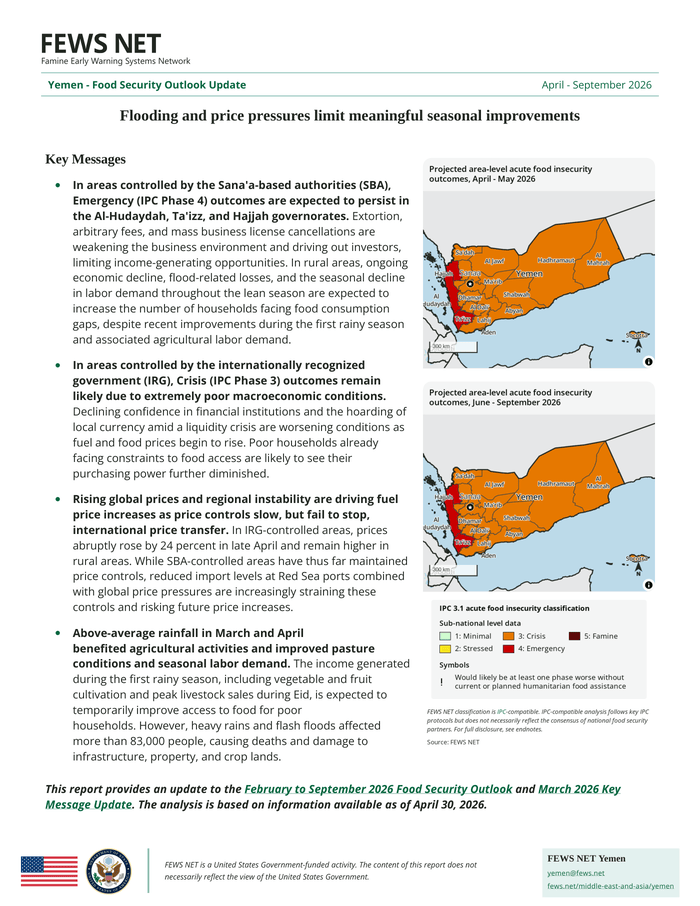
Country: Yemen Source: Famine Early Warning System Network Please refer to the attached file. Key Messages In areas controlled by the Sana’a-based authorities (SBA), Emergency (IPC Phase 4) outcomes are expected to persist in the Al-Hudaydah, Ta’izz, and Hajjah governorates. Extortion, arbitrary fees, and mass business license cancellations are weakening the business environment and driving out investors, limiting income-generating opportunities. In rural areas, ongoing economic decline, flood-related losses, and the seasonal decline in labor demand throughout the lean season are expected to increase the number of households facing food consumption gaps, despite recent improvements during the first rainy season and associated agricultural labor demand. In areas controlled by the internationally recognized government (IRG), Crisis (IPC Phase 3) outcomes remain likely due to extremely poor macroeconomic conditions. Declining confidence in financial institutions and the hoarding of local currency amid a liquidity crisis are worsening conditions as fuel and food prices begin to rise. Poor households already facing constraints to food access are likely to see their purchasing power further diminished. Rising global prices and regional instability are driving fuel price increases as price controls slow, but fail to stop, international price transfer. In IRG-controlled areas, prices abruptly rose by 24 percent in late April and remain higher in rural areas. While SBA-controlled areas have thus far maintained price controls, reduced import levels at Red Sea ports combined with global price pressures are increasingly straining these controls and risking future price increases. Above-average rainfall in March and April benefited agricultural activities and improved pasture conditions and seasonal labor demand. The income generated during the first rainy season, including vegetable and fruit cultivation and peak livestock sales during Eid, is expected to temporarily improve access to food for poor households. However, heavy rains and flash floods affected more than 83, 000 people, causing deaths and damage to infrastructure, property, and crop lands. This report provides an update to the February to September 2026 Food Security Outlook and March 2026 Key Message Update. The analysis is based on information available as of April 30, 2026.
Yemen Food Security Outlook Update, April – September 2026: Flooding and price pressures limit meaningful seasonal improvements

RELATED ARTICLES


