


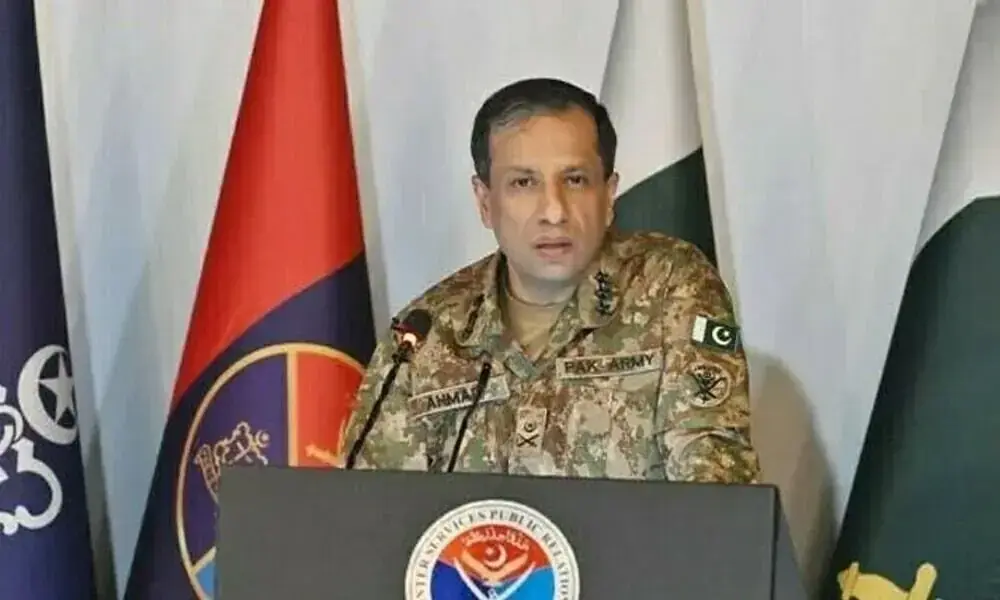
ISLAMABAD: A year after the military confrontation with India that Pakistan has officially labelled “Operation Marka-e-Haq” (Battle of Truth), the military’s media wing on Thursday presented a detailed strategic assessment of the conflict, claiming that it had fundamentally altered regional perceptions, dismantled New Delhi’s narrative on cross-border terrorism, and re-established the inviolability of deterrence between the two nuclear-armed neighbours. Addressing a press conference at the Inter-Services Public Relations (ISPR) headquarters, Director General Lt Gen Ahmed Sharif Chaudhry — flanked by senior officers from the Navy and Air Force — outlined what he termed “10 strategic consequences” of the episode that unfolded between April 22 and May 10, 2025. The briefing marked the first anniversary of the ceasefire that ended the escalation, which Pakistan refers to as its “Bunyan-ul-Marsoos” counter-offensive following the Pahalgam attack. READ MORE: Operation ‘Bunyan ul Marsoos’: Pakistan destroys Udhampur airbase, Pathankot airfield in India, state media reports “Today we are not going to revisit operational details that everyone already knows. The purpose is to explain the long-term strategic consequences that have emerged after the conflict, ” Lt Gen Chaudhry said. Collapse of Indian narrative: The first and most significant consequence, according to the military spokesperson, was the “burial” of India’s longstanding campaign to portray Pakistan as a sponsor of terrorism. He noted that in the year since the Pahalgam incident — in which 26 civilians were killed — India had failed to provide any evidence linking Pakistan to the attack. He claimed that international journalists who visited the sites of Indian strikes found civilian casualties, including women and children, undermining New Delhi’s claims of targeting militant infrastructure. “This narrative of terrorism is buried forever. Nobody buys this anymore, ” he asserted. The second consequence, he said, was Pakistan’s emergence as a “net regional stabilizer”. Unlike India, which escalated based on “fabricated claims”, Pakistan demonstrated restraint and mature escalation control — a critical factor between two nuclear neighbours, he added. Politicisation of Indian military: In a striking observation, Lt Gen Chaudhry pointed to what he called the “politicisation of Indian military leadership and militarisation of Indian political leadership” as the third strategic outcome. He alleged that Indian political leaders, driven by Hindutva ideology, had pressured military officials into making politically motivated statements. “You heard their air chief marshal a few months after Marka-e-Haq saying, ‘I got to know today that even we downed some planes. ’ That is politicisation of the military leadership. Why are you trying to make jokers out of your admirals and generals? ” he asked. He warned that the blurring of lines between military professionalism and political ambition was “dangerous” for any country. The fourth consequence, he said, was growing global recognition that India externalises its internal problems — such as the treatment of minorities and the Kashmir dispute — while internalising international disputes. “Kashmir is an internationally recognised dispute. You cannot make demographic changes there, ” he said. Indian media ‘discredited’: The DG ISPR also took aim at Indian media, claiming the fifth consequence was the “exposure of the true face of Indian media and its discredited information operations”. He accused Indian authorities of blocking Pakistani digital platforms and social media accounts during and after the conflict, but argued that misinformation had irreparably damaged the credibility of Indian news outlets internationally. “The only thing that survives in today’s information domain is truth, ” he said. The sixth consequence, according to Lt Gen Chaudhry, was the reaffirmation that modern warfare has transformed into multi-domain operations encompassing land, sea, air, cyber, and cognitive domains. He said Pakistan’s armed forces had demonstrated readiness across all these arenas during the conflict. The seventh and eighth consequences were Pakistan’s proven resilience against multifaceted threats and the “loud and clear” re-establishment of deterrence. “Anyone who thinks there is space for war between two nuclear neighbours is crazy. Only a madman can think that, ” he said. The ninth consequence was Pakistan’s elevated geopolitical standing as a responsible middle power. The tenth and “most important”, he said, was the “Bunyan-ul-Marsoos effect” — strengthened synergy between the people, government, and armed forces across ethnic and class lines. Air Force claims 8 confirmed kills: Air Vice Marshal Tariq Ghazi, Deputy Chief of Air Staff (Projects), provided specific operational claims. He said the Pakistan Air Force (PAF) initially adopted a strong defensive posture, which later transitioned to an offensive stance. “The tally is at 8-0, ” he said, elaborating that confirmed kills included four Rafale, one Su-30, one MiG-29, one Mirage 2000 and one “expensive multi-role unmanned aerial system”. He added that several other aircraft were damaged and deemed unrecoverable. “The IAF was not to be seen in the air for the rest of the conflict, ” AVM Ghazi claimed. He further stated that PAF strike assets — including killer drones, stand-off long-range weapons, and hypersonic vectors — hit 16 Indian air bases, critical command and control centres (including Barnala), BrahMos missile sites, and two S-400 air defence batteries. Copyright Business Recorder, 2026



GrowthPakistan brings you the latest news to keep an eye on Pakistan’s startup ecosystem. Business keeps you growing when you stay aware of your competitors' moves. GrowthPakistan offers Business, Tech, Global Tech, Global, Auto, and Startup News straight from industries all around the globe. This platform will help you identify upcoming opportunities not only in Pakistan but worldwide.
Email : growthpakistan@gmail.com
Whatsapp : +92320-9497079
© growthpakistan