


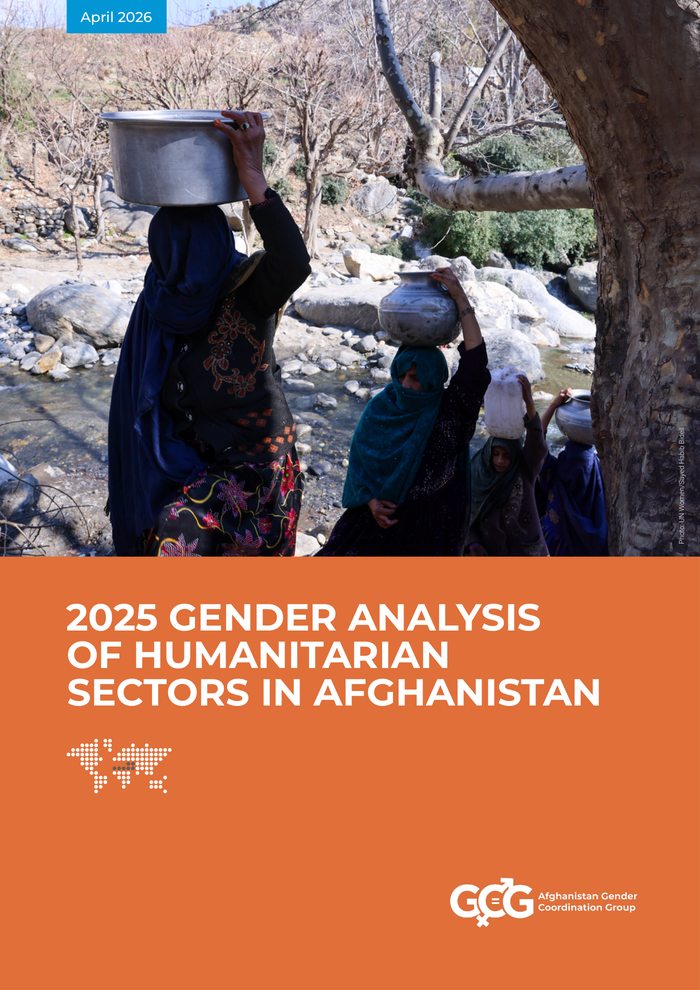
Country: Afghanistan Sources: Asia Pacific Gender in Humanitarian Action Working Group, UN Women Please refer to the attached file. EXECUTIVE SUMMARY The present Gender Analysis of Humanitarian Sectors in Afghanistan examines how overlapping crises, including economic decline, environmental hazards, migration pressures, and intensified restrictions under the de facto authorities (DfA), are shaping humanitarian needs and access to services for women and girls in Afghanistan. Drawing primarily upon Whole of Afghanistan Assessment (WoAA) 2025 data, triangulated with Gender in Humanitarian Action1 and Humanitarian Access Working Groups (GiHA WG/HAWG) gender and access survey tracking, perception data, and protection and return monitoring, this gender analysis highlights how structural gender inequality and operational constraints on women humanitarian workers’ participation are deepening deprivation, reducing access to services, and limiting women’s ability to influence humanitarian assistance in Afghanistan. A consistent pattern has emerged across all humanitarian sectors, with women and girls in Afghanistan facing multiple and intersecting risks, most acutely within women-headed households (WHHs), and among women living in men-headed households (MHHs). The data analysed for this gender analysis indicates that compared to MHHs, WHHs are overwhelmingly headed by widows report frequently functional difficulties, within an already highly constrained setting, has further constrained mobility, income generation, and access to information and services. Moreover, the impacts of the multiple overlapping crises borne by households are intensified by repeated shocks and large scale returns, which increased the strains felt by households and increased exposure to insecurity, eviction risks, and use of harmful coping mechanisms, particularly for women who have fewer protective options and limited social support. Pervasive access and accountability gaps persist. Women frequently lack clear information on how to access humanitarian assistance, how targeting decisions are made, and how to safely provide feedback. Mobility constraints, prevailing social norms, and limited presence of women aid workers continue to hamper safe access and weaken women-centred accountability. These gaps extend to hazard communication, as women are routinely excluded from preparedness and early‐warning information, essential for safe coping and recovery. Sector-specific findings show interlinked pressures across food security, livelihoods, and protection. Food insecurity remains very high, with women, especially within WHHs, more exposed to hunger and more likely to rely on negative coping that can harm boys and girls. Livelihood opportunities for women remain constrained and increasingly home-based, amid limited access to markets, documentation and financial services. These constraints are contributing to a cycle in which many households absorb shocks through strategies that heighten protection risks, including child labour, school withdrawal, and early marriage. Protection concerns cut across household types. WHHs report higher levels of tension associated with the reintegration of returnees and resulting pressures on host communities, including service denial, psychosocial stress, and child distress. Essential services remain difficult to reach for many women and children while funding cuts have further reduced the availability of services. Restrictions, geographic distance, and insufficient availability of health and nutrition services are limiting access, contributing to persistent risks for mothers, adolescent girls, and young children. Shelter, winterization and water, sanitation and hygiene (WASH) needs also remain critically elevated, with women in both WHHs and MHHs reporting the highest prevalence of crowded and unsafe living conditions, precarious tenure arrangements and documentation barriers, and WASH constraints that heighten health and protection risks, especially during winter and in shock-affected or displacement settings. This gender analysis thus points to a continuously reinforcing cycle. Restrictions on women’s mobility and participation, combined with economic strain, funding cuts to humanitarian programmes, shocks and migration pressures that are pushing women and girls across Afghanistan into deeper deprivation and higher protection risks – while limiting their ability to access, shape, and benefit from humanitarian assistance and livelihood opportunities. The findings underscore the need for integrated, gender-responsive programming that prioritizes WHHs, women returnees, adolescent girls, and other high-risk women and girls, strengthens safe access and accountability, and reduces reliance on harmful coping mechanisms, particularly in shock-affected and return contexts.



GrowthPakistan brings you the latest news to keep an eye on Pakistan’s startup ecosystem. Business keeps you growing when you stay aware of your competitors' moves. GrowthPakistan offers Business, Tech, Global Tech, Global, Auto, and Startup News straight from industries all around the globe. This platform will help you identify upcoming opportunities not only in Pakistan but worldwide.
Email : growthpakistan@gmail.com
Whatsapp : +92320-9497079
© growthpakistan