

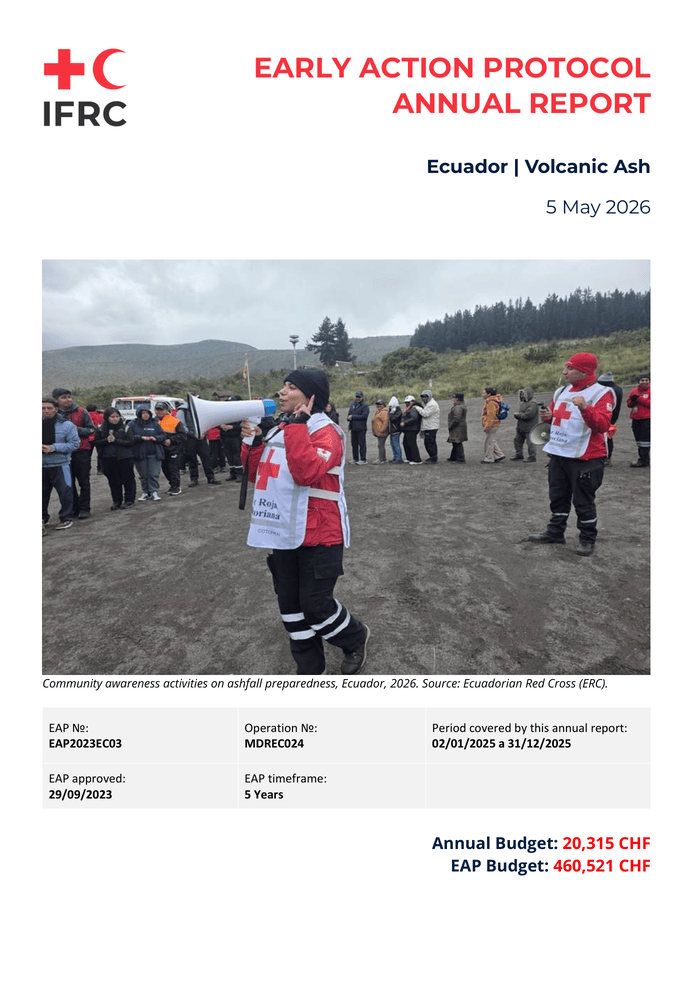
Country: Ecuador Source: International Federation of Red Cross and Red Crescent Societies Please refer to the attached file. SUMMARY OF THE EARLY ACTION PROTOCOL The IFRC Disaster Response Emergency Fund (DREF) has allocated CHF 460, 521 for the implementation of anticipatory actions to reduce and mitigate the impact of the Dispersion and Fall of Volcanic Ash in Ecuador. This Early Action Protocol includes an allocation of CHF 296, 404 to preposition stock and undertake annual readiness activities in order to implement early actions, if and when the trigger is reached. The early actions to be conducted have been pre-agreed with the National Society and are described in the Early Action Protocol summary. This report summarizes the annual readiness and prepositioning activities implemented during year two (2025), covering the period from 02 January 2025 to 31 December 2025. The report also includes any changes or updates made to the initially agreed plan. Summary During the second year of implementation of the Volcanic Ash Early Action Protocol (Volcanic Ash EAP), the Ecuadorian Red Cross (ERC) strengthened its preparedness capacity through the prepositioning of essential supplies in strategic warehouses at National Headquarters. These included 10, 000 KN95 masks, 3, 500 protective eyewear units and 6, 000 swimming goggles for children, ensuring the availability of key items to protect communities in the event of volcanic ashfall. In parallel, within the framework of the Emergency Appeal (MDREC027: Ecuador – Floods), the replenishment and prepositioning of additional relief items were carried out following their distribution during emergency operations. These supplies supported rapid humanitarian response efforts to emergencies associated with the rainy season, particularly in coastal provinces, as well as the 2025 oil spill in Esmeraldas Province. As a result, 4, 170 jerrycans, 2, 000 tarpaulins and 1, 540 tool kits were replenished and strategically prepositioned to strengthen operational readiness. Institutional preparedness was further reinforced through the socialization of the Volcanic Ash EAP with provincial branch coordinators, volunteers, National Headquarters management and operational units. These sessions detailed key operational components related to health, livelihoods, management and information processes, with the support of the administrative-financial, planning and communications departments. In addition, through its Information Management unit, the ERC continues to monitor eruptive activity in priority volcanoes, including Tungurahua, Cotopaxi and Guagua Pichincha, classified as very high threat, as well as Reventador, Cayambe and Sangay, categorized as high threat. Regional knowledge exchange was also promoted through coordination with the Colombian Red Cross and the Paraguayan Red Cross. These exchanges focused on lessons learned from the 2020 activation of the protocol and contributed to the ongoing validation and strengthening of the current plan. Finally, as part of community preparedness and coordination actions implemented jointly with the Geophysical Institute of the National Polytechnic School (IGEPN), the First National Meeting of Volcanic Observers was rescheduled from 25 October 2025 to 21 February 2026 at Cotopaxi National Park due to the simultaneous emergencies occurring in the country. The meeting aims to strengthen community-based volcanic monitoring, enhance understanding of volcanic risk and promote responsible information exchange between technical institutions and community observers.
Ecuador | Volcanic Ash: Early Action Protocol Annual Report (EAP2023EC03| MDREC024), 5 May 2026

RELATED ARTICLES


