


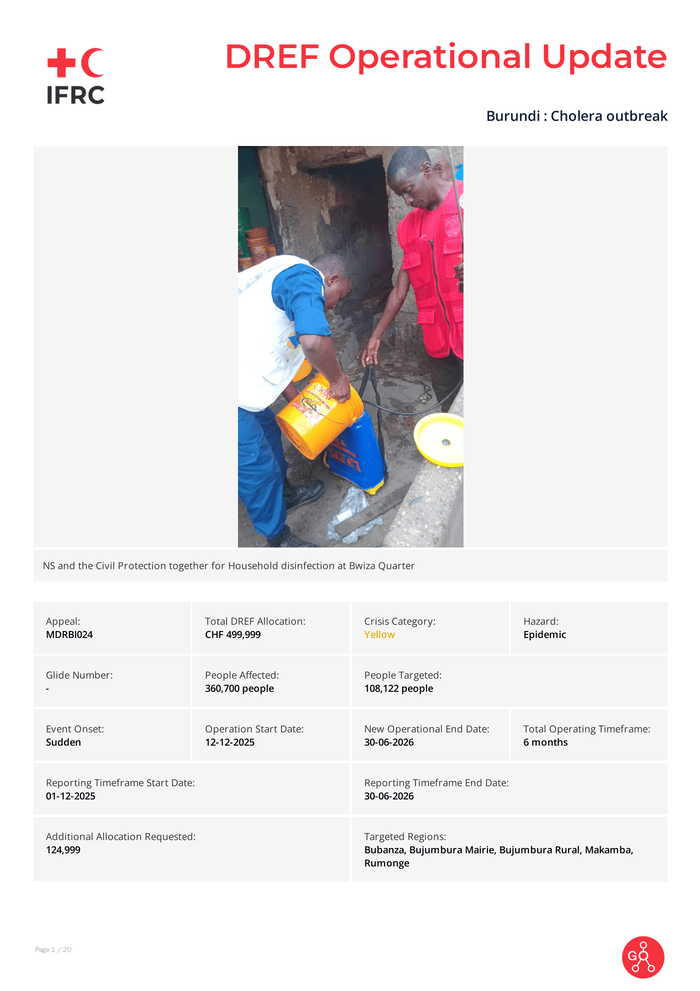
Country: Burundi Source: International Federation of Red Cross and Red Crescent Societies Please refer to the attached file. Description of the Event Date of event 07-12-2025 What happened, where and when? Since early 2025, cholera has reappeared in Burundi after several years without an outbreak. This is due to the lack of clean drinking water in the region, which has forced the population to fetch water from Lake Tanganyika and runoff. This situation is exacerbated by poor hygiene and inadequate sanitation, with schools lacking proper latrines. While the initial outbreaks in the north and center (Cibitoke, Bubanza, Bujumbura, and Rumonge) were relatively contained, transmission has surged in recent weeks in the Lake Nyanza health district, where the number of daily cases now frequently exceeds 50. On 27 November, the first case of cholera was identified in the Lac Nyanza health district, specifically in the Sangtaire area. From that point, the outbreak has taken another turn with an increase in cases as shown in the MoH SITREP of 7 December 2025. Between 27 November and 07 December, the cholera outbreak has continued to expand, intensifying in recent weeks, especially since late November. Between late November and early December 2025, with cumulative cases rising from 2, 689 on 29 November to 2, 968 on 7 December, indicating 279 new cases within one week. The epicentre remains Nyanza-Lac, which consistently reports the majority of new cases and active caseloads in all SITREPs. The escalation is compounded by flooding and deteriorating water and sanitation conditions, heightening the risk of further spread among vulnerable communities. Furthermore, given the significant population movement from the DRC into Burundi, the risk of cross‐border spread of cholera remains high. This recent surge is further aggravated by flooding caused by heavy rains during the 2025– 2026 agricultural season, which contaminates water sources, worsens sanitation conditions, and thereby facilitates the rapid spread of the disease among the most vulnerable communities. As of April, 12th, 2026, following the combined efforts of various stakeholders, particularly the Regional Health Commission (CRB), the outbreak declared in the Nyanza Lac Health District was quickly brought under control. However, an increase in cases was observed in the Mukaza, Kamenge, and Mutimbuzi Health Districts within the Bujumbura Municipality. According to the Ministry of Health (MoH) situation report published on April 13, 2026, there is a cumulative total of 806 cases, including 37 active cases. Among the 37 active cases, 15 are new cases from Mutimbuzi (7 cases from the Tenga neighborhood), Kamenge (4 cases from the Buterere and Uwinterekwa neighborhoods), and Mukaza (4 cases from the Bwiza and Buyenzi neighborhoods).



GrowthPakistan brings you the latest news to keep an eye on Pakistan’s startup ecosystem. Business keeps you growing when you stay aware of your competitors' moves. GrowthPakistan offers Business, Tech, Global Tech, Global, Auto, and Startup News straight from industries all around the globe. This platform will help you identify upcoming opportunities not only in Pakistan but worldwide.
Email : growthpakistan@gmail.com
Whatsapp : +92320-9497079
© growthpakistan