


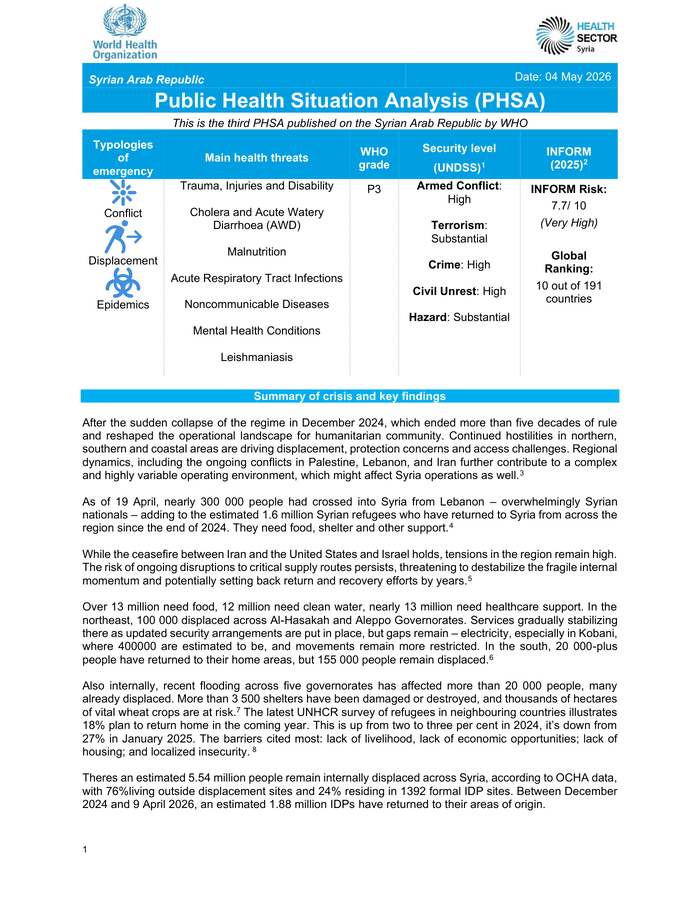
Country: Syrian Arab Republic Source: World Health Organization Please refer to the attached file. Summary of crisis and key findings After the sudden collapse of the regime in December 2024, which ended more than five decades of rule and reshaped the operational landscape for humanitarian community. Continued hostilities in northern, southern and coastal areas are driving displacement, protection concerns and access challenges. Regional dynamics, including the ongoing conflicts in Palestine, Lebanon, and Iran further contribute to a complex and highly variable operating environment, which might affect Syria operations as well. 3 As of 19 April, nearly 300 000 people had crossed into Syria from Lebanon – overwhelmingly Syrian nationals – adding to the estimated 1. 6 million Syrian refugees who have returned to Syria from across the region since the end of 2024. They need food, shelter and other support. 4 While the ceasefire between Iran and the United States and Israel holds, tensions in the region remain high. The risk of ongoing disruptions to critical supply routes persists, threatening to destabilize the fragile internal momentum and potentially setting back return and recovery efforts by years. 5 Over 13 million need food, 12 million need clean water, nearly 13 million need healthcare support. In the northeast, 100 000 displaced across Al-Hasakah and Aleppo Governorates. Services gradually stabilizing there as updated security arrangements are put in place, but gaps remain – electricity, especially in Kobani, where 400000 are estimated to be, and movements remain more restricted. In the south, 20 000-plus people have returned to their home areas, but 155 000 people remain displaced. 6 Also internally, recent flooding across five governorates has affected more than 20 000 people, many already displaced. More than 3 500 shelters have been damaged or destroyed, and thousands of hectares of vital wheat crops are at risk. 7 The latest UNHCR survey of refugees in neighbouring countries illustrates 18% plan to return home in the coming year. This is up from two to three per cent in 2024, it’s down from 27% in January 2025. The barriers cited most: lack of livelihood, lack of economic opportunities; lack of housing; and localized insecurity. 8 Theres an estimated 5. 54 million people remain internally displaced across Syria, according to OCHA data, with 76%living outside displacement sites and 24% residing in 1392 formal IDP sites. Between December 2024 and 9 April 2026, an estimated 1. 88 million IDPs have returned to their areas of origin. Challenges in service delivery, workforce shortages, and limited primary health care (PHC) capacity hinder both access and quality of care, resulting in low PHC utilization rates. Public health financing is severely constrained, forcing households to pay high out-of-pocket costs, while Syria’s traditional hospital-centric, curative-care model no longer matches current health needs. 9 Since the power shift in Damascus on 8 December 2024, the Syria continues to face complex and evolving mobility dynamics. The country’s humanitarian, political, demographic, and recovery landscape has undergone significant changes, and while opportunities for return have emerged across Syria’s 14 governorates, population movements remain fluid and closely linked to developments in the security situation. 10



GrowthPakistan brings you the latest news to keep an eye on Pakistan’s startup ecosystem. Business keeps you growing when you stay aware of your competitors' moves. GrowthPakistan offers Business, Tech, Global Tech, Global, Auto, and Startup News straight from industries all around the globe. This platform will help you identify upcoming opportunities not only in Pakistan but worldwide.
Email : growthpakistan@gmail.com
Whatsapp : +92320-9497079
© growthpakistan