


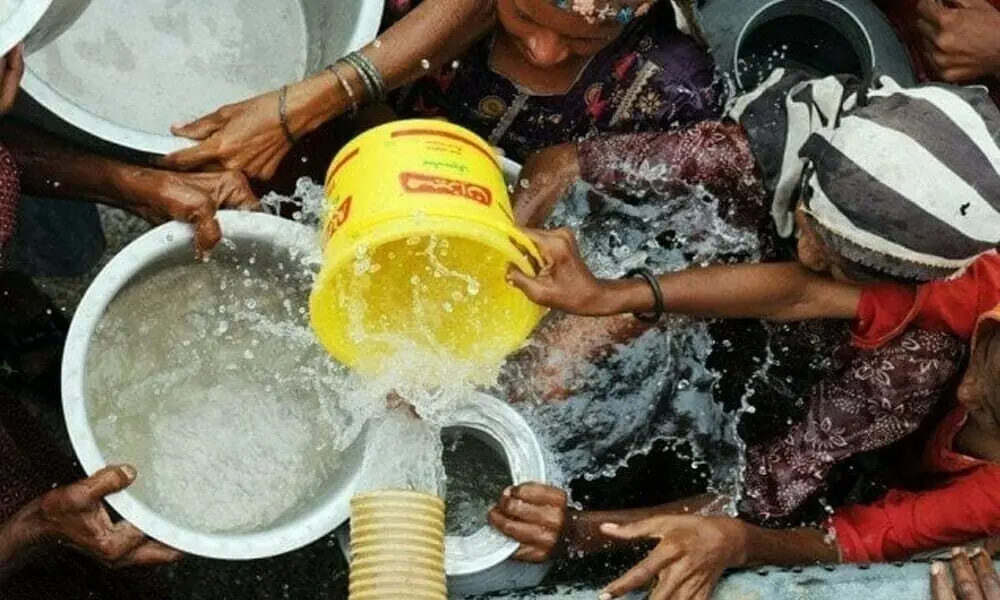
KARACHI: The opposition rattled the Sindh Assembly on Monday by forcefully raising Karachi’s worsening water crisis, prolonged power outages and governance failures, while the treasury maintained that concrete efforts were under way to improve utility services and address citizens’ hardships across the province. Replying to written and supplementary questions related to the Local Government Department, Parliamentary Secretary for Local Government Siraj Qasim Soomro informed the House that the Sindh government was taking serious steps to ensure water supply in line with public needs and to overcome Karachi’s chronic shortage. He said that under the TP-1 project, water supply capacity currently stood at 45 million gallons per day (MGD), which would be increased to 100 MGD by December. However, members of the opposition, particularly from the MQM, painted a grim picture. MQM lawmakers Adil Askari and Ijazul Haq told the Assembly that around 1. 5 million residents of Orangi Town were deprived of even a single drop of water. Responding, Siraj Qasim Soomro said infrastructure development was in progress and admitted that water distribution in Karachi faced multiple challenges. He emphasised the need for water conservation across Sindh. Raising similar concerns about Hyderabad, MQM member Sabir Kaimkhani said the city required nearly 100 MGD of water and questioned when its non-functional treatment plants would be restored. The parliamentary secretary replied that in districts other than Karachi, water supply fell under the jurisdiction of the Public Health Engineering Department. The House was also briefed on solid waste management. Siraj Qasim Soomro said the first phase of the Jam Chakro Garbage Transfer Station had been completed and that Sindh Solid Waste Management Board was operating in Hyderabad, Larkana and Sukkur as well. He regretted that many citizens continued to dump garbage outside their homes and explained that waste was transported through three transfer points before reaching landfill sites. He conceded that garbage collection in Karachi was not fully satisfactory but said efforts for improvement were ongoing. On the issue of plastic bags, MQM member Shariq Jamal pointed out that despite a ban, plastic bags were still being widely used and discarded. Responding to questions on water augmentation, Siraj Qasim Soomro said the federal and provincial governments had jointly decided to pursue desalination for Karachi. He recalled that the project was approved in 2004 and that a fresh feasibility study meeting international standards had now been ordered. MQM member Dr Fouzia Hameed criticized delays in the K-IV project, saying that despite MOUs signed during the President’s recent visit to China, Karachiites continued to suffer. She questioned why, after more than two decades, the project was now being termed flawed and blamed incompetent consultants for the situation. Siraj Qasim Soomro responded that the K-IV project had been taken over by the federal government in 2019. He said the project cost had risen from Rs25 billion to Rs100 billion and claimed that required pipelines had already been laid. According to him, the executing company expected completion in 2026, though he believed it would realistically be completed in 2027, followed by augmentation works. He added that part of a BRT line was also linked to K-IV and that three augmentation phases were planned. The Assembly also witnessed a heated debate on heatwave preparedness and electricity load-shedding. Senior Minister for Information and Transport Sharjeel Inam Memon advised MQM members to take up the issue of prolonged load-shedding and alleged mistreatment of poor consumers by power distribution companies with the federal government. He was responding to a call-attention notice by MQM member Qurrat Ul Ain Khan, who criticized lengthy outages of up to 12 to 15 hours and questioned the adequacy of government measures to deal with extreme heat. Sharjeel Memon said the issue was administrative rather than climatic, noting that extreme weather was a recurring phenomenon. He said that upon receiving heatwave alerts from the PDMA, Chief Minister Syed Murad Ali Shah had directed the establishment of heatwave camps across the province, which were now operational in all districts. He added that load-shedding was a separate matter and questioned whether MQM, despite being part of the federal government, had raised the issue in the federal cabinet or the National Assembly. Copyright Business Recorder, 2026



GrowthPakistan brings you the latest news to keep an eye on Pakistan’s startup ecosystem. Business keeps you growing when you stay aware of your competitors' moves. GrowthPakistan offers Business, Tech, Global Tech, Global, Auto, and Startup News straight from industries all around the globe. This platform will help you identify upcoming opportunities not only in Pakistan but worldwide.
Email : growthpakistan@gmail.com
Whatsapp : +92320-9497079
© growthpakistan