

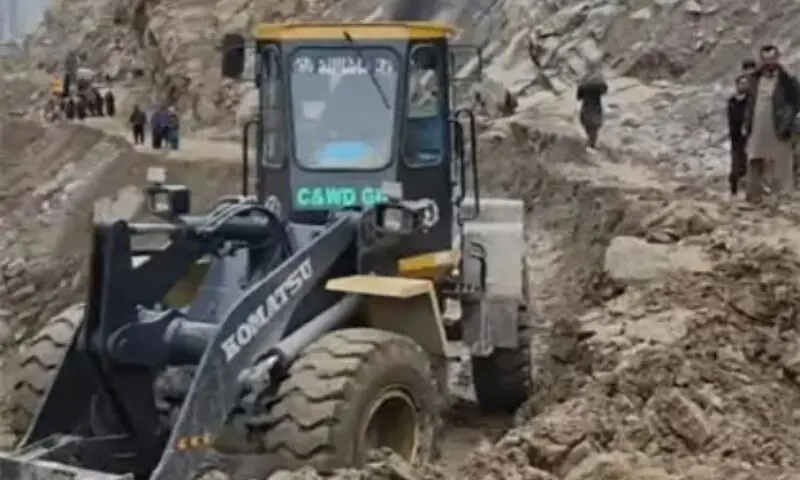
EFFORTS being made to reopen a road after a landslide in Gilgit-Baltistan. —Dawn • KKH, Astore valley road temporarily blocked • Heavy rain, thunderstorms also expected in KP GILGIT: Intermittent rain across Gilgit-Baltistan on Saturday triggered landslides and road blockages, while the Pakistan Meteorological Department (PMD) issued a fresh alert warning of glacial lake outburst floods (Glof) in the region due to an approaching westerly weather system. The blocked roads included the Karakoram Highway (KKH) and the Astore valley road, which were later reopened for traffic after debris was cleared. According to police, scattered rain was recorded across the region on Friday and Saturday. In Hunza’s Murtazabad area, rain-induced flooding temporarily blocked the KKH, but traffic was restored after clearance operations. Landslides and falling debris also blocked the Astore valley road at multiple locations, after which the Gilgit-Baltistan Communication and Works Department deployed machinery to clear the road. Police later confirmed that traffic on the route was restored. Rainfall also caused landslides in various remote areas, disrupting access to several link roads. Meanwhile, the Pakistan Meteorological Department (PMD) on Saturday issued an alert for glacial lake outburst floods (Glof) in the upper regions, including Gilgit-Baltistan and Khyber Pakhtunkhwa, due to an expected westerly weather system this weekend. A Glof refers to the sudden release of water and debris from a glacial lake, which can result in loss of lives, property and livelihoods in mountainous communities. According to the Ministry of Climate Change, more than 7. 1 million people in GB and KP are vulnerable to the phenomenon. In its alert, the Met Office said a moderate westerly wave is likely to enter the upper parts of the country from Sunday. “During this period, widespread rain, wind and thunderstorms, with isolated heavy falls, are anticipated across Gilgit-Baltistan and Khyber Pakhtunkhwa, ” it said. The PMD warned that a sudden rise in temperatures followed by precipitation “significantly elevates” the risk of Glofs, debris flow and flash flooding in vulnerable areas, including Hoper, Ghulkin, Shishper, Yasin, Phander, Badswat, lower Hunza, Nagar, Ghanche, Shigar, Swat, upper Chitral, Dir and Astore. Residents in glaciated valleys have been advised to avoid riverbanks and stream beds during rainfall and to move livestock and essential belongings to higher, safer ground. Authorities also urged the public to share alerts via SMS and social media. The PMD also advised residents to monitor local nullahs for sudden changes in water colour or unusual sounds that could indicate incoming debris flows. It urged close coordination with Community-Based Disaster Risk Management Committees. Disaster management authorities have been directed to remain on high alert and maintain communication with technical focal persons in remote valleys. Pakistan is home to over 13, 000 glaciers — the largest concentration outside the polar regions — but experts warn that many are receding due to rising temperatures linked to climate change. In February, the National Emergencies Operation Centre (NEOC) of the NDMA issued an advisory warning of elevated Glof risks between March and September 2026 due to rising temperatures and changing weather patterns. Last summer, rapidly melting glaciers, Glofs and cloudbursts caused significant damage in Gilgit-Baltistan. Experts say residents, particularly those living downstream of rivers and glacial lakes, face serious risks this summer. Published in Dawn, May 3rd, 2026
PMD warns of Glof risk as rains, landslides batter GB

RELATED ARTICLES


