


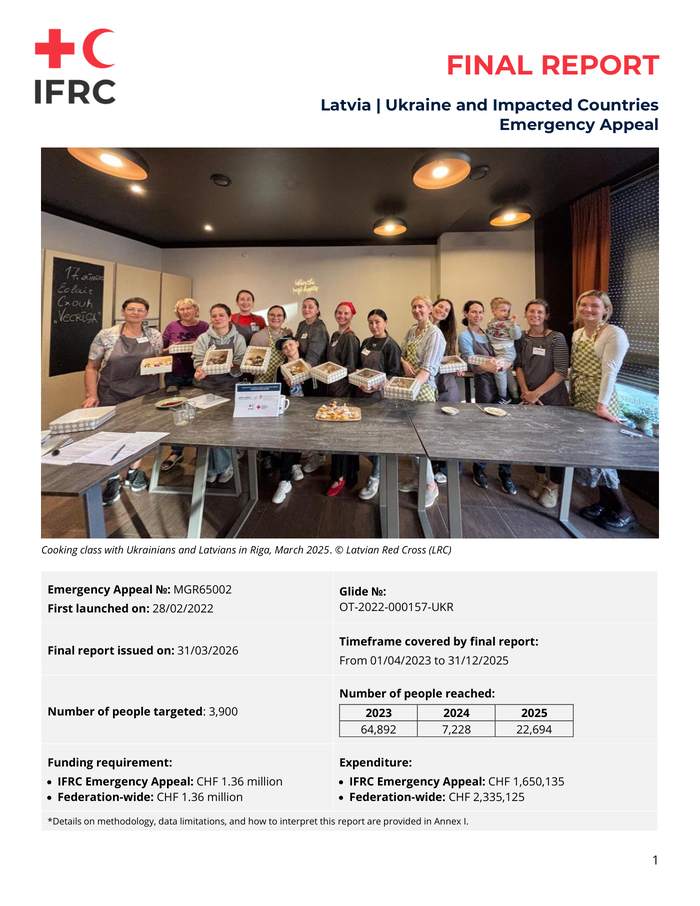
Countries: Latvia, Ukraine Source: International Federation of Red Cross and Red Crescent Societies Please refer to the attached file. A. SITUATION ANALYSIS Description of the crisis Since the escalation of the Russia‐Ukraine international armed conflict in 2022, Latvia has been affected by the humanitarian consequences of large-scale displacement from Ukraine. As of 20 December 2022, Latvian authorities reported approximately 218, 000 entries of people displaced from Ukraine through Latvia’s external non-EU borders1. By February 2023, 45, 299 people displaced from Ukraine had been registered for temporary protection. Temporary protection status grants the right to reside in Latvia and provides access to healthcare, employment, financial assistance, education, and the protection of personal and property rights. In the initial phase of displacement, priority needs included financial assistance, transportation, accommodation, access to employment, information services, and language courses. From the outset of the conflict in February 20222, Latvian Red Cross responded to these needs through the provision of humanitarian assistance, including food parcels, first aid, information services, and branch-level psychosocial and practical support. Essential items such as clothing, footwear, and hygiene kits were distributed to people in vulnerable situations. Throughout 2023, the operating environment continued to evolve as the conflict persisted. While some immediate emergency needs were partially addressed, longer-term challenges became more prominent, particularly in relation to livelihoods, housing stability, and mental health. By mid-2023, needs increasingly shifted from acute life-saving assistance towards stabilisation-oriented support, with a growing emphasis on livelihoods and mental health and psychosocial support. The context also became more complex due to differing needs between newly arrived people displaced from Ukraine and those planning to remain in Latvia for longer periods. In 2024, Latvia continued to experience the humanitarian consequences of the protracted conflict. Although conditions improved for some people displaced from Ukraine and in certain sectors, others continued to face ongoing challenges, including protection risks, economic vulnerability, and limited access to services. Prolonged displacement negatively affected mental health, and for many households, financial resources became increasingly strained. While a number of displaced people secured employment, jobs were often low-paid and did not correspond to qualifications or previous professional experience in Ukraine. As of 31 October 2025, 31, 290 people displaced from Ukraine were recorded as residing in Latvia. Priority needs included access to healthcare, employment and livelihoods support, language courses, medicines, education for children under 18, and adequate accommodation3. Approximately 9, 000 people displaced from Ukraine were employed, primarily in lower-paid occupations such as cleaning, auxiliary services, and retail support. Limited Latvian language proficiency and the non-recognition of qualifications obtained in Ukraine continued to constrain access to better paid and more stable employment opportunities. During the implementation of the UIC Emergency Appeal, Latvian Red Cross prioritised support to people in the most vulnerable situations, particularly single mothers, children with disabilities, and older people, who often face greater barriers to labour market participation and integration. Support focused on the following sectors: •Health and care: Provision of primary health care services, First Aid, MHPSS. •Shelter, housing and settlements: Support for housing and household items. •Cash and voucher assistance: Provision of vouchers and cash. •Protection, gender and inclusion: Setting up child-friendly spaces. •Community engagement and accountability: consulting, taking feedback from the community.



GrowthPakistan brings you the latest news to keep an eye on Pakistan’s startup ecosystem. Business keeps you growing when you stay aware of your competitors' moves. GrowthPakistan offers Business, Tech, Global Tech, Global, Auto, and Startup News straight from industries all around the globe. This platform will help you identify upcoming opportunities not only in Pakistan but worldwide.
Email : growthpakistan@gmail.com
Whatsapp : +92320-9497079
© growthpakistan