

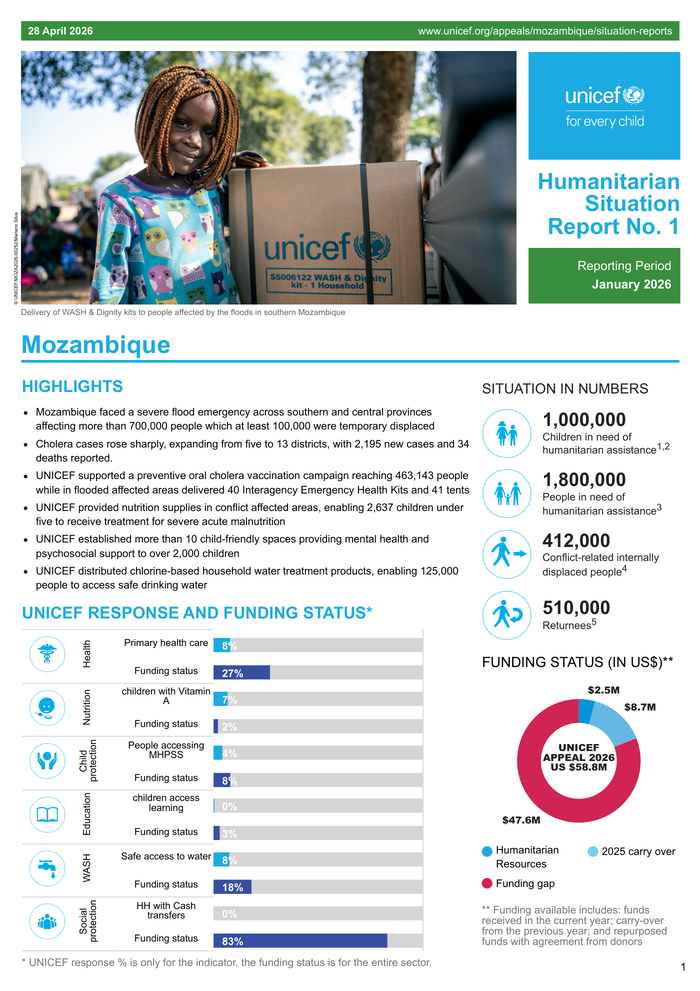
Country: Mozambique Source: UN Children’s Fund Please refer to the attached file. Highlights · Mozambique faced a severe flood emergency across southern and central provinces affecting more than 700, 000 people which at least 100, 000 were temporary displaced. · Cholera cases rose sharply, expanding from five to 13 districts, with 2, 195 new cases and 34 deaths reported. · UNICEF supported a preventive oral cholera vaccination campaign reaching 463, 143 people while in flooded affected areas delivered 40 Interagency Emergency Health Kits and 41 tents. · UNICEF provided nutrition supplies in conflict affected areas, enabling 2, 637 children under five to receive treatment for severe acute malnutrition. · UNICEF established more than 10 child-friendly spaces providing mental health and psychosocial support to over 2, 000 children. · UNICEF distributed chlorine-based household water treatment products, enabling 125, 000 people to access safe drinking water. SITUATION OVERVIEW AND HUMANITARIAN NEEDS The security situation in Cabo Delgado remained volatile and unpredictable despite a reduction in reported incidents. Non-State Armed Groups (NSAGs) continued operating along the coastal districts, indicating sustained mobility despite intensified maritime patrols by security forces. Historical trends in the province suggest that insurgent activity may gradually increase as the rainy season subsides6. In January 2026, 2, 429 people—of whom 1, 386 were children—were on the move in the northern region of the country. Approximately 96 per cent of these movements were voluntary, with 57 per cent recorded as departures, primarily from Mueda, Macomia and Pemba to Mocímboa da Praia, Macomia, Ibo and other districts. The main drivers of movement were intention to return (41 per cent), family reunification (32 per cent) and lack of food (23 per cent)7. During the reporting period, Mozambique faced a severe flood emergency following exceptionally heavy rainfall in upstream countries and across southern and central provinces, triggering large-scale flooding along the Limpopo River in Gaza Province and the Incomati and Umbeluzi river basins in Maputo Province. On 16 January 2026, the Government activated a nationwide Red Alert, the highest emergency level. According to Instituto Nacional de Gestão e Redução do Risco de Desastres (INGD) data (9–29 January 2026), floods affected more than 700, 000 people across Gaza, Maputo and Sofala provinces. As of 29 January 2026, 100, 730 people were accommodated in 112 temporary accommodation centres, the majority in Gaza. Damaged social infrastructure included 355 schools (796 classrooms), 229 health facilities and 83 education administration buildings, affecting 233, 489 students and 6, 348 teachers8. Mozambique continues to face multiple public health emergencies across the central and northern regions. Measles cases increased by 8 per cent in January 2026, reaching 617 cumulative cases as of 31 January. Cholera cases rose sharply, expanding from five to 13 districts, with 2, 195 new cases reported—a 131 per cent increase—primarily in Nampula and Tete provinces, and additional cases in Cabo Delgado and Zambezia. As of 31 January, no measles-related deaths had been reported, while 34 deaths were attributed to cholera9.
UNICEF Mozambique Humanitarian Situation Report No. 1, 31 January 2026

RELATED ARTICLES


