

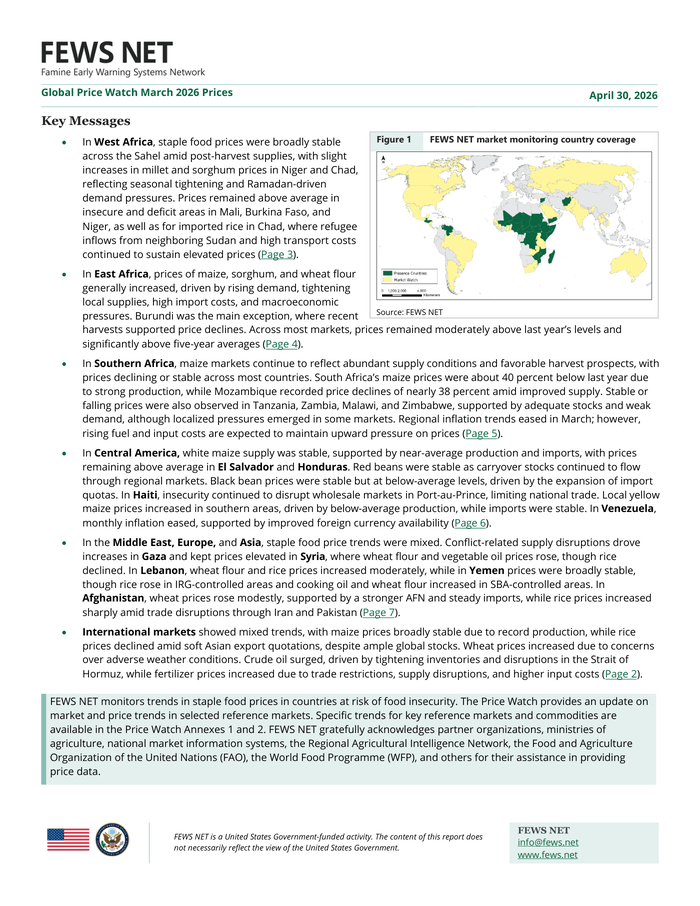
Country: World Source: Famine Early Warning System Network Please refer to the attached file. Key Messages In West Africa, staple food prices were broadly stable across the Sahel amid post-harvest supplies, with slight increases in millet and sorghum prices in Niger and Chad, reflecting seasonal tightening and Ramadan-driven demand pressures. Prices remained above average in insecure and deficit areas in Mali, Burkina Faso, and Niger, as well as for imported rice in Chad, where refugee inflows from neighboring Sudan and high transport costs continued to sustain elevated prices (Page 3). In East Africa, prices of maize, sorghum, and wheat flour generally increased, driven by rising demand, tightening local supplies, high import costs, and macroeconomic pressures. Burundi was the main exception, where recent harvests supported price declines. Across most markets, prices remained moderately above last year’s levels and significantly above five-year averages (Page 4). In Southern Africa, maize markets continue to reflect abundant supply conditions and favorable harvest prospects, with prices declining or stable across most countries. South Africa’s maize prices were about 40 percent below last year due to strong production, while Mozambique recorded price declines of nearly 38 percent amid improved supply. Stable or falling prices were also observed in Tanzania, Zambia, Malawi, and Zimbabwe, supported by adequate stocks and weak demand, although localized pressures emerged in some markets. Regional inflation trends eased in March; however, rising fuel and input costs are expected to maintain upward pressure on prices (Page 5). In Central America, white maize supply was stable, supported by near-average production and imports, with prices remaining above average in El Salvador and Honduras. Red beans were stable as carryover stocks continued to flow through regional markets. Black bean prices were stable but at below-average levels, driven by the expansion of import quotas. In Haiti, insecurity continued to disrupt wholesale markets in Port-au-Prince, limiting national trade. Local yellow maize prices increased in southern areas, driven by below-average production, while imports were stable. In Venezuela, monthly inflation eased, supported by improved foreign currency availability (Page 6). In the Middle East, Europe, and Asia, staple food price trends were mixed. Conflict-related supply disruptions drove increases in Gaza and kept prices elevated in Syria, where wheat flour and vegetable oil prices rose, though rice declined. In Lebanon, wheat flour and rice prices increased moderately, while in Yemen prices were broadly stable, though rice rose in IRG-controlled areas and cooking oil and wheat flour increased in SBA-controlled areas. In Afghanistan, wheat prices rose modestly, supported by a stronger AFN and steady imports, while rice prices increased sharply amid trade disruptions through Iran and Pakistan (Page 7). International markets showed mixed trends, with maize prices broadly stable due to record production, while rice prices declined amid soft Asian export quotations, despite ample global stocks. Wheat prices increased due to concerns over adverse weather conditions. Crude oil surged, driven by tightening inventories and disruptions in the Strait of Hormuz, while fertilizer prices increased due to trade restrictions, supply disruptions, and higher input costs (Page 2).
World: Global Price Watch March 2026 Prices (April 30, 2026)

RELATED ARTICLES


