


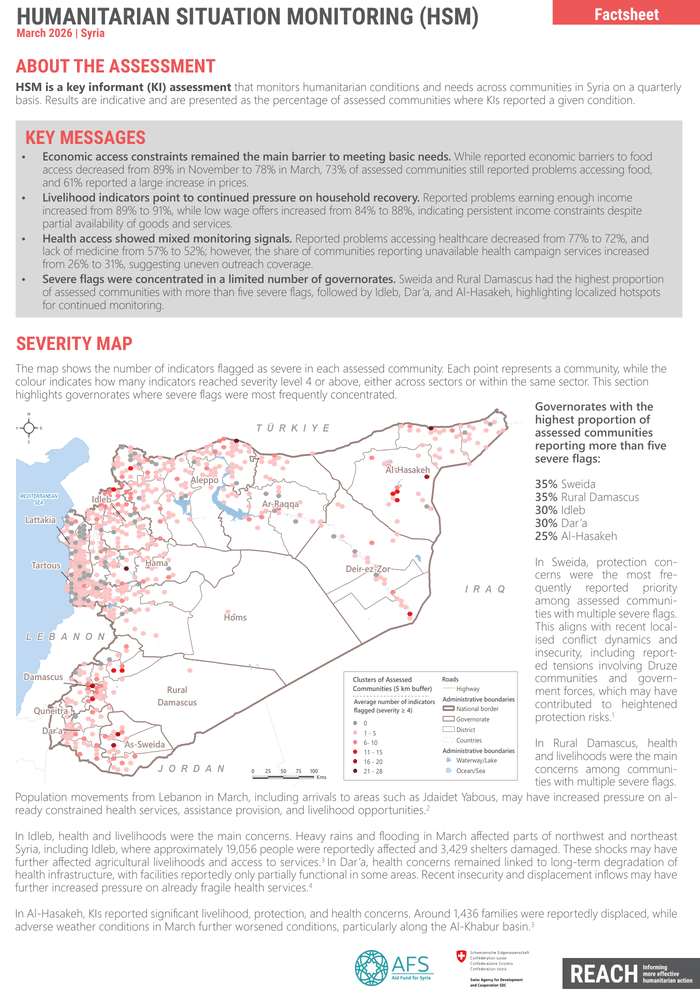
Country: Syrian Arab Republic Source: REACH Initiative Please refer to the attached file. KEY MESSAGES • Economic access constraints remained the main barrier to meeting basic needs. While reported economic barriers to food access decreased from 89% in November to 78% in March, 73% of assessed communities still reported problems accessing food, and 61% reported a large increase in prices. • Livelihood indicators point to continued pressure on household recovery. Reported problems earning enough income increased from 89% to 91%, while low wage offers increased from 84% to 88%, indicating persistent income constraints despite partial availability of goods and services. • Health access showed mixed monitoring signals. Reported problems accessing healthcare decreased from 77% to 72%, and lack of medicine from 57% to 52%; however, the share of communities reporting unavailable health campaign services increased from 26% to 31%, suggesting uneven outreach coverage. • Severe flags were concentrated in a limited number of governorates. Sweida and Rural Damascus had the highest proportion of assessed communities with more than five severe flags, followed by Idleb, Dar’a, and Al-Hasakeh, highlighting localized hotspots for continued monitoring.



GrowthPakistan brings you the latest news to keep an eye on Pakistan’s startup ecosystem. Business keeps you growing when you stay aware of your competitors' moves. GrowthPakistan offers Business, Tech, Global Tech, Global, Auto, and Startup News straight from industries all around the globe. This platform will help you identify upcoming opportunities not only in Pakistan but worldwide.
Email : growthpakistan@gmail.com
Whatsapp : +92320-9497079
© growthpakistan