


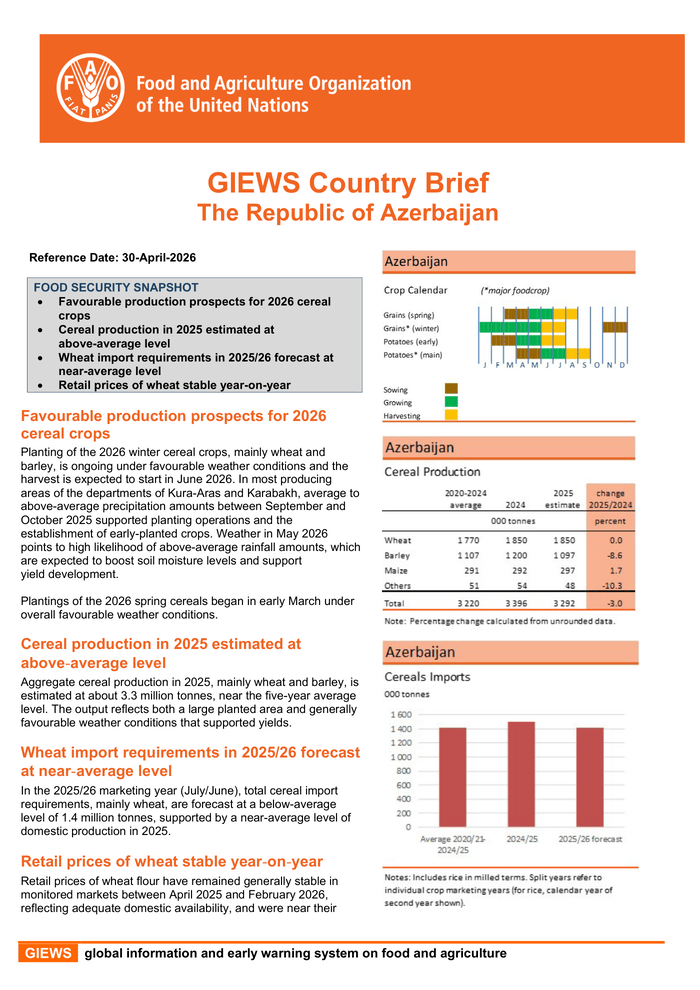
Country: Azerbaijan Source: Food and Agriculture Organization of the United Nations Please refer to the attached file. FOOD SECURITY SNAPSHOT Favourable production prospects for 2026 cereal crops Cereal production in 2025 estimated at above‐average level Wheat import requirements in 2025/26 forecast at near‐average level Retail prices of wheat stable year‐on‐year Favourable production prospects for 2026 cereal crops Planting of the 2026 winter cereal crops, mainly wheat and barley, is ongoing under favourable weather conditions and the harvest is expected to start in June 2026. In most producing areas of the departments of Kura‐Aras and Karabakh, average to above‐average precipitation amounts between September and October 2025 supported planting operations and the establishment of early‐planted crops. Weather in May 2026 points to high likelihood of above‐average rainfall amounts, which are expected to boost soil moisture levels and support yield development. Plantings of the 2026 spring cereals began in early March under overall favourable weather conditions. Cereal production in 2025 estimated at above‐average level Aggregate cereal production in 2025, mainly wheat and barley, is estimated at about 3. 3 million tonnes, near the five‐year average level. The output reflects both a large planted area and generally favourable weather conditions that supported yields. Wheat import requirements in 2025/26 forecast at near‐average level In the 2025/26 marketing year (July/June), total cereal import requirements, mainly wheat, are forecast at a below‐average level of 1. 4 million tonnes, supported by a near‐average level of domestic production in 2025. Retail prices of wheat stable year‐on‐year Retail prices of wheat flour have remained generally stable in monitored markets between April 2025 and February 2026, reflecting adequate domestic availability, and were near their year‐earlier values as of February 2026. The exemption from the 18 percent value added tax (VAT) on wheat imports and sales is contributing to the stability of domestic wheat prices. Introduced in January 2017 and scheduled to remain in force until January 2027, the measure is expected to continue supporting price stability over the medium term.



GrowthPakistan brings you the latest news to keep an eye on Pakistan’s startup ecosystem. Business keeps you growing when you stay aware of your competitors' moves. GrowthPakistan offers Business, Tech, Global Tech, Global, Auto, and Startup News straight from industries all around the globe. This platform will help you identify upcoming opportunities not only in Pakistan but worldwide.
Email : growthpakistan@gmail.com
Whatsapp : +92320-9497079
© growthpakistan