


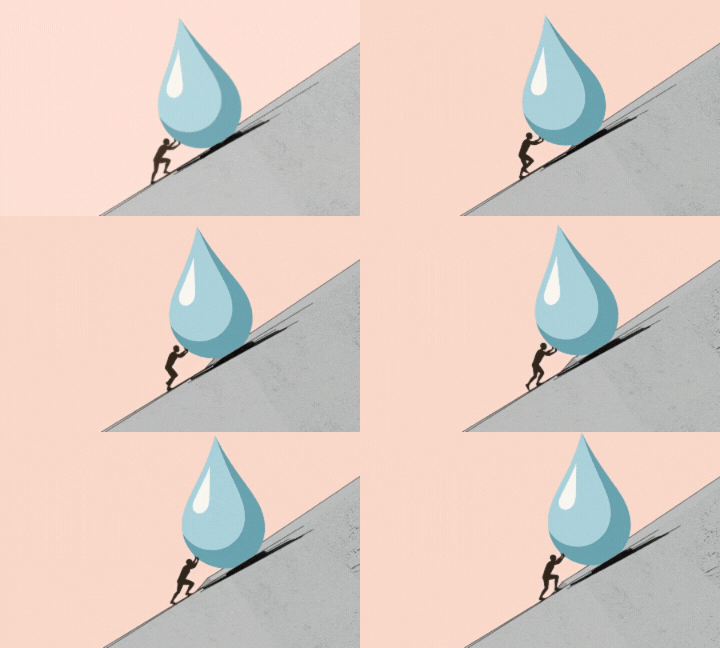
Polio still not eradicated Four-year-old Shahmeer* in Sindh’s Sujawal had been receiving his hifazati teekay on time for pneumonia, diarrhoea, measles, typhoid, poliovirus. Every box on his vaccination card was marked complete. Yet, on March 5, he became Pakistan’s first reported polio case of 2026. Shahmeer showed no visible symptoms — he went out to play as usual, did not complain of joint pain, and showed no signs of paralysis. This is because he had contracted non-paralytic polio, which is a form of the disease that goes unnoticed, sometimes showing up only as a mild flu, but still capable of spreading the virus. The virus in his gut was genetically linked to a positive environmental sample from Hyderabad, lab analysis showed, pointing to ongoing transmission in Sindh. In many ways, Shahmeer’s case reflects Pakistan’s dilemma today: the country may be close to eradication, but the virus has not been eliminated. It has simply become harder to detect and, therefore, harder to wipe out. Right now, Pakistan is in what is called “ the last mile, ” or its most challenging phase, says the prime minister’s focal person, Ayesha Raza Farooq. It has reached this point thrice in the last decade: in 2017, when eight cases were reported, in 2021, when only one case was recorded, and in 2023, when six cases were reported. But each time, progress was derailed by a surge in cases. By the end of 2025, the tally was 31. Three months into this year, only one case has been reported, and a majority of samples from sewage have been clear of the virus. This has given Unicef Sindh’s team lead Azeem Khawaja the hope that we will reach zero cases by the end of 2026. “Sustaining them there is the big question, ” he added. Pakistan must have no cases for at least three years in a row to be declared polio-free. No virus can be detected in humans, the environment, or laboratory samples. The last mile means Pakistan will have to vaccinate 95 per cent of its children. It aims for over 45 million children each campaign but manages about 43 million every time. That two million or so is the last mile. During the February and April campaigns this year, 950, 000 and 300, 000 children were not vaccinated, respectively. Typically, between 800, 000 and a million children are missed in each nationwide drive. Behind these numbers are the doors that never open, the children who are not home, and the parents who keep turning polio workers away. Familiarity that coexists with suspicion At seven o’clock on a December morning, Sindhi Para in Karachi’s Dalmia, UC-7 of Gulshan Town, had barely risen for the day. Deep in the coil of the basti’s narrow alleys, mothers speed-walked to school, their children straggling behind. Not much else was stirring, except for the sweeper’s long-handled broom. A medical centre sat at the edge of the alley leading to Sindhi Para, where dozens of women were gathered under an old tree. Its entrance was littered with run-down furniture yet to be discarded. Inside, the buzzing of a pedestal fan greeted visitors before the fading paint on the walls. The women, most of them clad in burqas and joggers, queued in the courtyard. Their eyes darted from their phone screens to the office, where their supervisor sat. Finally, his voice rang loud. Names were called, data sheets were handed over, and an announcement was made: “What is our goal? Not a single child is to be missed. ” The polio teams fanned out. Before she led her team into the assigned neighbourhood, Samina adjusted the strap of her blue vaccine carrier box and stepped into the first house on her list. A toddler ran past her. “Ali hasn’t gone to school yet? ” she asked. His mother laughed and called him back. As soon as he entered, Bilqis squeezed the two precious drops into the child’s open maw and dragged a pen across his cuticle. Parmeela chalked up cryptic symbols at the gate: EPI St. 4, H. 9. 1/1 + 0 T+2, AFP 0, ZD 0 ←. Before leaving, Samina double-checked: “Any newborns? Any visiting children? Any cases of paralysis? ” Then they inched forward to the next gate. “ Arey Samina, I was only wondering when you will come over, ” an elderly woman at the door said. “Come on in, ladies. ” Samina led the way in, and for the next 20 minutes, the women chatted over a cup of tea, swiftly switching from Urdu to Sindhi. The conversation jumped from the new family that recently moved upstairs from Balochistan’s Hub to the upcoming wedding, and inflation. Before they said goodbye, the lady health workers took turns to use the bathroom, Samina refilled her water bottle as Bilqis squeezed the dropper over the open mouth of the newest member of the family. Parmeela herded the women upstairs to meet the newcomers. A woman, with a toddler cradled on her hip, answered the door. As Samina greeted them, Parmeela and Bilqis’ eyebrows shot up. “We didn’t know you could speak Balochi that well, ” they later said to tease her. “When you have been meandering these streets for years, it is easy to know everyone and for everyone to know you, ” Samina explained. “This way, vaccinations become easier. .. and it also keeps up to date with what is happening in the neighbourhood. ” The familiarity, however, coexisted with suspicion. A woman once spat on Parmeela and screamed that she was poisoning her children. A man pulled a gun on Samina each time she came to his door. In some homes, fathers would turn Bilquis away but the mothers would sneak the children out for the drops when the men were not home. They would tell the women not to mark the child’s finger and just note the tally on their official sheet. The women blamed rumours for this resistance: that the “vaccine causes infertility”, that it is “un-Islamic”, that it is “aimed at reducing the population of a particular ethnicity”. For a period, police accompanied the teams. But that created even more scepticism and fear, said Parmeela. So now, a police van was parked a short distance from teams at all times, but the men were rarely ever involved. The instruction was to persist. If persuasion failed, report the refusal; if tensions escalated, involve the in-charge or the police. Ninety-eight per cent of refusals come from 30 districts across Pakistan, according to National Emergency Operations Centre Coordinator Anwarul Haq. These include areas with a history of high polio incidence (Karachi, Peshawar, Quetta and south Khyber Pakhtunkhwa). — – — — — → &&&



GrowthPakistan brings you the latest news to keep an eye on Pakistan’s startup ecosystem. Business keeps you growing when you stay aware of your competitors' moves. GrowthPakistan offers Business, Tech, Global Tech, Global, Auto, and Startup News straight from industries all around the globe. This platform will help you identify upcoming opportunities not only in Pakistan but worldwide.
Email : growthpakistan@gmail.com
Whatsapp : +92320-9497079
© growthpakistan