


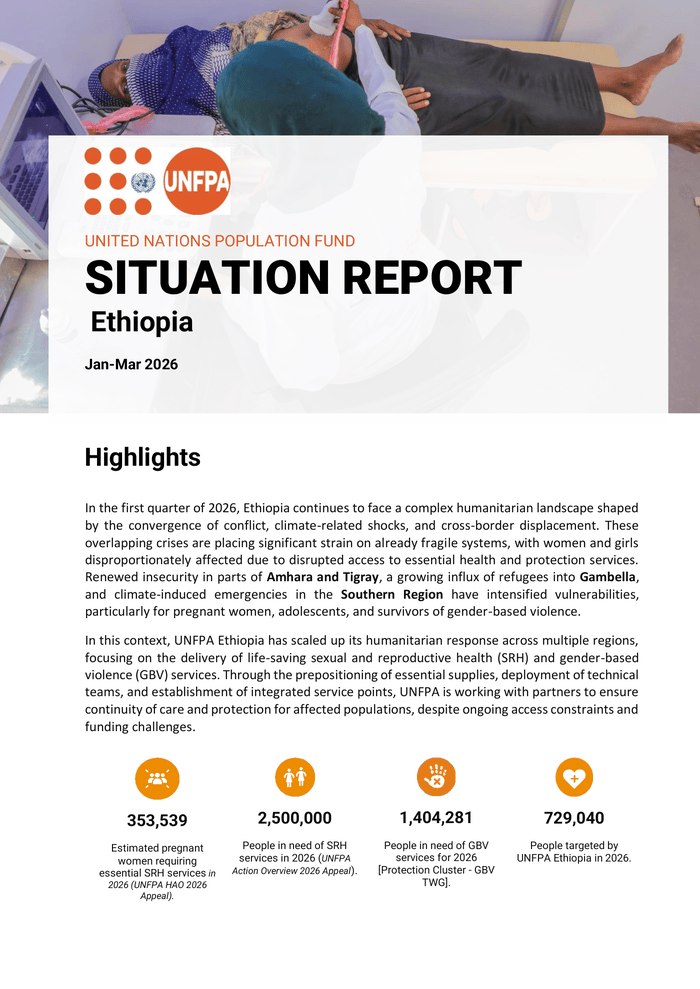
Countries: Ethiopia, South Sudan Source: United Nations Population Fund Please refer to the attached file. Highlights In the first quarter of 2026, Ethiopia continues to face a complex humanitarian landscape shaped by the convergence of conflict, climate-related shocks, and cross-border displacement. These overlapping crises are placing significant strain on already fragile systems, with women and girls disproportionately affected due to disrupted access to essential health and protection services. Renewed insecurity in parts of Amhara and Tigray, a growing influx of refugees into Gambella, and climate-induced emergencies in the Southern Region have intensified vulnerabilities, particularly for pregnant women, adolescents, and survivors of gender-based violence. In this context, UNFPA Ethiopia has scaled up its humanitarian response across multiple regions, focusing on the delivery of life-saving sexual and reproductive health (SRH) and gender-based violence (GBV) services. Through the prepositioning of essential supplies, deployment of technical teams, and establishment of integrated service points, UNFPA is working with partners to ensure continuity of care and protection for affected populations, despite ongoing access constraints and funding challenges. 353, 539 Estimated pregnant women requiring essential SRH services in 2026 (UNFPA HAO 2026 Appeal). 2, 500, 000 People in need of SRH services in 2026 (UNFPA Action Overview 2026 Appeal). 1, 404, 281 People in need of GBV services for 2026 [Protection Cluster – GBV TWG]. 729, 040 People targeted by UNFPA Ethiopia in 2026. Situation Overview Ethiopia’s humanitarian context in early 2026 remains highly complex, driven by the convergence of conflict, climate shocks, and regional instability. These overlapping crises are deepening vulnerabilities, particularly in hard-to-reach areas where access to basic health and protection services is limited. Women and girls continue to be disproportionately affected, facing heightened risks of gender-based violence and reduced access to essential sexual and reproductive health care. In the absence of a comprehensive national HRP 2026 in Ethiopia, UNFPA through the HAO 2026 appeal for GBV and SRH IDPS needs, and the 2026 Country Refugee Response Plan, focuses on the most severe needs for IDP, refugees, and conflict-affected host community populations. Climate-related shocks have intensified across several regions, particularly in Southern Ethiopia, where landslides in Gamo and flooding in Arbaminch have displaced communities and disrupted essential services. According to national and partner assessments, heavy and irregular rainfall patterns linked to seasonal variability are expected to increase the likelihood of flash floods in flood-prone areas (EDRMC, 2026). These events have damaged infrastructure, limited humanitarian access, and heightened risks for women and girls, including exposure to GBV and reduced access to maternal health services. In response, UNFPA has deployed emergency health supplies and dignity kits to affected areas, alongside the establishment of temporary service delivery points to ensure continuity of care. Conflict dynamics in northern Ethiopia continue to drive displacement and humanitarian needs, particularly in Amhara and Southern Tigray. In February 2026, renewed hostilities in Alamata, Raya Alamata, and Raya Bala displaced approximately 78, 450 people into Kobo, North Wollo Zone, exacerbating pressure on already overstretched health systems (OCHA, 2026). Displaced populations are sheltering in overcrowded sites with limited access to food, water, and sanitation, increasing health risks and protection concerns. Women and girls face significant barriers in accessing sexual and reproductive health services, including safe delivery care and clinical management of rape. UNFPA has scaled up the provision of essential supplies, including clean delivery kits, post-rape treatment kits, and dignity kits, to address urgent needs and mitigate further risks. The regional crisis in South Sudan continues to spill over into Ethiopia, particularly in Gambella, which hosts a large refugee population. Since early 2025, escalating violence in Upper Nile and Jonglei has driven sustained displacement, with over 80, 000 people crossing into Ethiopia and additional arrivals reported in March 2026 (ECHO, 2026). Many remain unregistered and live in overcrowded transit sites with limited access to basic services. UNFPA has responded by deploying SRH kits and dignity kits aimed to serve 154, 000 individuals, including the establishment of a transit site to kick-start integrated SRH and GBV protection services.



GrowthPakistan brings you the latest news to keep an eye on Pakistan’s startup ecosystem. Business keeps you growing when you stay aware of your competitors' moves. GrowthPakistan offers Business, Tech, Global Tech, Global, Auto, and Startup News straight from industries all around the globe. This platform will help you identify upcoming opportunities not only in Pakistan but worldwide.
Email : growthpakistan@gmail.com
Whatsapp : +92320-9497079
© growthpakistan