


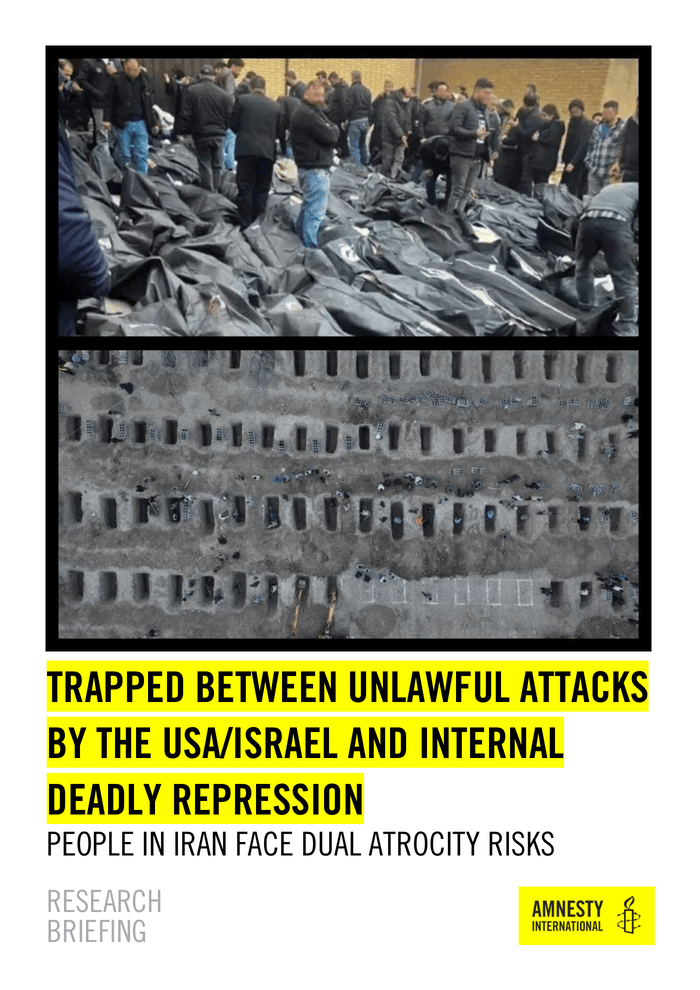
Country: Iran (Islamic Republic of) Source: Amnesty International Please refer to the attached file. 1. EXECUTIVE SUMMARY People in Iran have been trapped between unlawful US and Israeli attacks and deadly domestic repression. Between 28 February 2026 and 7 April 2026, the USA and Israel launched an unlawful attack against Iran, in violation of the UN Charter’s prohibition on the use of force, and carried out tens of thousands of air strikes on targets in Iran causing grave civilian harm. These attacks began while people in Iran were still reeling from the unprecedented massacres of thousands of protesters and bystanders during the January 2026 uprising. In this context, the risks of atrocity crimes against people in Iran have multiplied, both from the authorities inside the country and from external attacks by US and Israeli forces. On the one hand, civilians have suffered grave harm amid relentless US and Israeli air strikes and remain at risk of further harm given the fragility of the ceasefire reached on 7 April 2026. The air strikes killed at least 2, 362 civilians, including 383 children, and injured over 32, 314 civilians, according to official figures. In one egregious incident, an unlawful US strike on a school in Minab, Hormozgan province, killed 156 people, including 120 children. Amnesty International’s investigation into the attack found that the school was directly hit with precision guided munitions and that US forces failed to take all feasible precautions to avoid civilian harm. US and Israeli attacks have also caused extensive destruction and damage to civilian infrastructure, including power plants, bridges, universities, schools, residential buildings, medical centres, steel factories, oil depots and petrochemical facilities, condemning the population to deepened economic hardship, harming the environment, and endangering the lives, health and livelihoods of millions of people. Just hours before the 7 April 2026 ceasefire was announced, US President Donald Trump issued apocalyptic threats of large‐scale civilian devastation, warning that “a whole civilization will die tonight, ” amounting to a possible threat to commit genocide. On 23 April 2026, Israeli Defence Minister Israel Katz threatened to commit war crimes, saying “we are awaiting a green light from the United States. .. to return Iran to the Dark Age and the Stone Age by destroying key energy and electricity facilities and dismantling its national economic infrastructure. ” On the other hand, people in Iran have been subjected to decades of brutal repression by the authorities of the Islamic Republic with impunity and are at further risk of atrocity crimes. Since February 2026, senior Iranian officials have openly boasted about their massacre of thousands of protesters in January 2026 and threatened to violently supress any further attempted protests, warning that security forces have received “orders to shoot” and remain ready “with their fingers on the trigger. ” They have also threatened “a blow more severe than that on 8 January 2026, ” the day security forces unlawfully killed thousands of protesters, including children. In addition, the authorities have escalated their use of the death penalty as a tool of political repression, arbitrarily executing at least 21 individuals for politically motivated reasons, including nine protesters, nine dissidents, and three other individuals accused of “armed rebellion” (baghi) or espionage for the USA and/or Israel since the armed conflict began on 28 February 2026. The Iranian authorities’ threats to carry out mass killings have been further made frighteningly real as armed security agents have intensified street patrols since the outbreak of hostilities, including through machine gun mounted pickup trucks. According to information gathered by Amnesty International, security forces have fatally shot, beaten, coercively interrogated or arbitrarily arrested individuals in cities across the country for engaging in any acts deemed critical of the Islamic Republic system. Risks to people in Iran have been further heightened by the deliberate prolonged internet shutdown imposed by the Iranian authorities since 28 February 2026. The internet blackout, coupled with the authorities’ persistent refusal to allow international human rights monitors, severely obstructs investigations into civilian harm caused by US and Israeli attacks as well as serious violations and crimes under international law committed by the Iranian authorities. Against this backdrop, Amnesty International urges all states, as well as regional and international bodies, including the UN Secretary General, the High Commissioner for Human Rights, the Human Rights Council’s expert mechanisms and relevant atrocity prevention mechanisms, to recognize that Iran’s human rights and impunity crisis, now compounded by armed conflict, requires a dual people-centred diplomatic approach. This requires urgently combining efforts to establish a durable ceasefire, protect civilians, ensure respect for international humanitarian law and deter war crimes by all parties to the conflict, with robust efforts to prevent further atrocity crimes by the Iranian authorities against the people of Iran. This must include addressing structural conditions and root causes of Iran’s human rights and impunity crisis, and supporting Iranian civil society-led calls for fundamental changes, including to the constitution, to ensure equality and respect for human rights including the right to take part in public affairs. The atrocity-prone environment also urgently merits the activation of global, regional, and national atrocity prevention tools and mechanisms, including early warning, rapid action, political engagement, and structural prevention measures, alongside a concerted global diplomatic effort toward a transformative solution, grounded in international law, that places the protection of the human rights of Iran’s people at its core.



GrowthPakistan brings you the latest news to keep an eye on Pakistan’s startup ecosystem. Business keeps you growing when you stay aware of your competitors' moves. GrowthPakistan offers Business, Tech, Global Tech, Global, Auto, and Startup News straight from industries all around the globe. This platform will help you identify upcoming opportunities not only in Pakistan but worldwide.
Email : growthpakistan@gmail.com
Whatsapp : +92320-9497079
© growthpakistan