

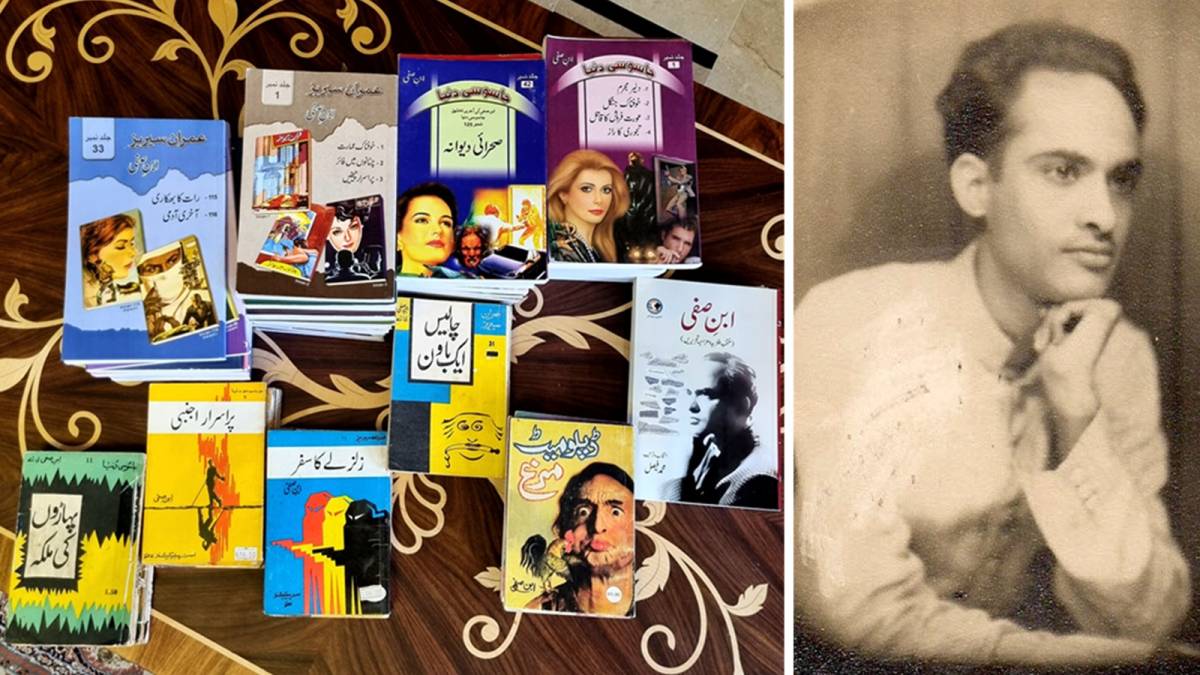
Escape is not always about running away. Sometimes it is just the mind taking a step back when everything feels too much. These days, it often means endless scrolling that feels like relief at first but ends up leaving the mind more scattered and tired. But not all escapes are like that. Some forms of escape actually give something back instead of draining the mind. Long before algorithms, streaming platforms, and cinematic universes, Urdu readers discovered exactly that kind of meaningful escape in the world of Ibn-e-Safi. His novels were never just a way to pass the time. They were a doorway into wit, suspense, imagination, and a kind of depth that stayed with the reader even after the book was finished. Few writers in Urdu have influenced readers as widely and as deeply as Ibn-e-Safi. His work gave popular fiction both reach and a sense of meaning. The beginning of his journey is worth noting. Around 1951, in an informal gathering, someone commented that only vulgar writing could achieve popularity in Urdu. Ibn-e-Safi argued that the problem was not the reader but the absence of a meaningful alternative. Until such an alternative existed, nothing would really change. It was from this point that he moved towards creating that alternative. His first novel, Daler Mujrim, was published in 1952 and marked the beginning of the Jasoosi Duniya series. It introduced Inspector Faridi and Sergeant Hameed, who soon became lasting figures in Urdu popular fiction. Faridi was calm and disciplined, while Hameed added a lighter, more easy-going touch. After a few years, he created another fictional universe, the Imran Series, built around the character of Ali Imran. On the surface, Imran appeared careless, even absurd, but beneath that exterior was a sharp and calculating mind. Together, these two worlds gave readers memorable characters and a style of storytelling where suspense, humour, and intelligence came together naturally. Some forms of escape actually give something back instead of draining the mind – and Urdu readers discovered exactly that kind of meaningful escape in the world of Ibn-e-Safi Between the early 1950s and the late 1970s, he wrote nearly 245 novels across the Jasoosi Duniya and Imran Series. Ibn-e-Safi’s popularity is visible in the way his books were received. His novels were published regularly, and readers often placed advance orders because new releases would sell out quickly. In many cities, particularly in Karachi and Lahore, and even in parts of India, people would gather at bookshops on release days. Novels sometimes even circulated later at higher prices due to demand. There is a lasting charm to the Imran Series and Jasoosi Duniya that is hard to explain but easy to feel. I discovered Ibn-e-Safi in 2012 during my school days, and it soon turned into a proper craze. I remember that when my father wouldn’t allow me to read novels, I used to hide under the blanket and read them by the faint light of a small lighter. Chaka Gali: Reviving Peshawar’s Fading Love For Fiction And Literary Culture One of Ibn-e-Safi’s most impressive qualities is that even his negative characters were as memorable as the heroes themselves. Alongside Faridi, Hameed, and Imran, figures like Theresia, Sing Hi, Adlava, Gerald Shastri, Nanotah, Finch, Doctor Duago, and Allama Dehshatnak remained equally popular, not because they were glorified, but because they had real depth and intelligence. Despite this, he never romanticised crime. No matter how clever or powerful the criminal appeared, the story always brought them to accountability. In the end, neither Faridi nor Imran allowed them to escape. More than anything, it was his command over language and expression that made his work stand out. For many readers, including myself, the connection with Urdu did not just begin with Ibn-e-Safi; it deepened because of him. His books played a major role in developing my interest in reading and literature, and whatever little sense of language I have today is largely because of him. Humour is also a dominant element of his writing. He created humour through both character and situation. Imran’s deliberate absurdity, Hameed’s mischief, and Qasim’s remarks create moments of lightness without disrupting the plot. Many scenes and dialogues stay with the reader; even later, they come back and bring a smile. Sometimes, in a quiet moment, a line comes back and one cannot help but laugh. Ibn-e-Safi’s imagination often moved beyond conventional detective fiction into a space that came close to science fiction. His novels feature advanced laboratories, experimental chemicals, secret devices, and unusual systems that felt far ahead of their time. These ideas were not vague or decorative. They were built with surprising detail and logic. In Sugar Bank, for instance, he imagined a coded language based on twenty-six musical strings, while in Toofan ka Aghwa, the concept of a “Fouladmi” hinted at something remarkably close to modern robotic figures like Iron Man. His fictional world also included inventions like the transmitter made from the golden moss of Tareek Wadi, and experiments involving the transfer of human brains. Many of these ideas once felt like pure fantasy, yet today they no longer seem entirely distant from reality. It was not science fiction in a strict sense, but there is a clear forward-looking vision in his work. The Double Art: Anisur Rahman And The English Afterlives Of Urdu Poetry As Ibn-e-Safi’s popularity rose, many tried to imitate him by adopting similar names and borrowing his characters. Particularly in the 1960s, when he remained inactive for a period due to illness, a wave of writers stepped in, using figures like Imran, Faridi, and Hameed to produce their own versions. Over time, this turned into a pattern, with more than two hundred writers attempting to build their identity on what he had already created. But most of these efforts were short-lived. The names faded, the works lost their hold, and the characters they borrowed never truly belonged to them. Yet Ibn-e-Safi remained. More than four decades have passed since Ibn-e-Safi’s death, yet his novels remain just as compelling. Even now, whenever I feel like reading something good, I pick up one of his novels, and despite having read them so many times, they still feel fresh every time. I don’t think characters in literature are often loved the way readers love Imran and Faridi. Not with this kind of attachment. There are many novelists who create their own worlds, but Ibn-e-Safi’s style, characters, language, and humour feel different. At least, that is how it seems to me. It is often said that with time, preferences change and attachments shift. That may be true. But for some reason, I feel certain that this will not change for me. That connection with Imran and Faridi does not fade.
Ibn-e-Safi And The Art Of Intelligent Escape In Urdu Fiction

RELATED ARTICLES


