


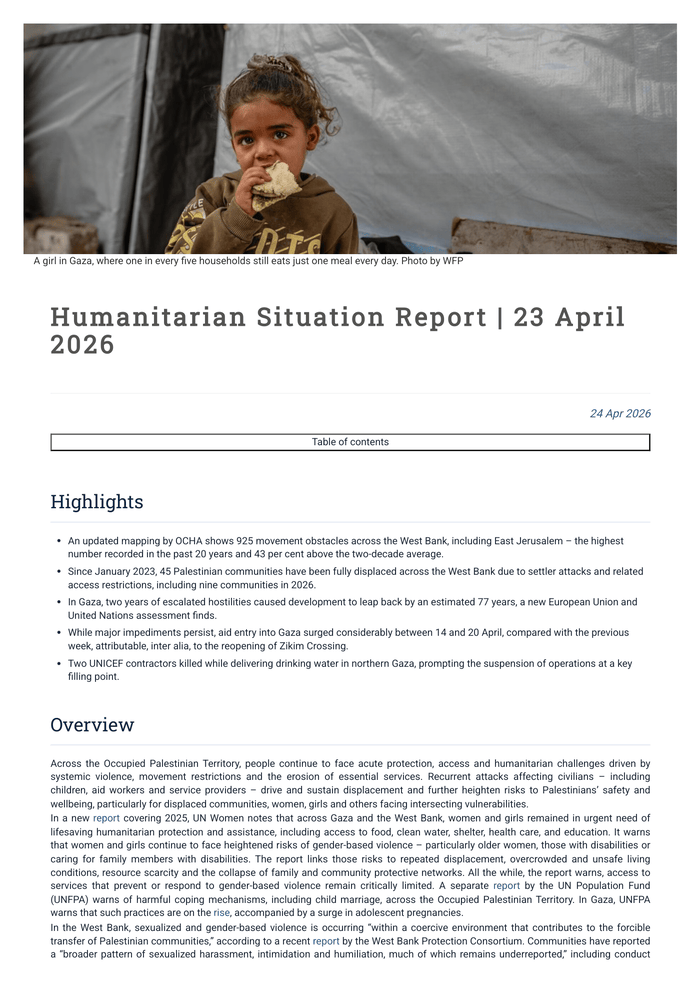
Country: occupied Palestinian territory Source: UN Office for the Coordination of Humanitarian Affairs Please refer to the attached file. Highlights An updated mapping by OCHA shows 925 movement obstacles across the West Bank, including East Jerusalem – the highest number recorded in the past 20 years and 43 per cent above the two-decade average. Since January 2023, 45 Palestinian communities have been fully displaced across the West Bank due to settler attacks and related access restrictions, including nine communities in 2026. In Gaza, two years of escalated hostilities caused development to leap back by an estimated 77 years, a new European Union and United Nations assessment finds. While major impediments persist, aid entry into Gaza surged considerably between 14 and 20 April, compared with the previous week, attributable, inter alia, to the reopening of Zikim Crossing. Two UNICEF contractors killed while delivering drinking water in northern Gaza, prompting the suspension of operations at a key filling point. Overview Across the Occupied Palestinian Territory, people continue to face acute protection, access and humanitarian challenges driven by systemic violence, movement restrictions and the erosion of essential services. Recurrent attacks affecting civilians – including children, aid workers and service providers – drive and sustain displacement and further heighten risks to Palestinians’ safety and wellbeing, particularly for displaced communities, women, girls and others facing intersecting vulnerabilities. In a new report covering 2025, UN Women notes that across Gaza and the West Bank, women and girls remained in urgent need of lifesaving humanitarian protection and assistance, including access to food, clean water, shelter, health care, and education. It warns that women and girls continue to face heightened risks of gender-based violence – particularly older women, those with disabilities or caring for family members with disabilities. The report links those risks to repeated displacement, overcrowded and unsafe living conditions, resource scarcity and the collapse of family and community protective networks. All the while, the report warns, access to services that prevent or respond to gender-based violence remain critically limited. A separate report by the UN Population Fund (UNFPA) warns of harmful coping mechanisms, including child marriage, across the Occupied Palestinian Territory. In Gaza, UNFPA warns that such practices are on the rise, accompanied by a surge in adolescent pregnancies. In the West Bank, sexualized and gender-based violence is occurring “within a coercive environment that contributes to the forcible transfer of Palestinian communities, ” according to a recent report by the West Bank Protection Consortium. Communities have reported a “broader pattern of sexualized harassment, intimidation and humiliation, much of which remains underreported, ” including conduct that takes “sexualized and gendered forms. ” In this context, “more than 70% of displaced households identified threats to women and children, particularly sexualized violence, as the decisive reason for leaving, ” highlighting its role as a key driver of displacement. The report further notes that such violence “penetrates domestic space, fractures family life and renders continued civilian residence untenable, ” reinforcing the cumulative pressures that lead families to leave their communities.



GrowthPakistan brings you the latest news to keep an eye on Pakistan’s startup ecosystem. Business keeps you growing when you stay aware of your competitors' moves. GrowthPakistan offers Business, Tech, Global Tech, Global, Auto, and Startup News straight from industries all around the globe. This platform will help you identify upcoming opportunities not only in Pakistan but worldwide.
Email : growthpakistan@gmail.com
Whatsapp : +92320-9497079
© growthpakistan