


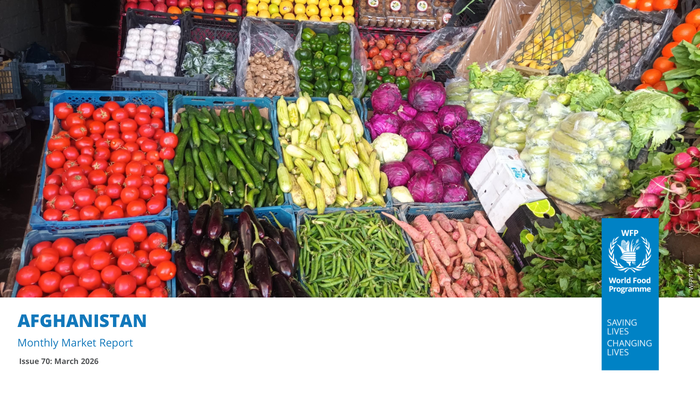
Country: Afghanistan Source: World Food Programme Please refer to the attached file. KEY HIGHLIGHTS Key Economic Developments Afghanistan’s economy remains in a low-growth, high-vulnerability environment, constrained by sustained inflows of returnees, recurring climate-related shocks, and ongoing regional trade disruptions. While overall economic activity has shown a moderate recovery, per capita GDP has declined, reflecting continued pressure on living standards amid rapid population growth. Macroeconomic conditions remain fragile, with limited external buffers and a weak external position. In March, severe flooding and heavy rainfall further exacerbated vulnerabilities, causing widespread damage to infrastructure, agricultural land, and livelihoods, thereby adding pressure on already constrained economic conditions. Trade flows continued to adjust amid persistent disruptions in regional connectivity, particularly the prolonged closure of key crossings with Pakistan and intermittent operational constraints along transit routes through Iran. These developments have sustained a structural shift in Afghanistan’s import corridors toward western and northern routes, helping maintain the availability of key commodities. However, reliance on these alternative routes has resulted in higher transportation costs, longer delivery times, and operational inefficiencies, contributing to uneven distribution and localized price variations. With a significant share of imports now concentrated through key corridors such as Islam Qala, pressure on trade routes has increased, heightening the risk of bottlenecks and delays. Overall, while markets remain adequately supplied, they continue to operate under structural strain, with elevated price levels reflecting the cumulative impact of prolonged trade disruptions and constrained regional connectivity. The Afghani remained broadly stable against the US dollar in March 2026, averaging AFN 64. 3/USD, while remaining strong compared to last year and historical averages. This relative stability reflects continued foreign currency inflows, effective liquidity management, and central bank interventions. A stable exchange rate has helped contain import costs, particularly for food and fuel, although its impact on domestic prices remains partially offset by persistent supply constraints and cross-border trade disruptions. Inflationary pressures continued to build compared to last year, driven by increases across both food and non-food categories. Rising costs of key food items, including cereals, oils, and meat, remained the main contributors to food inflation, while non-food inflation was largely supported by higher housing and health-related expenses, partly reflecting increased demand pressures linked to returnee inflows. Overall, the trend indicates a sustained upward movement in consumer prices. Global and Domestic Market Conditions Global commodity markets continued to trend upward in March 2026. The FAO Cereal Price Index averaged around 110 points, showing a modest monthly increase while remaining slightly below last year, supported by rising wheat prices amid weather-related risks in key producing countries and ongoing trade uncertainties. The FAO Vegetable Oil Price Index increased further, marking a third consecutive monthly rise, driven by higher palm, sunflower, and rapeseed oil prices amid tightening supply conditions and elevated energy markets. Global fertilizer prices rose sharply, reflecting high input and energy costs, geopolitical tensions, and trade restrictions, with notable increases in urea and DAP prices. National average food prices showed renewed upward momentum in March. Wheat grain and wheat flour prices increased, while rice prices rose more sharply due to persistent supply constraints and higher import costs, as Pakistani imports were partly replaced by Indian supplies via longer, costlier trade routes. Cooking oil remained broadly stable but above last year’s level, while sugar rose sharply. Vegetable prices also surged, driven by higher tomato and potato prices due to seasonal shortages and declining imports. Overall, market conditions remain constrained, with reduced cross-border flows sustaining upward price pressure. Labour market conditions remained weak in March, with labour availability stagnant at 1. 6 days per week and casual wages at AFN 297/day. Increased competition in the labour market from returnees, along with limited employment opportunities, rising staple prices, and constrained labour availability, continued to limit household income. Terms of Trade (ToT) remained under pressure, with real unskilled labour ToT declining to 2. 3 kg of wheat flour (–36% y-o-y). Pastoralist ToT also decreased to 259 kg of wheat flour per one-year-old female sheep (–15% y-o-y). Overall, persistently weak labour conditions and increasing food prices continued to erode purchasing power for both labour- and livestock-dependent households, with a full-time casual labourer able to afford only 37 per cent of the WFP food basket. Diesel prices increased in March to AFN 63. 4/litre, reflecting higher import costs and tighter supply conditions. Rising global fuel prices and ongoing regional tensions continue to exert pressure on domestic markets despite stable import flows from Iran and Central Asia.



GrowthPakistan brings you the latest news to keep an eye on Pakistan’s startup ecosystem. Business keeps you growing when you stay aware of your competitors' moves. GrowthPakistan offers Business, Tech, Global Tech, Global, Auto, and Startup News straight from industries all around the globe. This platform will help you identify upcoming opportunities not only in Pakistan but worldwide.
Email : growthpakistan@gmail.com
Whatsapp : +92320-9497079
© growthpakistan