

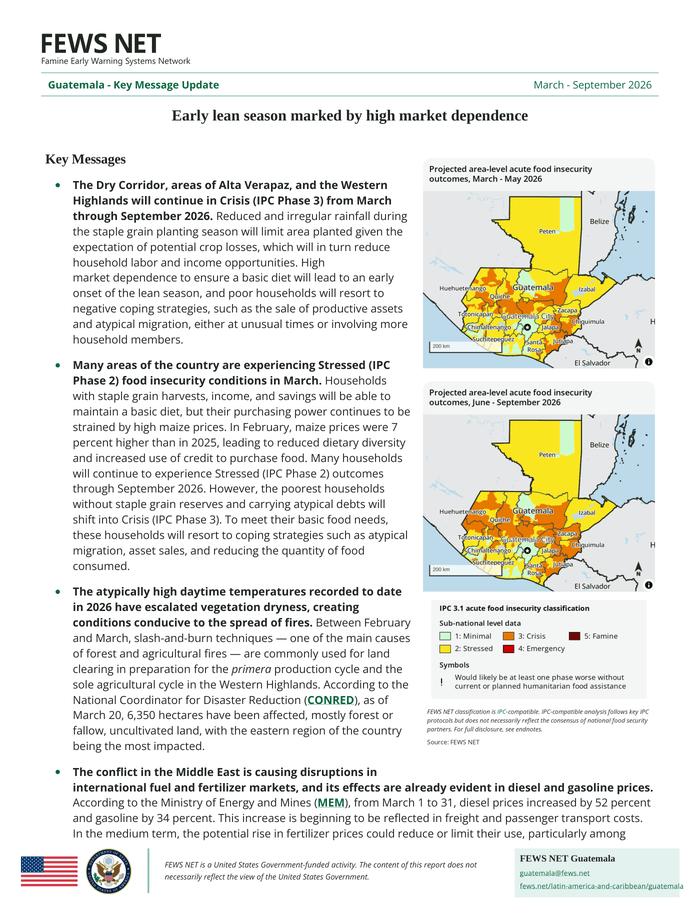
Country: Guatemala Source: Famine Early Warning System Network Please refer to the attached file. Key Messages The Dry Corridor, areas of Alta Verapaz, and the Western Highlands will continue in Crisis (IPC Phase 3) from March through September 2026. Reduced and irregular rainfall during the staple grain planting season will limit area planted given the expectation of potential crop losses, which will in turn reduce household labor and income opportunities. High market dependence to ensure a basic diet will lead to an early onset of the lean season, and poor households will resort to negative coping strategies, such as the sale of productive assets and atypical migration, either at unusual times or involving more household members. Many areas of the country are experiencing Stressed (IPC Phase 2) food insecurity conditions in March. Households with staple grain harvests, income, and savings will be able to maintain a basic diet, but their purchasing power continues to be strained by high maize prices. In February, maize prices were 7 percent higher than in 2025, leading to reduced dietary diversity and increased use of credit to purchase food. Many households will continue to experience Stressed (IPC Phase 2) outcomes through September 2026. However, the poorest households without staple grain reserves and carrying atypical debts will shift into Crisis (IPC Phase 3). To meet their basic food needs, these households will resort to coping strategies such as atypical migration, asset sales, and reducing the quantity of food consumed. The atypically high daytime temperatures recorded to date in 2026 have escalated vegetation dryness, creating conditions conducive to the spread of fires. Between February and March, slash-and-burn techniques — one of the main causes of forest and agricultural fires — are commonly used for land clearing in preparation for the primera production cycle and the sole agricultural cycle in the Western Highlands. According to the National Coordinator for Disaster Reduction ( CONRED ), as of March 20, 6, 350 hectares have been affected, mostly forest or fallow, uncultivated land, with the eastern region of the country being the most impacted. The conflict in the Middle East is causing disruptions in international fuel and fertilizer markets, and its effects are already evident in diesel and gasoline prices. According to the Ministry of Energy and Mines ( MEM ), from March 1 to 31, diesel prices increased by 52 percent and gasoline by 34 percent. This increase is beginning to be reflected in freight and passenger transport costs. In the medium term, the potential rise in fertilizer prices could reduce or limit their use, particularly among smallholder farmers during the primera agricultural cycle and the sole agricultural cycle in the Western Highlands, leading to lower yields and greater market dependence; in addition, it could raise production costs, consequently affecting food prices.
Guatemala – Key Message Update: Early lean season marked by high market dependence, March – September 2026

RELATED ARTICLES


