


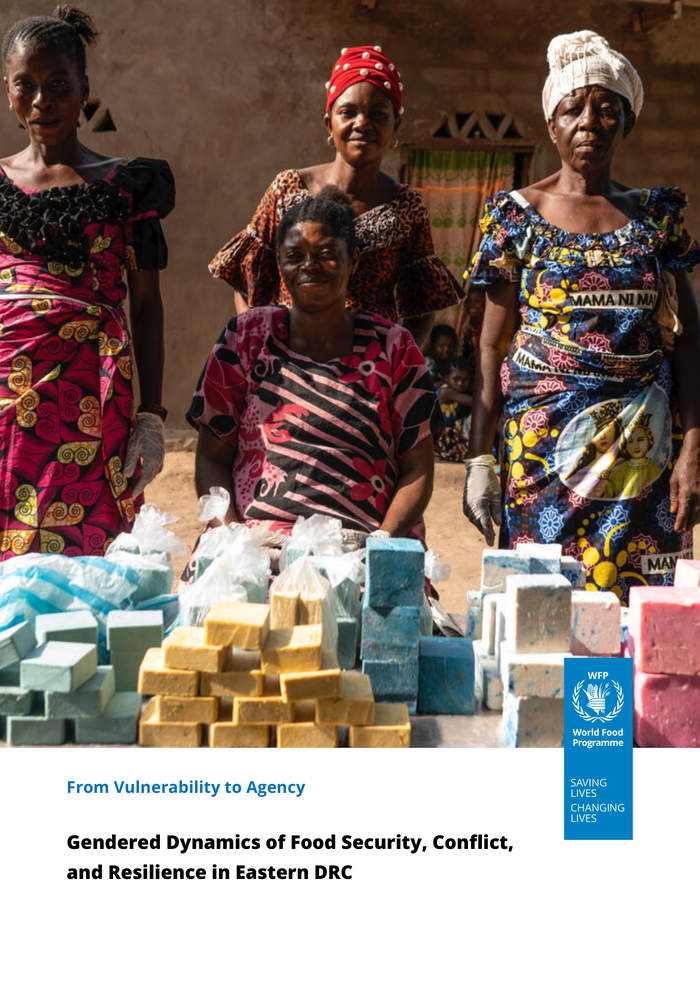
Country: Democratic Republic of the Congo Source: World Food Programme Please refer to the attached file. Executive Summary Eastern DRC continues to face protracted conflict, largescale displacement, and recurrent livelihood disruption, deepening food insecurity across the eastern provinces. According to the October 2025 IPC, 26. 7 million people are projected in the IPC 3+ Phase for the period January – June 2026, of whom 38% in Eastern DRC, making it among the most severe food crises globally. Using a mixed methods approach combining quantitative data from the 2025 Joint Nutrition and Food Security Assessment, JANFSA (6, 665 households) and qualitative evidence from 44 Focal Group Discussions (FGDs) with 408 women, this report examines how gender, resilience capacity, and food security intersect in a highly volatile environment. Evidence shows that: • Female-Headed households face structural disadvantages and worse Food Security outcomes: They show systematically poorer outcomes in education, land access, agricultural capacity, asset ownership, and food security indicators. They are more likely to be moderately or severely food insecure, to rely on crisis or emergency coping strategies, and to register lower dietary diversity in children. These inequalities shape women’s vulnerability long before shocks occur and persist across all provinces and displacement profiles. • Women demonstrate strong agency through adaptation despite severe constraints: Qualitative evidence highlights that women are not passive victims; they actively adapt through small-scale agriculture, petty trade, day labour, home-based microenterprises such as soap-making, and collective mechanisms like AVECs. These strategies allow women to compensate for reduced male mobility and income, maintain food access, and sustain household functioning under insecurity. • Vulnerability does not imply lack of capacity: A central finding is that households’ food security status alone does not predict their capacity for recovery. High and moderate capacity households are present in all food security categories, including severely food insecure households, demonstrating that acute need and recovery potential can coexist. This challenges the assumption that IPC 3+ conditions automatically preclude resilience support and shows that integrated humanitarian – resilience approaches are feasible even in extreme contexts. • Gendered labour roles and control over income shape nutrition and livelihood pathways: Across FGD areas, women’s workload, gender norms, and decision-making power show the strongest intersection with livelihoods and food access. These gendered dynamics determine how women participate in economic activities, how they navigate time burdens, and how constraints affect nutrition drivers. Control over income emerges as particularly influential in shaping women’s ability to invest in food, services, and productive activities. Women consistently articulate that with practical support (startup capital, strengthened AVECs, improved market access, skills training, and protection sensitive modalities), they can scale their livelihood activities, reduce reliance on negative coping, and invest more reliably in food, education, and productive assets. The report concludes that expanding resilience support to IPC 3+ contexts, integrating capacity analysis into targeting, and leveraging platforms that already work, especially AVECs, soapmaking, and RBA collaboration, can meaningfully reduce long term dependence on humanitarian assistance and support more durable recovery trajectories.



GrowthPakistan brings you the latest news to keep an eye on Pakistan’s startup ecosystem. Business keeps you growing when you stay aware of your competitors' moves. GrowthPakistan offers Business, Tech, Global Tech, Global, Auto, and Startup News straight from industries all around the globe. This platform will help you identify upcoming opportunities not only in Pakistan but worldwide.
Email : growthpakistan@gmail.com
Whatsapp : +92320-9497079
© growthpakistan