

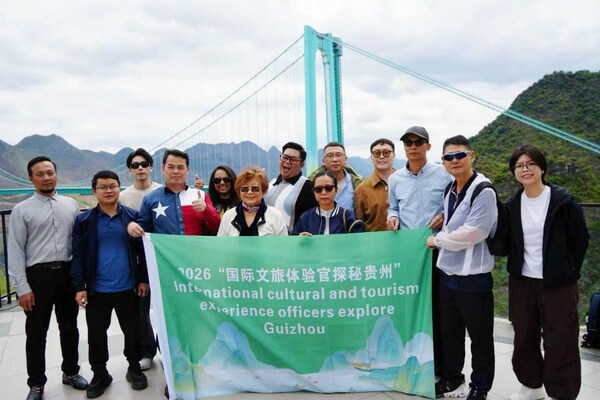
GUIYANG, China, April 20, 2026 /PRNewswire/ — A news report from CNS: Amid the karst peaks of southwestern China, a succession of super-bridges—soaring across deep gorges and piercing the cloud line—are fundamentally redrawing both the geographic reality and the development trajectory of Guizhou Province. 2026 “International Cultural Tourism Experience Officers Explore Guizhou” check in at China Guizhou Huajiang Canyon Bridge. Once proverbially constrained by the adage “not three li of flat land,” Guizhou’s progress was long hamstrung by its rugged terrain. That narrative is now being decisively rewritten, driven by sustained investment in transport infrastructure across China’s western regions. Today, the province boasts over 32, 000 completed road bridges and more than 9, 000 kilometers of operational expressways. A comprehensive, province-wide transport network has essentially taken shape, delivering expressway access to every county and high-speed rail connectivity to every prefecture-level city. This extraordinary concentration of structures has earned Guizhou the international moniker of a “Museum of Bridges.” The province holds a commanding presence on the global list of the world’s highest spans. Flagship projects—including the Beipanjiang Bridge, the Pingtang Bridge, and the Balinghe Bridge—have repeatedly garnered prestigious international engineering accolades, cementing their status as iconic benchmarks of Chinese bridge-building prowess. The Huajiang Canyon Bridge, which opened to traffic in 2025, represents the latest milestone in this unfolding story. Spanning the Huajiang section of the Beipan River, the deck clears the gorge floor by 625 meters, securing its ranking among the planet’s loftiest crossings. The structure slashes a once-arduous two-hour canyon traverse down to mere minutes, dramatically boosting regional mobility and logistical efficiency. Beyond pure transportation utility, Guizhou is actively pioneering a “bridge-plus-tourism” integration model. Capitalizing on the synergy between monumental engineering and dramatic natural vistas, local authorities are developing viewing platforms, high-altitude walkways, and experiential facilities, effectively transforming these spans from functional arteries into destinations in their own right. Sites such as the Pingtang Bridge and Balinghe Bridge have already emerged as major draws for visitors seeking a unique blend of awe and adrenaline. As the nexus of expressways, high-speed rail, and aviation continues to densify, Guizhou is accelerating its integration into the New International Land-Sea Trade Corridor, thereby enhancing its level of external openness. The bridges arcing through this mountainous terrain do more than merely alter travel conditions; they stand as critical fulcrums, connecting regional revitalization with broader global engagement.
Bridging the Gorge: How China’s Guizhou is Redefining Its Mountainous Landscape

RELATED ARTICLES


