


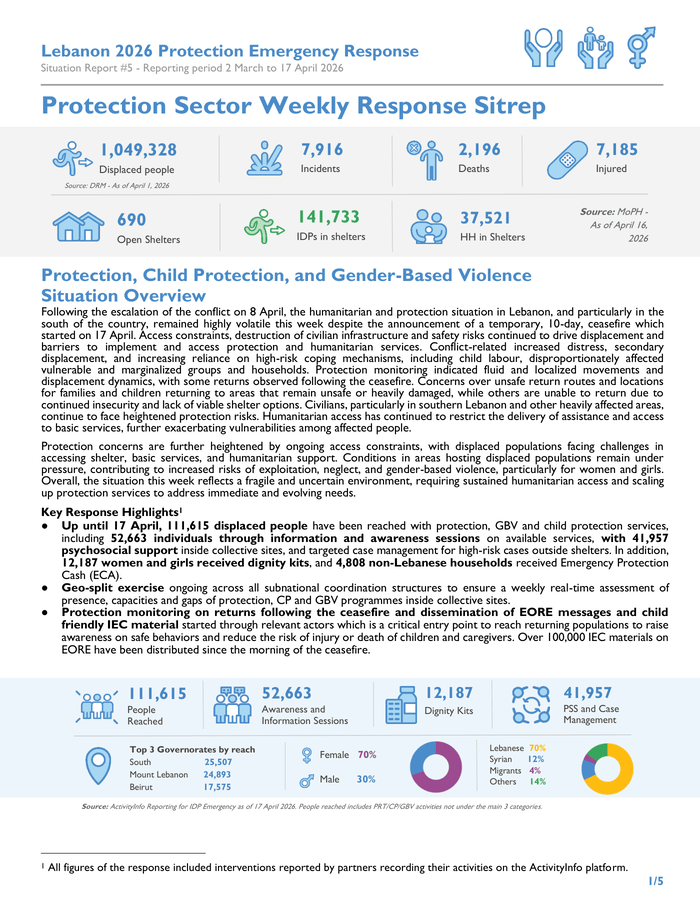
Country: Lebanon Sources: UN Children’s Fund, UN High Commissioner for Refugees, United Nations Population Fund Please refer to the attached file. Following a sharp escalation of conflict on 8 April, the protection situation in Lebanon remains highly volatile despite a temporary ceasefire announced on 17 April. Ongoing insecurity, destruction of civilian infrastructure, and access constraints continue to drive large-scale displacement, with over 1 million people displaced and protection risks intensifying, particularly in southern Lebanon. Displacement dynamics remain fluid, with some returns observed, often to unsafe or heavily damaged areas due to lack of alternatives. Humanitarian access limitations are significantly constraining the delivery of protection services, while overcrowded conditions, inadequate shelter, and economic hardship are increasing risks of exploitation, child labour, and gender-based violence (GBV), especially for women, girls, and vulnerable groups. Mental health needs are rising sharply amid widespread distress, family separation, and repeated displacement. As of 17 April, protection partners have reached 111, 615 individuals with protection, child protection, and GBV services, including psychosocial support, awareness raising, case management, and emergency cash assistance. Over 12, 000 women and girls received dignity kits, while Explosive Ordnance Risk Education (EORE) messaging has been scaled up in response to increased risks linked to returns in contaminated areas. Child protection concerns remain critical, with children exposed to trauma, disrupted education, and heightened risks of violence and separation. Since early April, dozens of unaccompanied and separated children have been identified, with ongoing efforts for family tracing and reunification. GBV risks are also increasing, with intimate partner violence reported as the most prevalent form, compounded by displacement, financial stress, and lack of safe housing. Key operational challenges include limited access to displaced populations outside collective shelters, closure of safe spaces, insufficient funding, and overstretched response capacity. Significant gaps persist in GBV service coverage, shelter conditions, and support for persons with disabilities. Urgent priorities include scaling up community-based outreach, expanding access to services, strengthening protection monitoring, and ensuring safe and informed returns.



GrowthPakistan brings you the latest news to keep an eye on Pakistan’s startup ecosystem. Business keeps you growing when you stay aware of your competitors' moves. GrowthPakistan offers Business, Tech, Global Tech, Global, Auto, and Startup News straight from industries all around the globe. This platform will help you identify upcoming opportunities not only in Pakistan but worldwide.
Email : growthpakistan@gmail.com
Whatsapp : +92320-9497079
© growthpakistan