


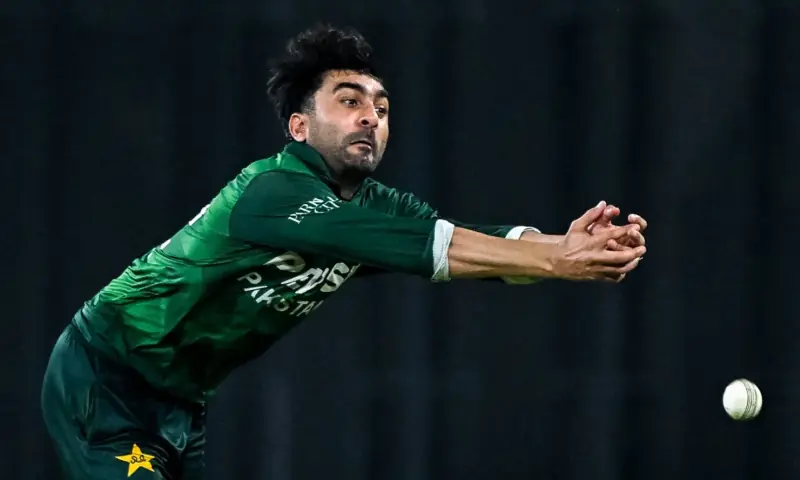
KARACHI: Salman Mirza, the left-arm pacer who burst onto the international scene last year, has set his sights firmly on representing Pakistan at the 2027 ODI World Cup. Having broken into the national T20I setup just last year at the age of 31, Salman has never looked back, transforming himself from a late-blooming domestic grinder into a reliable performer for the green jersey. In his short international career, Salman has already made a strong impression. He made his T20I debut against Bangladesh in July 2025 and quickly showcased his accuracy and variations. A standout moment came later that year when he was selected ahead of Shaheen Shah Afridi and delivered a match-winning spell of 3-14 against South Africa in Lahore. By the time the 2026 T20 World Cup concluded, he had featured in 17 T20Is, claiming 23 wickets at an impressive average of 16. 13 and a strike rate of 15. 04. His economy hovered around 6. 43, underlining his ability to control proceedings with late swing, in-swingers and stump-to-stump accuracy rather than relying solely on raw pace. At the showpiece in Sri Lanka, Salman contributed with disciplined spells in powerplay and death overs. Although not playing all matches, Salman saw Pakistan progress to the Super Eights stage before they were eliminated. For Salman, however, the experience was transformative. The ODI World Cup, scheduled for October-November 2027 to be co-hosted by South Africa, Zimbabwe and Namibia, now occupies a special place in his ambitions. “I want to play the 2027 World Cup indeed and I’m working hard to prepare myself for it. I’m putting in the extra yards to improve my fitness and trying to bowl for longer spells [during training] so that if I get an opportunity to play ODI cricket I could do well in it, ” he told Dawn on Saturday. “When I was studying, I played tape-ball because you can’t play with a proper cricket ball alongside studies, ” he recalls. “It’s a full-time job — morning till evening on the ground. So when I left studies, I came into this. ” FULL-TIME JOB Salman’s journey to this point reads like a testament to quiet perseverance. Growing up in Lahore, he balanced studies with tape-ball cricket in streets and small grounds. Professional cricket felt distant because of time constraints. The turning point arrived through Lahore Qalandars’ Player Development Programme open trials in 2021. Unlike the conventional age-group pathway, these trials offered hope to late starters. Inspired by Haris Rauf’s success from similar roots, Salman seized the opportunity. He made his PSL debut that season but remained largely undiscovered. The following year he trained with the squad without playing. Domestic appearances tested his resolve until PSL 2025, when he emerged as a finished product during the knockout stages. Called up for Qalandars, Salman delivered defining spells, including 3-16 against Islamabad United and 4-31 against Peshawar Zalmi. These performances helped his team push deep into the tournament and silenced doubts about his late entry. “Tape-ball is totally different cricket, ” he explained. “You just have to save boundaries. Here it’s proper cricket — you have to develop skills, bring control, improve fitness. It was difficult, but as a professional you have to adapt. ” His development as a cricketer reflects steady professional growth. From raw talent in the PDP, where he absorbed routines from international players, to national setups under coaches like Mike Hesson and Ashley Noffke, Salman focused on identifying weaknesses and adapting to environments. “The biggest change has been learning to adapt to the environment around me and extract positive results from it, ” he noted. “I also realised my weaknesses and how much work I needed to put in to overcome them. ” Salman credited former Qalandars Director Cricket Operations Aaqib Javed for lessons beyond technique. “Aaqib bhai taught us less about pure cricket and more about life as a professional, ” Salman said. “How to deal with good days and bad days, how to tackle them, how to survive, what your character should be like. He helped me a lot. ” “Pace attracts everyone, ” Salman reflected, “but if you can bowl dot balls, restrict runs and take wickets close to 140kph with skill and control, then why should we only look at speed? The main purpose in T20 is not giving runs and taking wickets. ” SKILL MORE IMPORTANT THAN PACE In a culture where pace and youth are celebrated more than accuracy and experience, Salman has carved his own standing. Playing for Islamabad United in the ongoing PSL season after a trade from Qalandars, Salman is contributing to a side comfortably placed in the top two. A recurring hamstring injury from the T20 World Cup limited his early appearances, but rehabilitation is complete and he is easing back into bowling. “Team winning and a good combination matter more to me than playing every match, ” he said. The franchise’s support during his lean start impressed him. “When I came, the initial matches didn’t go that well, but despite that the support from United has been huge. They played a big role. ” While building his name with United, Salman’s deeper ambitions centre on the national side and the 2027 World Cup. He believes Pakistan’s white-ball setup, under Hesson, is moving in the right direction. “If you analyse Pakistan’s show in T20 cricket over the last one year, there have been loads of positives, ” he said. “Earlier, the team used to be reliant on two, three, four players – if they performed, the team used to win, if they didn’t then the team lost. “In the last one year, we have seen a variety of players stand out for Pakistan on different occasions. That shows that each player is taking his responsibility and trying to produce maximum returns and the team management is valuing and giving confidence to each and every player, ” the pacer added. Salman spoke with evident emotion about the pull of World Cups. “. .. participating in the World Cup and representing your country is every player’s dream, ” he said. “And for me, it’s a feeling I cannot express in words. When you line up for the national anthem, the goosebumps that follow, truly inexpressible. ” Published in Dawn, April 19th, 2026



GrowthPakistan brings you the latest news to keep an eye on Pakistan’s startup ecosystem. Business keeps you growing when you stay aware of your competitors' moves. GrowthPakistan offers Business, Tech, Global Tech, Global, Auto, and Startup News straight from industries all around the globe. This platform will help you identify upcoming opportunities not only in Pakistan but worldwide.
Email : growthpakistan@gmail.com
Whatsapp : +92320-9497079
© growthpakistan