


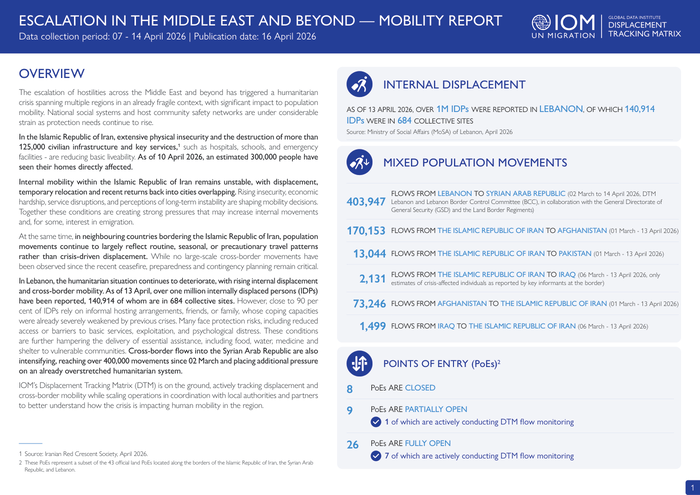
Countries: Iran (Islamic Republic of), Afghanistan, Armenia, Azerbaijan, Iraq, Lebanon, Pakistan, Syrian Arab Republic, Türkiye, Turkmenistan Source: International Organization for Migration Please refer to the attached file. OVERVIEW The escalation of hostilities across the Middle East and beyond has triggered a humanitarian crisis spanning multiple regions in an already fragile context, with significant impact to population mobility. National social systems and host community safety networks are under considerable strain as protection needs continue to rise. In the Islamic Republic of Iran, internal mobility within the country remains unstable, with displacement, temporary relocation and recent returns back into cities overlapping. Rising insecurity, economic hardship, service disruptions, and perceptions of long‐term instability are shaping mobility decisions. Together these conditions are creating strong pressures that may increase internal movements and, for some, interest in emigration. At the same time, no large‐scale cross‐border movements between the Islamic Republic of Iran and neighbouring countries have been observed since the recent ceasefire. Population movements continue to largely reflect routine, seasonal, or precautionary travel patterns rather than crisis‐driven displacement. In Lebanon, the humanitarian situation continues to deteriorate, with rising internal displacement and cross-border mobility. As of 14 April, over one million internally displaced persons (IDPs) have been reported. Cross-border flows from Lebanon into the Syrian Arab Republic are also intensifying, reaching over 400, 000 movements since 02 March and placing additional pressure on an already overstretched humanitarian system.



GrowthPakistan brings you the latest news to keep an eye on Pakistan’s startup ecosystem. Business keeps you growing when you stay aware of your competitors' moves. GrowthPakistan offers Business, Tech, Global Tech, Global, Auto, and Startup News straight from industries all around the globe. This platform will help you identify upcoming opportunities not only in Pakistan but worldwide.
Email : growthpakistan@gmail.com
Whatsapp : +92320-9497079
© growthpakistan